
Fellow Ode vs Fellow Ode Gen 2: Which Should You Buy?
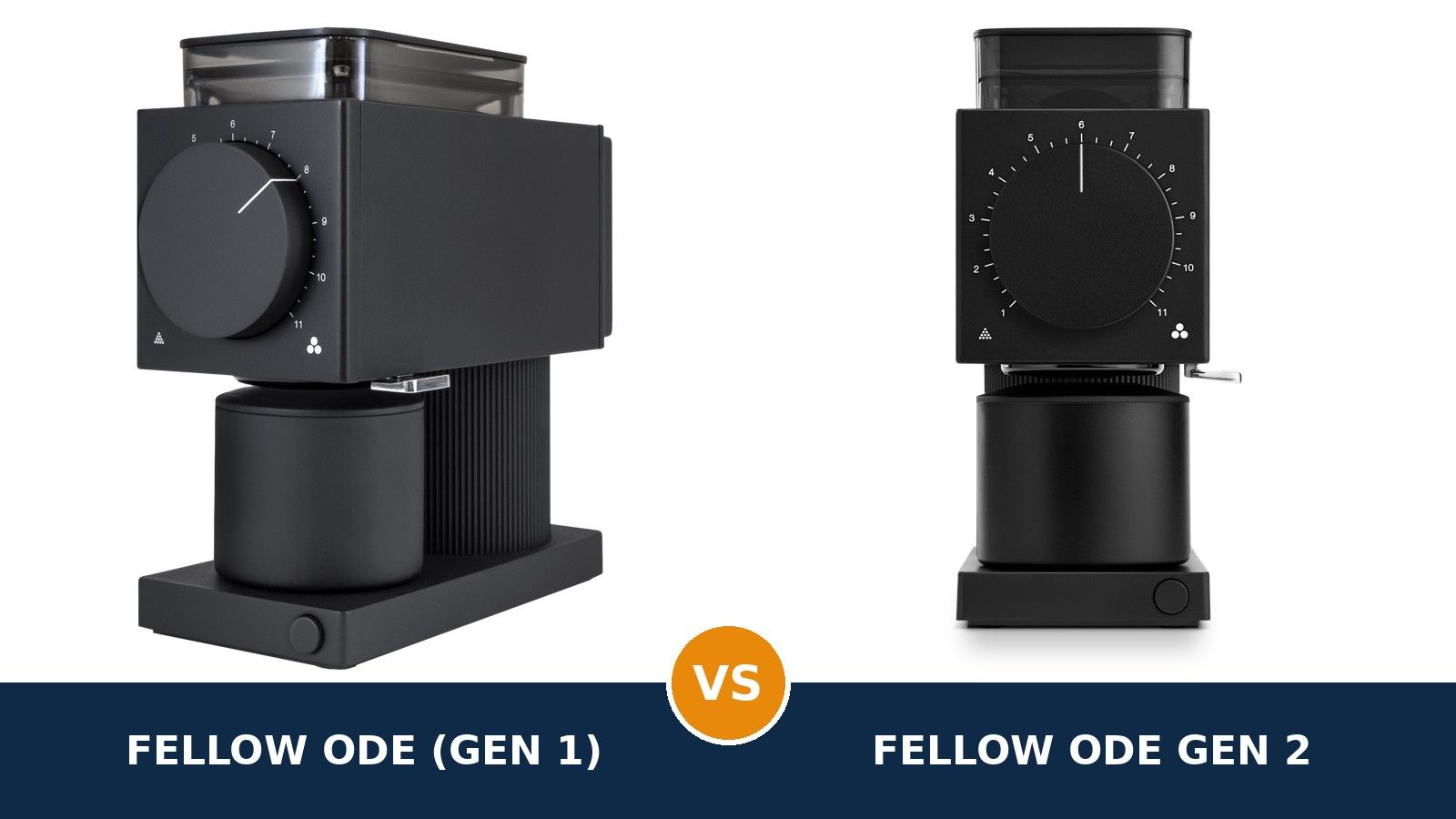
One grinder, two generations — and a naming puzzle that trips up almost everyone who shops for them.
First, the names, because the search term needs pinning down. The bare “Ode” is the original Fellow Ode Brew Grinder, launched in 2020. The “Ode 2” is the Ode Brew Grinder Gen 2, which replaced it in late 2022 — and “Ode 2” is Fellow’s own shorthand, used on its Opus 2 page: “Should I get the Opus 2 or the Ode 2?”
With that settled, this comparison answers two questions: which generation your money should go to if you are buying, and whether the Gen 2 fixes enough of the first machine’s known weaknesses to justify replacing one you already own.
The short version: Gen 2 kept the platform and fixed the complaints — same 64 mm flat burr size, same 31-step dial, same body, same single-dose format, but finer-grinding burrs, an anti-static ionizer the original never had, a bigger cup, and double the warranty. Every specification below comes from Fellow’s own published data.
Key Takeaways
- The Gen 2 wins overall. Its Gen 2 Brew Burrs grind as fine as roughly 250 microns, against around 500 microns for the original’s Standard Brew Burrs — Fellow’s own figures.
- Static control is the biggest daily difference. The Gen 2 adds an anti-static ionizer; the original relies on a grounded chute and a knocker, and static and retention were its best-known complaints.
- Capacity rose from 80 g to 100 g at both ends — load bin and catch cup — and the load bin was redesigned for smoother bean feeding.
- The platform stayed put. Same 31 stepped settings, same Smart Speed PID motor holding 1,400 RPM, same footprint to within a few millimetres, same aluminium body.
- The original is discontinued. Fellow no longer sells it new; the Gen 2 is the current, warrantied machine, and the original now trades through remaining marketplace listings, used offers and Fellow’s own Rebrew refurbished programme.
Quick Verdict
Buy the Fellow Ode Gen 2 if you are buying new. It is the only one of the two Fellow still sells, and it is better at the things owners of the original complained about.
The Gen 2 burrs grind twice as fine at the floor, the ionizer keeps grounds in the cup instead of on the counter, and the warranty doubled. No specification favours the original.
Consider the original Ode only as a used or refurbished buy. It shares the dial, body, burr size and motor concept with its replacement, and its burrs can be upgraded later.
If a clean used example or a Fellow Rebrew unit costs meaningfully less than a new Gen 2, and your brewing lives in the pour-over to French press range, the first generation still does the core job. Just know what you give up: the fine end of the range, the ionizer, and any remaining warranty.
The Scorecard
Scores below are derived directly from the manufacturer specifications compared in this guide. They are a reading aid, not benchmark results. Fellow publishes no decibel figure for either generation, so the noise row is scored on published noise engineering only.
| Category | Fellow Ode (Gen 1) | Fellow Ode Gen 2 | ||
|---|---|---|---|---|
| Burr set | 7.5 / 10 | 9 / 10 | ||
| Adjustment & espresso resolution | 5 / 10 | 5 / 10 | ||
| Motor & published output | 7.5 / 10 | 7.5 / 10 | ||
| Retention & static control | 6 / 10 | 8.5 / 10 | ||
| Noise (published features) | 8 / 10 | 8.5 / 10 | ||
| Brew-method range | 5.5 / 10 | 7 / 10 | ||
| Build, footprint & capacity | 7.5 / 10 | 8.5 / 10 | ||
| Overall | 6.9 / 10 | 7.7 / 10 | ||
The pattern tells the generational story: ties where the platform carried over — dial and motor — and Gen 2 wins exactly where Fellow aimed the redesign.
At a Glance: Who Each Grinder Fits
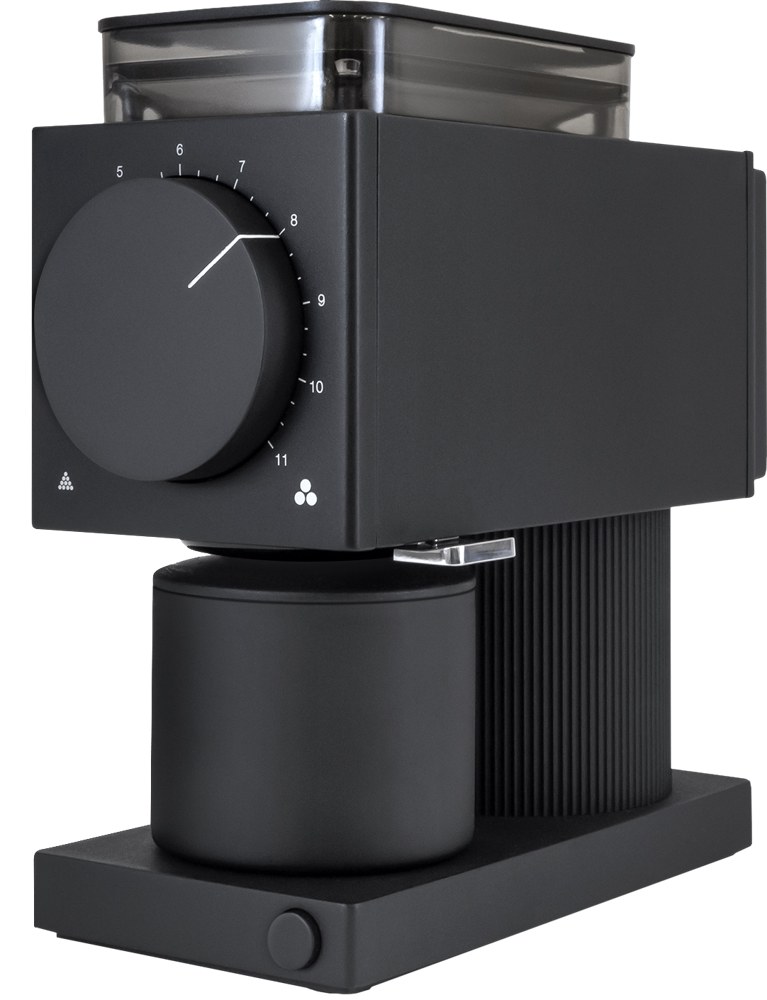
Fellow Ode (Gen 1)
- 64 mm flat stainless steel Standard Brew Burrs — Fellow rates the fine floor at roughly 500 microns
- 31 stepped grind settings on a front dial — 11 numbered settings with a printed grind guide
- Brewed coffee only: AeroPress, pour-over, drip, French press and cold brew — no espresso
- 80 g single-dose load bin and an 80 g magnetically aligned catch cup
- Aluminium body, 4.5 kg, grinds knocker and automatic stop — but no anti-static ionizer
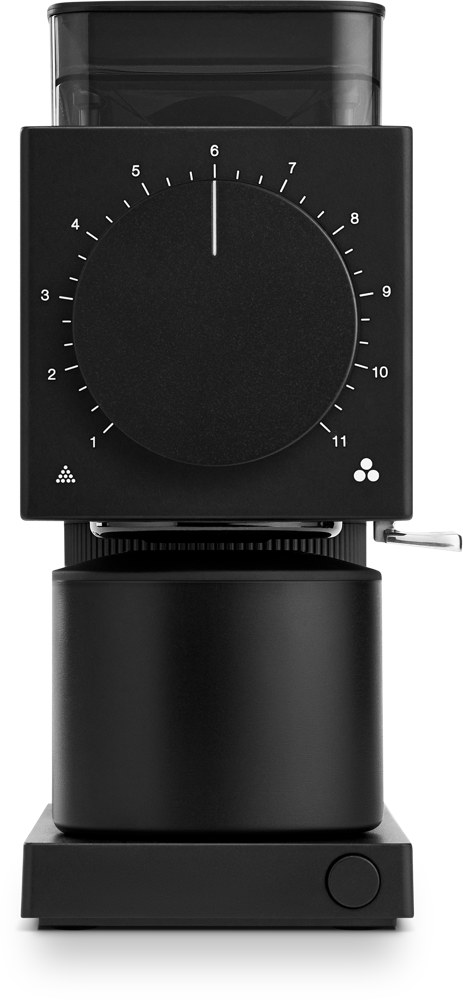
Fellow Ode Gen 2
- 64 mm flat Gen 2 Brew Burrs in uncoated stainless steel, with two-stage grinding geometry
- 31 stepped grind settings on a front dial — 11 numbered settings with a printed grind guide
- Brewed coffee only: AeroPress, pour-over, drip, French press and cold brew — no espresso
- 100 g single-dose load bin, redesigned for smoother feeding, and a 100 g magnetically aligned catch cup
- Aluminium body, 4.6 kg, with anti-static ionizer, grinds knocker and automatic stop
Choose the Fellow Ode (Gen 1) if…
You already own one and your coffee tastes fine. Nothing in the Gen 2 changes what the original does well — same dial, body and burr size. Read the upgrade section below before spending anything.
You found one used or refurbished at a genuinely low price. A clean example, ideally from Fellow’s Rebrew programme with its own warranty, undercuts a new Gen 2 while keeping most of the experience.
Your brewing sits from pour-over coarser. If you never grind at the fine end — no Prismo, no fine AeroPress recipes — the original’s higher burr floor rarely shows.
Choose the Fellow Ode Gen 2 if…
You are buying new. It is the only generation Fellow sells, the only one with a live warranty, and the better grinder on the rows that matter.
Static drives you up the wall. The ionizer is the single improvement you will notice every single morning.
You grind fine for brewed coffee, or big batches. The roughly 250-micron floor opens the fine AeroPress end, and 100 g at both ends beats 80 g for drip pots.
As an Amazon Associate I earn from qualifying purchases at no extra cost to you.
Specifications: The Specs That Actually Matter
Every figure below is from Fellow’s own published data: the Gen 2 product page, the original Ode’s manual and retail specification block, and Fellow’s Ode gear guide.
| Specification | Fellow Ode Brew Grinder (Gen 1, 2020) | Fellow Ode Brew Grinder Gen 2 |
|---|---|---|
| Model identity | Original Ode Brew Grinder (manual model BGAAUS); discontinued and replaced by the Gen 2 in late 2022 | Ode Brew Grinder Gen 2 (listing model “Ode Gen 2”); the current model |
| Burr set | 64 mm flat, stainless steel — Standard Brew Burrs (also sold as Ode Brew Burrs) | 64 mm flat, uncoated stainless steel — Gen 2 Brew Burrs with two-stage grinding geometry |
| Adjustment system | Stepped front dial: 11 numbered settings, 31 steps in total, printed grind guide | Stepped front dial: 11 numbered settings, 31 steps in total, printed grind guide |
| Grind range | Brewed coffee; Fellow rates the Standard burrs’ fine floor at roughly 500 microns | Brewed coffee; Fellow rates the Gen 2 burrs’ fine floor at roughly 250 microns |
| Espresso | Not suitable — the manual states it cannot grind fine enough for most espresso machines | Not suitable — Fellow states the burrs and motor are geared to drip and immersion brewing |
| Motor | Smart Speed PID motor holding a steady 1,400 RPM burr speed; manual rates the US build at 150 W (retail spec block: 140 W, 1.3 A — see the power note) | 140 W, 1.3 A (US version); Smart Speed PID motor holding a steady 1,400 RPM burr speed |
| Published grind output | No output rate published by Fellow | No output rate published; built around 100 g batches |
| Load bin | Single-dose, 80 g | Single-dose, 100 g, redesigned for smoother bean feeding |
| Catch cup | One 80 g magnetically aligned catch cup, with pour fins and a lid that doubles as a chaff shield | One 100 g magnetically aligned catch cup, redesigned |
| Retention & static handling | Electrically grounded chute and grinds chamber, built-in grinds knocker, magnetically aligned cup — no ionizer | Anti-static ionizer, built-in grinds knocker, magnetically aligned cup |
| Automatic stop | Yes — stops when the grind finishes | Yes — stops when the grind finishes |
| Noise engineering | Marketed by Fellow as a reduced-noise, quieter grinder; no decibel figure published | Engineered to reduce grind noise (Fellow); no decibel figure published |
| Dimensions (L × W × H) | 239 × 105 × 241.5 mm (9.4 × 4.2 × 9.5 in) | 239 × 105 × 248.3 mm (9.4 × 4.2 × 9.8 in) |
| Weight | 4.5 kg / 9.9 lb | 4.6 kg / 10.14 lb |
| Materials | Aluminium body; plastic load bin and base; stainless steel burrs | Aluminium body; plastic load bin and base; stainless steel burrs |
| Cord length | 1 m | 1 m |
| Warranty | 1-year limited warranty (original manual) — long expired on every unit by age | 2-year warranty, extendable on registration |
The name note: on the record, then. The bare “ode” in the search term is the original Ode Brew Grinder of 2020 — this guide’s Gen 1. “Ode 2” is the Ode Brew Grinder Gen 2; Fellow’s own Opus 2 page uses the shorthand itself. The generations share a name, body and dial, which is why listings get tangled; the buying guide below separates them.
The power note: the original Ode’s documents disagree. Its manual (model BGAAUS) rates the US build at 120 V, 60 Hz, 150 W; Fellow’s retail block prints 140 W and 1.3 A — the Gen 2’s figures. We print both and let the manual lead. Nothing practical turns on it: same Smart Speed PID concept, same published 1,400 RPM.
The dimensions note: dealer tables mix the generations’ figures freely. The Gen 1 manual lists 239 × 105 × 241.5 mm and 4.5 kg; the Gen 2 block lists 239 × 105 × 248.3 mm and 4.6 kg. Pages showing the Gen 2 at 242 mm, 4.5 kg or with an 80 g cup are recycling first-generation copy.
The grind-range note: Fellow does not publish micron ranges on its product pages. The floors here come from Fellow’s Ode gear guide: Gen 2 Brew Burrs as fine as 250 microns, the original’s Standard Brew Burrs as fine as 500. Dealer copy puts the original’s factory-calibrated finest setting in the same neighbourhood.
The Differences That Actually Matter
1. Two generations, one name — why the naming had to be settled first
Start here, because Fellow’s naming invites an expensive mistake. The original Ode launched in 2020 to genuine acclaim — SCA Best New Product 2021 — and the Gen 2 replaced it in late 2022 without changing the product’s name, shape or price class.
That continuity is the trap. First-generation machines still circulate through marketplace listings and old dealer pages, photographed at angles where the generations are indistinguishable. They separate in the specification block: burr set, capacity, ionizer, warranty.
2. Burrs — the same 64 mm size, a floor twice as fine
Both generations carry 64 mm flat stainless steel burrs — café-sized hardware that was the original’s headline feature and remains the platform’s core strength. What changed is the burr set.
The original’s Standard Brew Burrs were designed for the middle of the brewed range; Fellow’s gear guide puts their fine floor at roughly 500 microns. The Gen 2 Brew Burrs use a two-stage geometry — beans broken down, then finished — and Fellow rates their floor at roughly 250 microns, half the particle size.
In the cup, that gap is about reach, not just quality. The Gen 2 covers the fine end of brewed coffee — Prismo attachments, fine AeroPress recipes, tight pour-over ranges — that the original physically cannot grind. Through the shared middle, both sets do the same job.
3. Static and retention — the fix owners actually asked for
Ask what frustrated original-Ode owners and the answer was rarely the coffee. It was the mess: static-scattered grounds and grounds held back in the chute. Fellow’s Gen 2 announcement reads like a point-by-point reply.
The original was not defenceless — grounded chute and chamber, a magnetic cup, the same flick-the-lever knocker. What it never had is an ionizer.
The Gen 2 adds exactly that: an anti-static ionizer at the chute exit, working on the grounds as they leave. It is the difference between managing static and preventing it — the upgrade you feel every morning.
4. Capacity and feeding — 80 g becomes 100 g
The Gen 2 grew the working volume at both ends: bin and cup, 80 g to 100 g.
Twenty grams sounds trivial until you brew a full drip pot: the original asks you to split the dose or heap the bin; the Gen 2 takes the whole batch in one load. Fellow also redesigned the load bin for smoother bean feeding, and the catch cup alongside it.
For a two-cup household, none of this matters. For batch brewers, it is one grind versus a small ritual.
5. Adjustment and motor — the parts Fellow left alone
Some sections here are short because nothing changed. The dial is the same dial: 11 numbered settings, 31 steps, a printed grind guide, click-stop repeatability. Dial in your pour-over setting once and return to it exactly, on either generation.
The motor concept carried over too: both run Fellow’s Smart Speed PID design, holding the burrs at a steady 1,400 RPM under load rather than letting speed sag as beans feed in. No published output rate separates them.
Score these rows as ties, because they are. The Gen 2 is not a new grinder; it is this grinder, corrected.
6. Espresso — the line neither generation crosses
One limit unites the generations: neither grinds for espresso. The original’s manual states the Ode “is designed for brewing coffee and cannot grind fine enough for (most) espresso machines”; the Gen 2’s FAQ says its burrs and motor are geared to drip and immersion, full stop.
The Gen 2’s finer floor does not change this: 250 microns is not espresso range, and the 31 steps are spread across the brewed spectrum. Nor does the factory SSP MP configuration convert it — a clarity upgrade for brewed coffee, and a variant, not the configuration compared here.
If espresso is in your honest future, this is the wrong comparison — Fellow’s Opus line is built for that. Here, the espresso row is a shared zero.
7. Warranty, support and the reality of a discontinued machine
The ownership terms diverged as the hardware converged. The original shipped with a 1-year limited warranty; the Gen 2 carries two years, extendable on registration. Every original Ode is now outside its term by age.
Support has not vanished. Fellow still publishes the original’s manual and gear guides, sells burr sets that fit it, and runs Rebrew — its certified-refurbished programme, covering the Ode line with a 1-year warranty. Dealer stock is gone: authorised retailers list the original as out of stock.
That is the honest frame for the original in 2026: supported but discontinued, bought used or refurbished, priced accordingly.
Brew-Method Fit Guide
The fastest way to choose between these generations is to start from what you actually brew.
| Your brewing | Fellow Ode (Gen 1) | Fellow Ode Gen 2 | Our call |
|---|---|---|---|
| Espresso, any basket | Cannot — the manual excludes it | Cannot — Fellow excludes it outright | Neither — look at an espresso-capable grinder |
| Pour-over | Excellent — the burr set’s home ground | Excellent — the burr set’s home ground, with static control | Fellow Ode Gen 2 |
| Drip and batch brewing | Good — 80 g bin can mean splitting a full pot’s dose | Excellent — 100 g bin and cup take the batch in one load | Fellow Ode Gen 2 |
| AeroPress, standard recipes | Excellent | Excellent | Dead tie |
| AeroPress with Prismo, fine recipes | Limited — the manual’s own guide starts Prismo at its finest settings, and the burr floor is around 500 microns | Excellent — Gen 2 burrs floor around 250 microns | Fellow Ode Gen 2 |
| French press and cold brew | Excellent | Excellent | Dead tie |
| Buying used on a tight budget | Excellent — the only way this generation is sold now | Good — current model, holds its price | Fellow Ode (Gen 1) |
| Single-dosing and rotating beans | Good — knocker and grounded chute, but static to manage | Excellent — ionizer, knocker and magnetic cup | Fellow Ode Gen 2 |
Read the table from your own kitchen outward. If your methods sit between pour-over and French press and the price is right, the original’s weaknesses may never touch you. The moment fine grinding, big batches or a warranty matter, the Gen 2 pulls away.
Ready to check today’s price?
The Gen 2 is Fellow’s current model and sells new through Amazon. The original is discontinued — Fellow no longer sells it new, so its Amazon listing now carries remaining marketplace and used offers rather than a new-machine supply; check what is actually on it before assuming.
View on Amazon — Fellow Ode (Gen 1)View on Amazon — Fellow Ode Gen 2The 30-Second Decision
| If this sounds like you… | Buy this |
|---|---|
| “I am buying new and want the warranty and the fixes.” | Fellow Ode Gen 2 — the only generation sold new |
| “I already own the original and my coffee tastes good.” | Keep the Fellow Ode (Gen 1) — consider a burr upgrade, not a new grinder |
| “I found a used or Rebrew original at a low price.” | Fellow Ode (Gen 1) — if the discount is real and your range is pour-over and coarser |
| “Static and grounds on the counter drive me mad.” | Fellow Ode Gen 2 (the ionizer is the fix) |
| “I grind fine — Prismo, tight AeroPress recipes.” | Fellow Ode Gen 2 (roughly 250-micron floor versus 500) |
| “I grind a full drip batch every morning.” | Fellow Ode Gen 2 (100 g in one load) |
| “I want espresso eventually.” | Neither — both generations are brewed-coffee only |
What You Gain. What You Give Up.
Fellow Ode (Gen 1)
You gain: the same platform for less money, bought the way this generation is now sold — the same 64 mm flat burr size, the same 31-step dial, the same aluminium body and PID motor concept, and a burr chamber that accepts the Gen 2’s burrs if you ever want them.
You give up: the fine end of the grind range, the ionizer, 20 g of capacity at each end, and any warranty — the 1-year term has expired on every unit by age. You also give up certainty: used condition varies, and listings confuse the generations freely.
Fellow Ode Gen 2
You gain: the corrected machine — burrs that grind half as coarse at the floor, anti-static technology, 100 g capacity with a load bin redesigned to feed smoothly, a two-year warranty extendable on registration, and a model Fellow still sells as current.
You give up: the bargain. A new Gen 2 costs new money while used originals trade far below it, and if your brewing never leaves the middle of the range, you pay for reach and polish you may rarely use. Espresso remains off the menu either way.
Pros and Cons
Fellow Ode (Gen 1) — Pros
- 64 mm flat burrs — the same café-sized format as the Gen 2
- 31 stepped settings — dial in once, return exactly
- Aluminium body; the same substantial build as its replacement
- Burrs are upgradeable — Gen 2 Brew Burrs and SSP sets fit the platform
- Available used and through Fellow’s Rebrew programme at well under new Gen 2 money
Cons
- Discontinued — no new stock, and the 1-year warranty has expired on all units
- No anti-static ionizer; static and retention were its signature complaints
- Burr floor around 500 microns — the fine brewed range is out of reach
- 80 g load bin and cup; full batches can mean splitting the dose
- Used-market listings routinely confuse it with the Gen 2
Fellow Ode Gen 2 — Pros
- Gen 2 Brew Burrs floor around 250 microns — the full brewed range
- Anti-static ionizer, knocker and auto-stop; the tidy counter the original promised
- 100 g load bin and catch cup suit full drip batches
- Two-year warranty, extendable on registration; current model with full support
- Same dial, footprint and build quality that made the original popular
Cons
- No espresso capability — Fellow excludes it with every burr set
- Costs new money while the original trades cheaply used
- Stepped adjustment only; no continuous fine-tuning
- The factory SSP version is a filter-clarity upgrade, not an espresso path
Check the Generation, the Burrs and the Channel
Check which generation a listing is really selling. The generations share a name and a silhouette, so read the specification block, not the photograph. A Gen 2 listing names the Gen 2 Brew Burrs, 100 g capacity and anti-static technology. A listing quoting 80 g, or silent on an ionizer, is the original — whatever the headline says.
Check the channel for the original. Fellow discontinued the Gen 1 when the Gen 2 arrived, and authorised dealers list it as out of stock. Any “new” original in 2026 is leftover or marketplace stock at best. The listing this guide links is the model’s original Amazon listing in Matte Black; expect remaining marketplace and used offers, not a factory-fresh supply.
Consider Fellow Rebrew for the original. Fellow’s certified-refurbished programme covers the Ode line and backs units with a 1-year warranty — the closest thing to buying the Gen 1 with cover. It sells direct from Fellow, not through Amazon.
Check which Gen 2 configuration you are pricing. Fellow sells the Gen 2 two ways: standard Gen 2 Brew Burrs, or pre-fitted with SSP MP burrs for maximum filter clarity. This guide compares the standard configuration. The SSP version is a variant — same range, same brief — not an espresso conversion.
Check the box contents. A Gen 2 should arrive with its 100 g magnetic catch cup and a brush; an original with its 80 g cup, lid and brush. A used listing missing the catch cup is missing a part the workflow assumes.
Check the voltage. Both generations were built in regional versions; the ratings here are the US builds. Buy the version made for your sockets — on a used original, confirm it is not an import.
The Upgrade Path Test
This is where a generational comparison earns its keep: the two machines share a burr chamber.
Own the original? Its biggest hardware gap is closable. The 64 mm format is a standard size: Fellow sells the Gen 2 Brew Burrs as an upgrade, documents installing and calibrating them in the Ode, and SSP sets fit the same platform. A burr swap moves a Gen 1 most of the way to Gen 2 grind quality — it cannot retrofit the ionizer, the 100 g bin and cup, or a warranty.
Buying today? The Gen 2 starts where that path ends. Its growth story is the same burr aftermarket, and its ceiling is the platform’s ceiling: brewed coffee only, forever.
Either way, parts and documentation stay current because the Gen 2 keeps the line alive.
When to Skip Both
Honesty cuts both ways — some drinkers should buy neither generation.
Skip both if espresso is anywhere in your plans. Neither generation grinds for it, no burr set adds it.
Skip both if you want the grinder to dose for you. Neither has a timer, scale or dose memory; both are weigh-in, single-dose home appliances, not café duty.
And skip the original if a listing cannot prove what it is. Verify the generation, cup size and burr set, or buy the current model.
Warranty and Long-Term Support
The terms differ by generation. The original’s 1-year limited warranty has expired on every unit by age. The Gen 2 carries two years, extendable on registration.
The exception is Fellow’s Rebrew programme: its refurbished units carry a 1-year warranty of their own — the only channel where a Gen 1 comes with live cover.
Beyond warranties, support is shared. Fellow still publishes manuals and gear guides covering both burr generations, documents burr removal, cleaning and calibration, and sells the burr sets both machines use. One caution: warranties follow territory and voltage version, so buy the build made for your country.
Final Verdict
The Fellow Ode Gen 2 is the grinder to buy.
It wins because the Gen 2 programme fixed the original exactly where owners felt it daily — finer burrs, an ionizer, more capacity, double the warranty — while keeping everything that made the first machine worth buying. As a new purchase there is no contest; it is also the only one you can buy new.
Buy the Fellow Ode Gen 2 for any new purchase: the complete brewed-coffee brief, the tidy counter, and a warranty with years left to run.
View on Amazon — Fellow Ode Gen 2
Buy the Fellow Ode (Gen 1) only through the channels that sell it now — a verified used example or a Fellow Rebrew unit — and only when the saving against a new Gen 2 pays for what you give up. In a pour-over-to-press kitchen, it still grinds a very good cup.
It loses on reach, tidiness and cover, not on the platform — and if you already own one, the smartest upgrade here is a set of Gen 2 burrs, not a new grinder.
View on Amazon — Fellow Ode (Gen 1)
Frequently Asked Questions
Is the “Ode 2” the same as the Ode Gen 2?
Yes. “Ode 2” is the shorthand for the Ode Brew Grinder Gen 2, and Fellow uses it itself — its Opus 2 page asks, “Should I get the Opus 2 or the Ode 2?” The original Ode of 2020 is the first generation; the Gen 2 replaced it in late 2022.
What actually changed from the Ode Gen 1 to the Gen 2?
Four things, by Fellow’s own account: the burrs (Gen 2 Brew Burrs at roughly 250 microns, against roughly 500 for the original’s Standard set), anti-static ionizer technology, capacity up from 80 g to 100 g with a redesigned bin and cup, and a two-year warranty in place of one year. The dial, motor concept, body and footprint carried over.
Can either Ode grind for espresso?
No — neither generation. The original’s manual says it cannot grind fine enough for most espresso machines, and Fellow states the Gen 2’s burrs and motor are geared to drip and immersion brewing. The factory SSP MP configuration is a filter-clarity variant, not an espresso conversion. For espresso, look at a grinder built for it, such as the Opus line.
Can I put Gen 2 burrs in my original Ode?
Yes. Both generations use the 64 mm flat format, Fellow sells the Gen 2 Brew Burrs as an upgrade, and its help centre documents installing and calibrating them in the Ode. SSP sets fit the same platform. A burr swap closes most of the grind-quality gap; it adds neither the ionizer, the larger bin and cup, nor a warranty.
Is the original Fellow Ode still sold in 2026?
Not new. Fellow replaced it in late 2022, its store sells only the Gen 2, and authorised dealers list the original as out of stock. What remains is the used and refurbished market: remaining offers on its original Amazon listing, resale sites, and Fellow’s Rebrew programme, with a 1-year warranty on its units.
How do I tell a Gen 1 from a Gen 2 in a listing?
Ignore the photograph — the generations look near-identical — and read the specifications. Gen 2: Gen 2 Brew Burrs, 100 g bin and cup, anti-static technology, two-year warranty. Gen 1: Standard Brew Burrs, 80 g capacity, no ionizer, one-year warranty in its manual. A listing quoting 80 g is a first-generation machine.
How much coffee does each generation hold?
The original loads and catches 80 g. The Gen 2 raised both to 100 g — a full drip batch in one load, where the original can ask you to split the dose. Both are single-dose designs: weigh beans per brew, no storage hopper.
Should I upgrade from the original Ode to the Gen 2?
Only if the original’s specific weaknesses bother you: static on the counter, the coarse burr floor, splitting big batches. If they do not, Gen 2 Brew Burrs in your existing machine buy most of the grind improvement for far less than a new grinder. The full replacement makes sense when you want the ionizer and warranty too.
Sources & Verification
Fellow Ode Brew Grinder Gen 2 official product page (fellowproducts.com) — Gen 2 Brew Burrs, anti-static technology, 100 g capacity, knocker, auto stop, espresso exclusion, 2-year warranty • Fellow Ode gear guide (fellowproducts.com) — Gen 2 Brew Burrs rated to 250 microns, the original’s Standard Brew Burrs to 500 • Fellow Ode Brew Grinder original manual (model BGAAUS) — 1-year limited warranty, 150 W US rating, 239 × 105 × 241.5 mm, 4.5 kg, espresso exclusion, Prismo grind guide • Fellow retail specification data via authorised dealers (Whole Latte Love, Prima Coffee, Oren’s Coffee) for the original’s 80 g capacity, grounded chute, 140 W/1.3 A retail block and out-of-stock status • Fellow Rebrew programme page (fellowproducts.com) — refurbished channel with 1-year warranty • Amazon listing data for both models, used for ASIN verification only. Specifications verified November 2026.

James Wilson
James has been testing coffee gear and small kitchen appliances for over a decade and writes Honestly Compared's coffee and grinder guides. His rule for every comparison: the verdict has to survive the spec sheet, not the marketing page.