
Fellow Opus 2 vs DF54: Which Should You Buy?
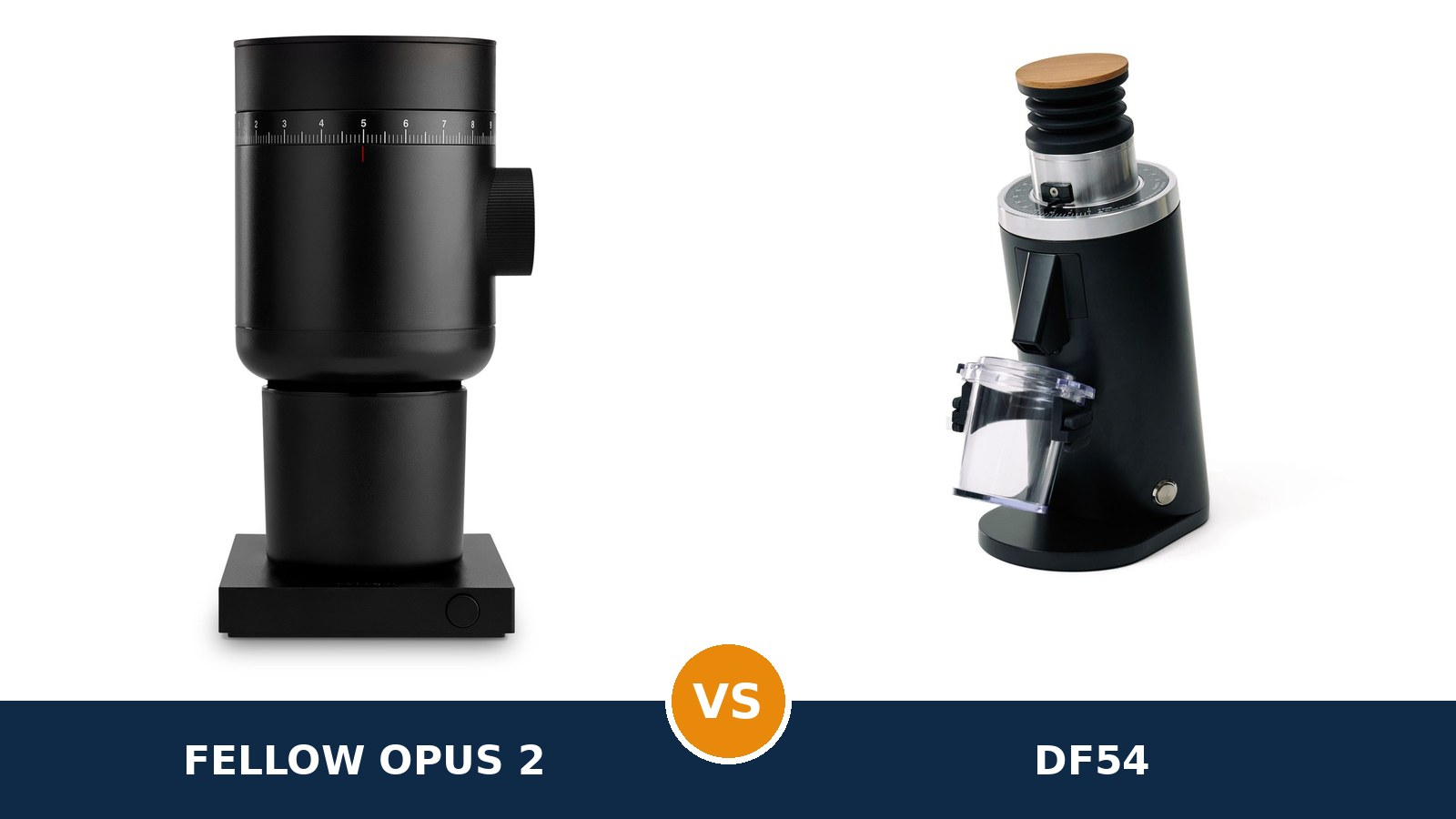
One grinder is a design object that happens to grind coffee. The other is a burr set with a motor attached and a price of admission for flat-burr espresso.
The Fellow Opus 2 wraps 48 mm conical burrs in the most polished single-dose package in its class: a stepless dial, an ionizer, an impeller grind path and auto-stop. The DF54 strips the idea down to its essentials: 54 mm flat burrs, a stepless chrome collar, a bellows, and a published retention claim of under a tenth of a gram.
Both are single-dose machines. Both cover espresso through French press on paper. Both ask you to weigh every dose and accept a routine in exchange for freshness.
What separates them is geometry and philosophy. Conical against flat. Polished all-rounder against specialist tool. This guide works through the manufacturers’ own published specifications and settles which philosophy deserves your counter.
One naming point first. The DF54 is its own machine — not the DF64, the DF64V or any other DF model, all walled off by name here. And the Opus 2 is Fellow’s current model, not the discontinued 2023 original Opus.
Key Takeaways
- The Opus 2 wins overall, 8.3 to 8.1. Adjustment, workflow and motor documentation carry it past the flat-burr specialist.
- The DF54 owns the retention row. It is the rare grinder with a quantified manufacturer claim — under 0.1 g — backed by a plasma ionizer in the chute.
- Geometry is the real contest. 48 mm conical burrs against 54 mm flat burrs; everything else in this pairing is workflow.
- Both are single-dose only. Neither has a hopper-fed batch mode; the Opus 2 loads 100 g, the DF54 just 20 g — 50 g with its bellows fitted.
- Ownership splits. Fellow doubles the warranty term at two years; the DF54 answers with a metal body, tool-free opening and a burr-swap option.
Quick Verdict
Buy the Fellow Opus 2 for most households. It is the more complete single-dose grinder on the published specifications.
Its stepless dial adjusts continuously, so the espresso setting you need is always reachable. Its 300 W motor carries Fellow’s claim of roughly nine seconds per shot. Its load bin, auto-stop and magnetic portafilter cup make the tidier daily routine, and its warranty runs two years.
Buy the DF54 if flat burrs are the point of the purchase. It is the specialist’s entry ticket.
Its 54 mm flat burr set, published sub-0.1 g retention claim and plasma ionizer serve one goal: a clean, repeatable single dose with nothing stale carried over. Its powder-coated aluminium body opens without tools, and an optional brew burr set lets the same machine re-specialise for filter.
The Scorecard
Scores below are derived directly from the manufacturer specifications compared in this guide. They are a reading aid, not benchmark results. Neither manufacturer publishes a decibel figure for these grinders, so no noise score appears.
| Category | Fellow Opus 2 | DF54 | ||
|---|---|---|---|---|
| Burr set | 8 / 10 | 8 / 10 | ||
| Adjustment & espresso resolution | 9.5 / 10 | 8.5 / 10 | ||
| Dosing & workflow | 8 / 10 | 7.5 / 10 | ||
| Motor & published output | 8.5 / 10 | 6.5 / 10 | ||
| Retention & static control | 9 / 10 | 9.5 / 10 | ||
| Brew-method range | 8 / 10 | 8.5 / 10 | ||
| Build, footprint & capacity | 7 / 10 | 8 / 10 | ||
| Overall | 8.3 / 10 | 8.1 / 10 | ||
The pattern is close. The DF54 wins the specialist rows — retention and range. The Opus 2 wins the everyday rows: adjustment, dosing and motor.
At a Glance: Who Each Grinder Fits
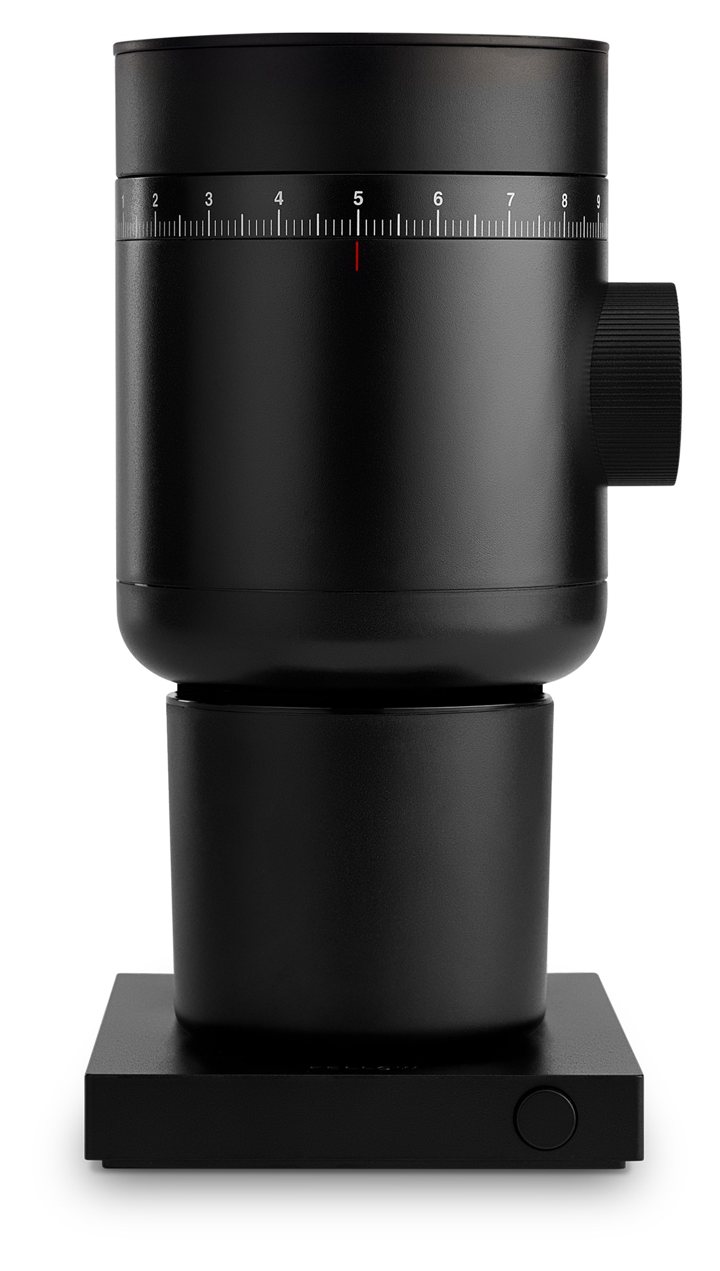
Fellow Opus 2
- 48 mm stainless steel conical burrs, espresso to cold brew
- Stepless side dial with 48 marked reference settings
- 300 W motor; Fellow cites roughly nine seconds for an espresso shot
- Single-dose 100 g load bin with auto-stop; ionizer and impeller grind path
- Two magnetic catch cups, including a 30 g espresso cup for 54 mm and 58 mm portafilters
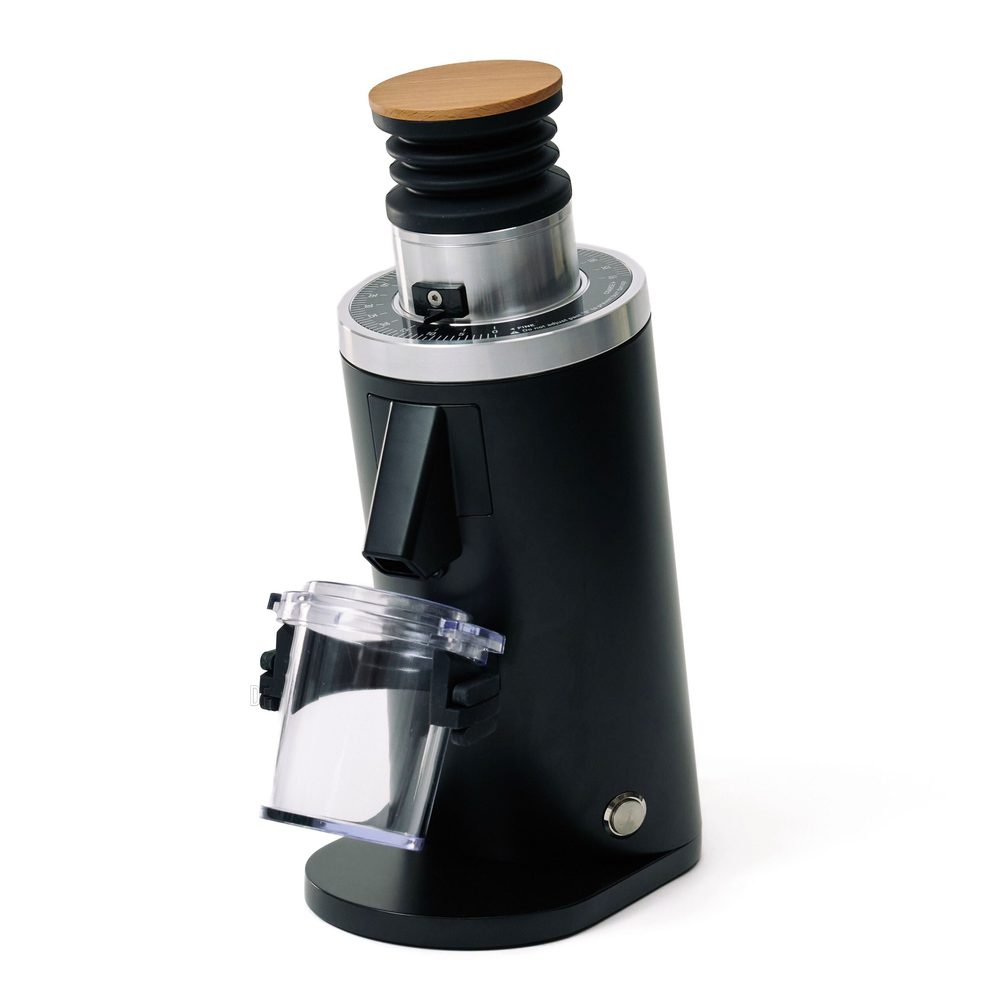
DF54
- 54 mm custom stainless steel flat burrs
- Stepless chrome collar dial with a metal indicator
- Plasma ionizer in the exit chute and an anti-popcorn disc
- Published retention claim under 0.1 g — even before the bellows
- Powder-coated aluminium body; opens for cleaning without tools
Choose the Fellow Opus 2 if…
You dial espresso in by taste and rotate beans and methods freely. A stepless dial and a full espresso-to-cold-brew range ask nothing of you in return.
Your routine matters as much as your results. Auto-stop, a 100 g load bin and a magnetic cup that doses straight into a portafilter keep mornings tidy.
Space and weight count. At 267 mm tall and 2.27 kg, the Opus 2 is the smaller, lighter object by a wide margin.
Choose the DF54 if…
Flat burrs are why you are shopping. The DF54 is the small, focused route into that geometry, with an optional brew burr set if filter becomes the priority.
You want the retention promise in writing. A published sub-0.1 g claim with an ionizer behind it is the strongest documented position in this pairing.
You prefer metal and mechanical honesty. A powder-coated aluminium body that opens without tools, and a distributor that publishes its burr speed outright.
As an Amazon Associate I earn from qualifying purchases at no extra cost to you.
Specifications: The Specs That Actually Matter
Every figure below is from published manufacturer and distributor data: Fellow’s Opus 2 product page and Safety and Maintenance manual, and the DF54’s official distributor pages (MiiCoffee and DF Grinders).
| Specification | Fellow Opus 2 Conical Burr Grinder | DF54 Single Dose Coffee Grinder |
|---|---|---|
| Model identity | Opus 2, models OP01AANA (standard) and OP02AANA (wooden upgrades) — the current Opus; the 2023 original is discontinued | Current-generation DF54, sold identically as the Turin DF54, MiiCoffee DF54, G-Iota and Solo — not the DF64 or any other DF model |
| Burr set | 48 mm conical, stainless steel | 54 mm flat, custom stainless steel; optional brew burr set offered by the distributor |
| Adjustment system | Stepless side dial — continuous, no clicks, with 48 marked reference settings | Stepless chrome collar dial with a metal indicator; no marked reference numbers |
| Grind range | Espresso to cold brew; roughly 200–1200 microns (retailer specification sheets — Fellow publishes no micron range) | Espresso, pour-over, French press and AeroPress (distributor rating); no micron range published |
| Motor | 300 W, 3.0 A (US version, per Fellow’s manual); burr speed not published by Fellow | 150 W AC; burr speed published at 1,400 RPM |
| Published grind output | Fellow cites about 9 seconds to grind an espresso shot; no output rate published | No output rate published; the distributor rates its grind speed “slow” against the larger DF64 II in its own comparison table |
| Dosing format | Single-dose load bin, 100 g; grind guide printed on the lid; stops automatically when the bin empties | Single-dose hopper: 20 g without the bellows, 50 g with it fitted |
| Catch cup | Two magnetic catch cups: 100 g brewed coffee, 30 g espresso (fits 54 mm and 58 mm portafilters) | 58 mm transparent plastic dosing cup; a portafilter rest is fitted, the cup is the recommended route |
| Retention & static handling | Upgraded ionizer and an internal impeller that moves grounds through the path — Fellow describes near-zero retention, with no gram figure published | Plasma ionizer in the exit chute, anti-popcorn disc, bellows with wooden lid — and a published “True Zero Retention” claim of under 0.1 g |
| Duty cycle | Manual caps use: under 45 seconds per grind cycle, at least 60 seconds’ rest between cycles, no more than 3 minutes’ grinding in any 10 | No comparable cycle cap published by the distributor |
| Dimensions (L × W × H) | 206 × 130 × 267 mm (8.1 × 5.1 × 10.5 in) | 7 × 4.5 × 12 in (about 178 × 114 × 305 mm, MiiCoffee); DF Grinders lists 19 × 11 × 29.7 cm |
| Weight | 2.27 kg / 5.0 lb (Fellow manual) | 10 lb (MiiCoffee and listing data); DF Grinders lists a 4.7 kg body weight |
| Materials | Standard model carries no premium-material trim in Fellow’s own comparison table; OP02AANA versions add a wood lid and weighted metal dial | Aluminium body with a powder-coated finish |
| Cleaning | Burr access documented in Fellow’s manual and gear guides; the base itself has no user-serviceable parts | Easy-Clean design: the grinder opens for cleaning in a few steps, without tools |
| Noise engineering | No decibel figure or noise feature published by Fellow | No decibel figure or noise feature published by the distributor |
| Warranty | 2-year limited warranty, extendable on registration | 1-year warranty with the distributor (MiiCoffee, US) |
The name note: three naming traps surround this comparison. First, “Opus” unqualified means the Opus 2 — the original Opus (40 mm burrs, 41 stepped settings, 140 W) was replaced in 2026. Second, the DF54 is not the DF64: the larger machine has 64 mm burrs and its own comparison elsewhere on this site. Third, the DF54 wears several seller badges — Turin, MiiCoffee, G-Iota, Solo — over one hardware generation, and the sellers’ version numbers do not align. The badge is not the machine; the specification is.
The power note: some dealer tables print “140 W, 1.3 A” against the Opus 2 — figures belonging to Fellow’s earlier grinders, pasted into the wrong column. Fellow’s Opus 2 manual rates models OP01AANA/OP02AANA at 120 V, 300 W and 3.0 A, and the manual governs.
The capacity note: the DF54’s hopper is 20 g without its bellows and 50 g with it, per MiiCoffee. A 25 g figure circulates in one distributor table; either way, a single espresso dose fits and a full drip batch does not.
The Differences That Actually Matter
1. Burr geometry — the conical all-rounder against the flat-burr specialist
This is the difference the whole pairing turns on, and it is a difference of shape, not size. Fifty-four millimetres of flat burr against 48 mm of conical is not a hierarchy; it is two grinding geometries with two followings.
The Opus 2’s conical set is the generalist’s choice. It sits under a stepless dial with the full espresso-to-cold-brew range, and Fellow sells the machine as the one grinder for every method in the house.
The DF54’s flat set is the specialist’s entry point. Flat burrs are the geometry espresso traditionalists and clarity-focused filter brewers ask for by name — and the DF line adds an option the Fellow cannot match: an alternative brew burr set that re-specialises the same machine for filter work.
We score the row a tie, deliberately. Neither manufacturer publishes particle data, and we do not invent it. What can be scored is everything around the burrs — the next six differences.
2. Adjustment — two stepless dials, only one with a map
Both grinders adjust continuously; neither strands a setting between clicks. The divide is in how you find your way back.
The Opus 2’s side dial carries 48 marked reference settings around its rotation. The marks are not stops — the dial turns smoothly through them — but they give every setting an address. Note the number, return to the number.
The DF54’s chrome collar turns against a single metal indicator. The classic flat-burr arrangement: precise in the hand, anchored to one reference mark, dependent on your own notes for repeatability across big range changes.
For a household that lives at one setting, the difference is small. For one that swings between espresso and French press daily, the Fellow’s numbered map is kinder. The row goes to the Opus 2.
3. Retention and static — a published number against a design description
Single-dosing lives or dies on this row. Grounds left inside are stale flavour in tomorrow’s cup.
The DF54 makes the boldest documented claim in this class: “True Zero Retention” under 0.1 g, stated as achievable even before the bellows is used. Behind it sits real hardware — a plasma ionizer in the exit chute, an anti-popcorn disc, and the bellows for a final purge.
The Opus 2 answers with engineering rather than a figure. An upgraded ionizer works on static, and an internal impeller moves grounds through the grind path; Fellow describes the result as near-zero retention. A thorough design — with no gram number attached.
Scored on what is published, the DF54 takes the row: a quantified claim outranks a qualitative one. Only one system here is written down as a number.
4. Motors and published output — 300 W and a stopwatch claim, against honest slowness
The Fellow’s motor is the stronger unit on paper and the faster by its maker’s account: 300 W per the manual, and a cited nine seconds per espresso shot. Fellow publishes no burr speed and no output rate alongside it.
The DF54 publishes its burr speed outright — 1,400 RPM — and rates its own grind speed “slow” in its distributor’s table against the larger DF64 II. Its 150 W motor is half the Fellow’s rating, with no output rate published.
Read honestly, the row splits: the DF54’s documentation is franker, the Opus 2’s hardware stronger. A grinder is bought to grind; the row goes to the Opus 2 — with respect for a distributor willing to print “slow” about its own product.
5. Dosing and workflow — auto-stop polish against the bellows routine
The Opus 2 is the more finished routine. Weigh into the 100 g load bin, and the machine stops itself when the bin empties. Grounds land in magnetic cups — a 100 g brew cup, and a 30 g espresso cup that doses straight into portafilters.
The DF54’s routine has one more step. The dose goes into a hopper holding 20 g bare or 50 g under the bellows; after grinding, the bellows purges the chamber. The 58 mm dosing cup is transparent plastic — functional, and the least premium-feeling part of either machine.
One limit belongs to the Fellow, from its manual: grind cycles are capped at under 45 seconds, with a minute’s rest between cycles. Back-to-back drinks for a crowd will meet that cap. The DF54 publishes no such limit — its ceiling is its small hopper, refilled dose by dose.
6. Build, size and cleaning — plastic and light, against aluminium and openable
Set them side by side and the materials tell the story. The DF54 is powder-coated aluminium, about 10 lb and roughly 305 mm tall. The Opus 2 is a plastic-bodied standard model — Fellow’s own table reserves premium materials for its wooden-upgrade variants — at 2.27 kg and 267 mm.
On the counter, the Fellow is easier to place and slide under cabinets. In the hand, the DF54 feels the more substantial tool; its deeper footprint is the price of the flat-burr layout.
Cleaning separates them further. The DF54’s Easy-Clean design opens in a few steps without tools — a genuine ownership advantage. The Opus 2 documents its burr access, but Fellow states the base contains no user-serviceable parts; deeper work is a service matter.
7. Range and the upgrade ladder — one machine that does everything, one that can change
On stated range, the two are close. Fellow rates the Opus 2 from espresso to cold brew; DF Grinders rates the DF54 for espresso, pour-over, French press and AeroPress. Neither publishes a micron range, so the honest verdict is parity of coverage, different centres of gravity.
The ladder differs. The Opus 2 is a finished answer — when it stops being enough, you replace it. The DF54 sits at the bottom of a burr ecosystem: the optional brew burr set re-aims it at filter today, and its distributor’s larger siblings define tomorrow’s step up.
Buy the finished answer if your methods are settled. Buy the ladder if they are still moving.
Brew-Method Fit Guide
The fastest way to choose is to start from what you brew. This table is the whole comparison in one view.
| Your brewing | Fellow Opus 2 | DF54 | Our call |
|---|---|---|---|
| Espresso, unpressurised baskets | Excellent — stepless dial, espresso cup included | Excellent — flat burrs, stepless collar | Opus 2 for workflow; DF54 for the flat-burr path |
| Espresso, pressurised baskets | Excellent | Excellent | Dead tie |
| Pour-over | Good — conical all-rounder covers it | Good — with an optional brew burr set to specialise | DF54, if filter clarity is the pursuit |
| Drip and batch brewing | Workable — 100 g loads, duty-cycle cap | Workable — 50 g loads under the bellows | Opus 2; neither is hopper-fed |
| AeroPress and moka pot | Excellent | Excellent — AeroPress is a distributor-rated method | Dead tie |
| French press and cold brew | Excellent | Excellent — French press is a distributor-rated method | Dead tie |
| A mixed household — espresso and filter | Excellent — one grinder, numbered dial for the swings | Good — one grinder, one indicator mark to manage | Fellow Opus 2 |
| Single-dosing and rotating beans | Excellent — ionizer, impeller, auto-stop | Excellent — published sub-0.1 g claim, bellows purge | DF54 on the documented claim |
| Owners who clean and tinker | Documented burr access; no user-serviceable base parts | Excellent — tool-free opening, burr options | DF54 |
Read the first and last rows together. Espresso routine points at the Opus 2; the flat-burr, hands-on ownership path points at the DF54.
Ready to check today’s price?
Both grinders sell through Amazon. Prices move, so check the live figure on the grinder that fits how you brew.
View on Amazon — Fellow Opus 2View on Amazon — DF54The 30-Second Decision
| If this sounds like you… | Buy this |
|---|---|
| “I want flat burrs, and this is my way into them.” | DF54 |
| “I dial in by taste and swing between espresso and filter daily.” | Fellow Opus 2 — stepless dial, 48 marked references |
| “I single-dose and want the retention promise in writing.” | DF54 — published claim under 0.1 g |
| “My mornings need auto-stop and a cup that fits my portafilter.” | Fellow Opus 2 |
| “My cabinets are low and my counter is small.” | Fellow Opus 2 (267 mm tall, 2.27 kg) |
| “I clean my burrs monthly and like machines that open up.” | DF54 — tool-free Easy-Clean opening |
| “I want the longer warranty in writing.” | Fellow Opus 2 (2 years) |
What You Gain. What You Give Up.
Fellow Opus 2
You gain: continuous stepless adjustment with a numbered map to return to. A 300 W motor with a manufacturer-cited nine-second espresso grind. Auto-stop dosing, a portafilter-ready espresso cup, an ionizer-and-impeller retention system, a two-year warranty, and the smaller, lighter footprint.
You give up: the flat-burr geometry and its burr-swap ladder. You give up a quantified retention figure — Fellow’s is a design description, not a number — accept a manual duty-cycle cap, and trade the DF54’s aluminium shell for a plastic-bodied standard model.
DF54
You gain: 54 mm flat burrs in a compact, metal-bodied machine. The strongest documented retention position in the pairing — a sub-0.1 g published claim with a plasma ionizer behind it. A fully published burr speed, tool-free cleaning access, and an optional brew burr set that re-aims the grinder at filter.
You give up: motor muscle and speed — half the wattage, and its own distributor calls the grind slow. You give up auto-stop, a numbered adjustment map and the second warranty year, and accept a bellows step in every dose.
Pros and Cons
Fellow Opus 2 — Pros
- Stepless dial with 48 marked references — fine control you can return to
- 300 W motor; Fellow cites about nine seconds per espresso shot
- Ionizer plus impeller path, designed for near-zero retention
- Auto-stop dosing; two magnetic cups, one portafilter-ready
- 2-year warranty; smallest and lightest here
Cons
- No published retention figure, burr speed or micron range
- Manual duty-cycle cap: short cycles, rests between
- Plastic body on the standard model
- No user-serviceable parts in the base
- Conical geometry only — no burr-swap path
DF54 — Pros
- 54 mm flat burrs — the specialist geometry at an entry size
- Published retention claim under 0.1 g, plasma ionizer fitted
- Burr speed published outright: 1,400 RPM
- Powder-coated aluminium body; opens without tools
- Optional brew burr set re-specialises it for filter
Cons
- 150 W motor; distributor rates its grind speed “slow”
- No output rate published; no auto-stop or timer
- Hopper holds 20 g bare, 50 g under the bellows
- 1-year distributor warranty — half the Fellow’s term
- Taller and more than twice the Opus 2’s weight
Check the Model, the Badge and the Burr Line
Check it is the Opus 2, not the original Opus. The 2023 machine still circulates through listings, and it is a different grinder: 40 mm burrs, 41 stepped settings plus an inner micro-adjust ring, a 140 W motor. The Opus 2 has 48 mm burrs and a smooth side dial. If a specification block says 40 mm or 41 settings, it is the old machine, whatever the headline claims.
Check which Opus 2 you are pricing. Model OP01AANA is the standard machine; OP02AANA adds wooden upgrades — a wood load-bin lid and a weighted metal dial. The burrs, motor and dial mechanism are identical. Buy the premium version for how it feels, not for performance.
Check the DF54 badge — then ignore it. The same machine sells as the Turin DF54, the MiiCoffee DF54, the G-Iota and the Solo, and the sellers’ version numbers do not align: a higher number on one badge is not a newer machine. Buy on the specification — 54 mm stainless flat burrs, plasma ionizer, anti-popcorn disc, bellows in the box.
Check it is not a DF64 in disguise. The DF64 is a larger machine with 64 mm burrs; the DF64V adds variable speed. A listing mixing 54 and 64 mm figures across its title and spec block is mislabelled, whichever machine is in the box.
Check the burr line and the box. The DF54’s stock burrs are custom stainless steel; the optional brew burr set is a separate purchase. The box should carry the bellows with its wooden lid, the 58 mm dosing cup and a brush. The Opus 2’s box should carry both magnetic catch cups.
Check the voltage. Both grinders are built in regional versions, and the ratings in this guide are the US builds (Opus 2: 120 V, 300 W; DF54: 100–120 V). The DF54 is also sold in 220 V form. Buy the version made for your sockets; the warranty follows the territory.
The Upgrade Path Test
A grinder earns its money in year two, not week one.
The Opus 2’s upgrade story is about range already owned. It starts as the everything machine and grows with an espresso habit: the stepless dial and portafilter cup that feel like extras today become the workflow as technique improves. Its ceiling is every all-rounder’s — want flat-burr geometry one day, and you will be shopping again.
The DF54’s story is about a ladder. The optional brew burr set re-aims it at filter without a new machine. Its burr chamber opens without tools, so routine maintenance is designed in. And its distributor’s range defines the next step up when the habit outgrows 54 mm.
The difference, in one line: the Fellow is the finished answer; the DF54 is the first rung. Choose based on whether your coffee habit has stopped moving.
When to Skip Both
Honesty cuts both ways — some coffee drinkers should buy neither of these.
Skip both if you want a hopper-fed grinder that doses by time or weight. Both machines here are single-dose designs: you weigh every dose, every time. That is their virtue and their workload.
Skip both for café, office or event duty. Both are household appliances; the Opus 2’s manual caps its grind cycles outright, and the DF54 is rated slow by its own distributor.
Skip the DF54 if your espresso habit is high-volume. A 20–50 g hopper and a bellows step per dose are a ritual, not a production line. Skip the Opus 2 if flat burrs are the settled goal — no conical all-rounder becomes the specialist tool.
Warranty and Long-Term Support
The warranty terms differ plainly. The Opus 2 carries a two-year limited warranty, extendable by registering the product with Fellow. The DF54 carries a one-year warranty with its US distributor, MiiCoffee.
Beyond the term, the philosophies diverge. Fellow publishes the manual and gear guides and documents burr access, but states plainly that the base contains no user-serviceable parts — deeper repair is an authorised-service matter.
The DF54’s distributor leans the other way: the Easy-Clean design opens without tools, and the burr set is a serviceable, swappable component, with an alternative brew set sold for the same machine. The more hands-on proposition, on a shorter warranty.
One caution applies to both: warranties follow territory and voltage version, so buy the build made for your country.
Final Verdict
The Fellow Opus 2 is the grinder we would put on most counters.
It wins by two-tenths of a point because the things it does better are the things a grinder does every day. Its dial adjusts continuously and gives every setting a number to return to. Its motor is the stronger unit with a manufacturer-cited nine-second shot. Its auto-stop routine and portafilter cup are the tidiest workflow here, and its warranty runs twice as long.
Buy the Opus 2 for espresso-first and mixed households, single-dosers who rotate methods, and anyone whose grinder has to be the finished answer rather than the first step.
View on Amazon — Fellow Opus 2
Buy the DF54 if flat burrs are the point. It is the focused route into that geometry: a quantified retention claim, an ionizer, a metal body that opens without tools, and a burr ecosystem with somewhere to go next.
It loses on polish, power and paperwork. On the specialist’s own terms — geometry, retention, openness — it wins its rows outright, and for the buyer those rows describe, the order of this page would read the other way round.
Frequently Asked Questions
Is the DF54 the same grinder as the DF64?
No. They are different machines in the same distributor family. The DF54 runs 54 mm flat burrs in a compact body; the DF64 runs 64 mm burrs in a larger one, and the DF64V adds variable motor speed. This guide compares the DF54 only, and the DF64 has its own comparison elsewhere on this site.
Why does the DF54 appear under so many names?
Because the same current-generation machine is distributed under several badges: Turin DF54, MiiCoffee DF54, G-Iota and Solo. The hardware is shared, but the sellers’ version numbers do not align, so one badge’s version label cannot be compared with another’s. Check the specification — 54 mm stainless flat burrs, plasma ionizer, anti-popcorn disc — rather than the badge.
Does the DF54 really retain under 0.1 g of grounds?
That is its distributor’s published claim — “True Zero Retention <0.1 gram” — stated as achievable even without the bellows. We report it as what it is: a manufacturer-side claim, supported on paper by a plasma ionizer in the chute. Fellow publishes no equivalent gram figure for the Opus 2, describing its impeller-based design as near-zero retention instead.
Which grinder is quieter?
Neither manufacturer publishes a decibel figure for these models, and this guide uses none. Both are marketed in the language of home-friendly operation, but without a published measurement from either maker there is no honest number to compare — anyone quoting you one is quoting a third party’s test, not a specification.
Can both grinders handle espresso and filter?
Yes — that is the premise of the pairing. Fellow rates the Opus 2 from espresso to cold brew. DF Grinders rates the DF54 for espresso, pour-over, French press and AeroPress, and sells an optional brew burr set for owners who lean toward filter. Neither maker publishes a micron range, so the coverage is stated in methods, not microns.
Which grinder is easier to clean and maintain?
The DF54, on published design. Its Easy-Clean system opens the grinder in a few steps without tools, and its burrs are treated as swappable components — including an alternative brew set. The Opus 2 documents burr access and cleaning in its manual and gear guides, but Fellow states the base has no user-serviceable parts, so deeper work is a service matter.
How do the warranties compare?
The Opus 2 carries a two-year limited warranty, extendable on registration — double the DF54’s one-year distributor warranty in the US. The balance runs the other way on openness: the DF54 is built to be opened and maintained by its owner, while the Opus 2’s longer cover protects a base its maker does not intend owners to service.
Sources & Verification
Fellow Opus 2 official product page (fellowproducts.com) — 48 mm stainless steel conical burrs, stepless dial, 48 marked settings, ionizer, impeller retention design, two catch cups, Opus 1 comparison, 2-year warranty • Fellow Opus 2 Safety and Maintenance manual (789-00291) — OP01AANA/OP02AANA specifications: 120 V, 300 W, 3.0 A, 2.27 kg, duty-cycle limits, automatic stop, 2-year limited warranty • MiiCoffee official DF54 product page — 54 mm custom stainless flat burrs, plasma generator, anti-popcorn disc, sub-0.1 g retention claim, 20 g / 50 g hopper, 150 W, 10 lb, one-year warranty, distributor comparison table • DF Grinders official DF54 page — burr options, method ratings, dimensions and body weight • Amazon listing data for both models, used for ASIN verification only. Specifications verified November 2026.

James Wilson
James has been testing coffee gear and small kitchen appliances for over a decade and writes Honestly Compared's coffee and grinder guides. His rule for every comparison: the verdict has to survive the spec sheet, not the marketing page.