
Fellow Opus 2 vs Fellow Opus (2023 Original): Which Should You Buy?
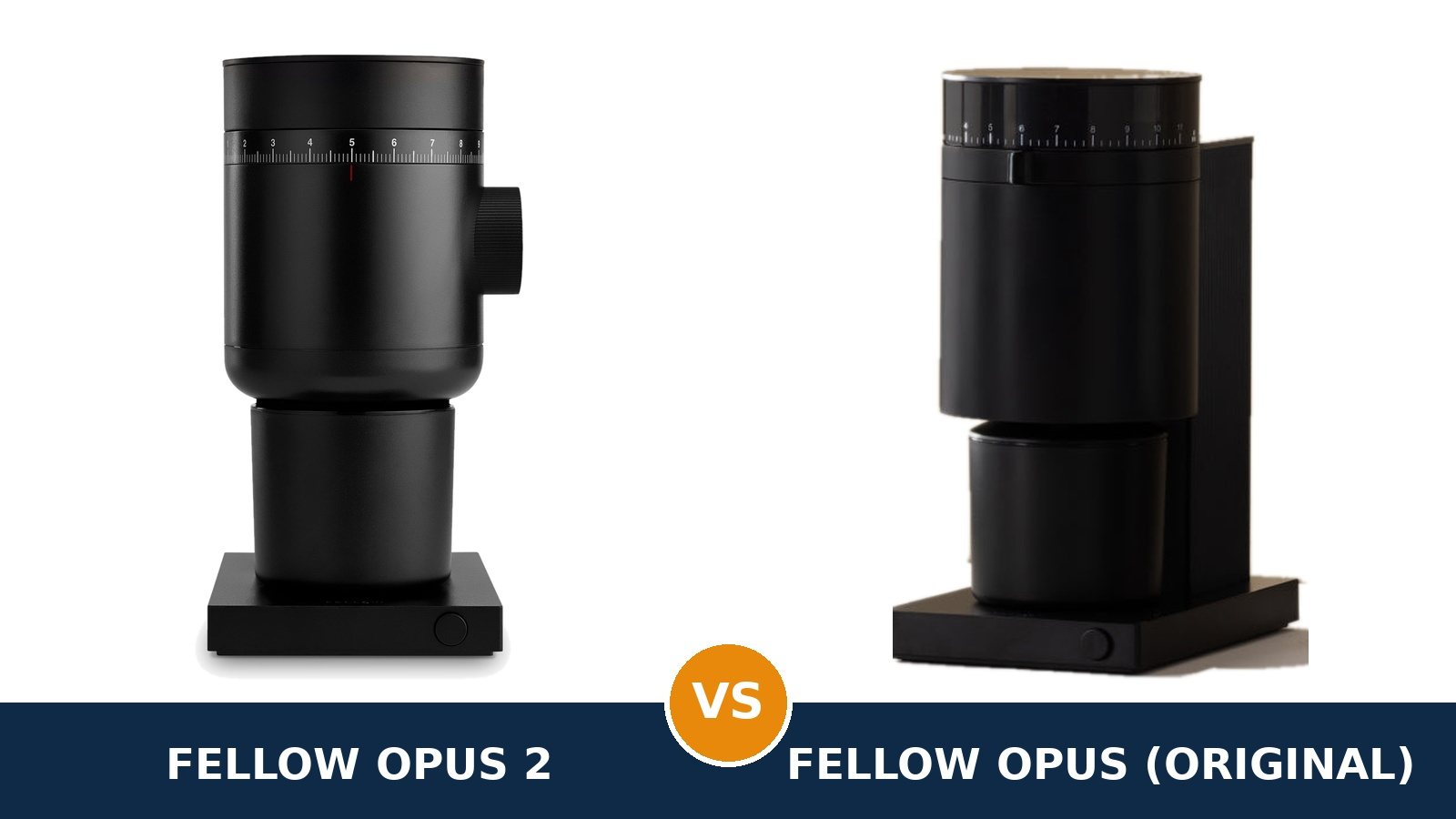
Same name, same silhouette, same slot in Fellow’s range — and two genuinely different grinders. This is a generational comparison, not a trim-level one.
The Fellow Opus 2 is the current model, released in 2026 to replace the original outright — the machine launched in 2023 as the Fellow Opus. Fellow no longer sells the original new; its own store lists only the Opus 2.
So why compare them? Because the original has not vanished. It still circulates through marketplace listings, leftover dealer stock and the secondhand market, often under a headline that just says “Opus”. Owners ask whether the upgrade is worth it; buyers ask whether a discounted original beats a full-price Opus 2. Both deserve a spec-sheet answer.
The tells are easy once you know them. The original wears its numbered grind ring (1–11) around the top of the body and has no side knob. The Opus 2 wears its scale ring around the middle, with a knurled adjustment knob on its right flank. If a specification block says 40 mm burrs and 41 settings, it is the 2023 machine, whatever the headline claims.
Every specification below comes from Fellow’s own published data for both generations.
Key Takeaways
- The Opus 2 wins, and it is not especially close. Bigger burrs, a stepless dial, more than double the motor rating and a far stronger anti-static system.
- The original Opus is discontinued. Fellow sells only the Opus 2 new. The original survives as leftover dealer stock, marketplace offers and used machines.
- Adjustment changed philosophy. The original clicks through 41 stepped settings, then hides a micro-adjust ring under its load bin. The Opus 2 turns one continuous side dial with 48 marked references.
- The original keeps two honest edges. It publishes its burr speed (350 RPM) where the Opus 2 publishes none, and its timed one-button grind cycles remain genuinely convenient.
Quick Verdict
Buy the Fellow Opus 2 if you are buying new. It is the better grinder on nearly every published line.
Its 48 mm burrs are a class up from the original’s 40 mm set. Its stepless dial never strands an espresso setting between clicks. Its motor is rated at 300 W against the original’s 150 W, its ionizer was upgraded, and an impeller now moves grounds through the path instead of letting them linger.
Buy the original Fellow Opus only in one situation: a verified machine at a clear saving. New-old-stock from a dealer clearing the shelf, or a used unit you can inspect.
Bought that way, it remains a capable all-rounder — the same espresso-to-cold-brew range, a named burr set, timed grind cycles, a two-year warranty design. Bought near the Opus 2’s price, it is simply the older machine for the same money.
The Scorecard
Scores below are derived directly from the manufacturer specifications compared in this guide — a reading aid, not benchmark results. Fellow publishes no decibel figure for either generation, so no noise score appears. Every Opus 2 category mark is carried from its earlier scorecards on this site; this pairing’s set mixes rows from both, which is why its overall lands between them.
| Category | Fellow Opus 2 | Fellow Opus (Original) | ||
|---|---|---|---|---|
| Burr set | 8 / 10 | 7.5 / 10 | ||
| Adjustment & espresso resolution | 9.5 / 10 | 7 / 10 | ||
| Dosing & workflow | 8 / 10 | 7.5 / 10 | ||
| Motor & published output | 8.5 / 10 | 6.5 / 10 | ||
| Retention & static control | 9 / 10 | 7 / 10 | ||
| Brew-method range | 8 / 10 | 8 / 10 | ||
| Build, footprint & capacity | 7 / 10 | 7 / 10 | ||
| Overall | 8.3 / 10 | 7.2 / 10 | ||
The result is a generational gap, not a rout: the original ties on range and footprint, and loses because its successor improved the burrs, the dial, the motor and the static problem.
At a Glance: Who Each Grinder Fits
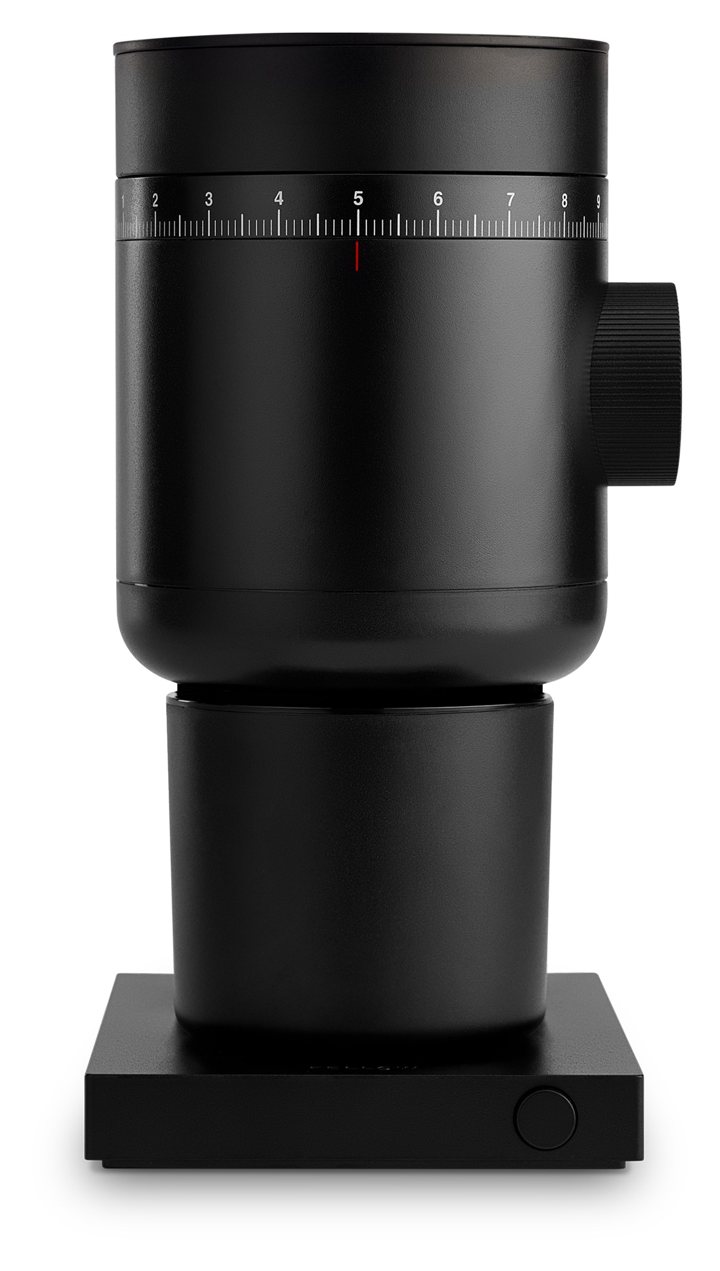
Fellow Opus 2
- 48 mm stainless steel conical burrs, espresso to cold brew
- Stepless side dial with 48 marked reference settings
- 300 W motor; Fellow cites roughly nine seconds for an espresso shot
- Single-dose 100 g load bin, auto-stop, upgraded ionizer and impeller grind path
- Two magnetic catch cups: 100 g brew cup and 30 g espresso cup for 54 mm and 58 mm portafilters
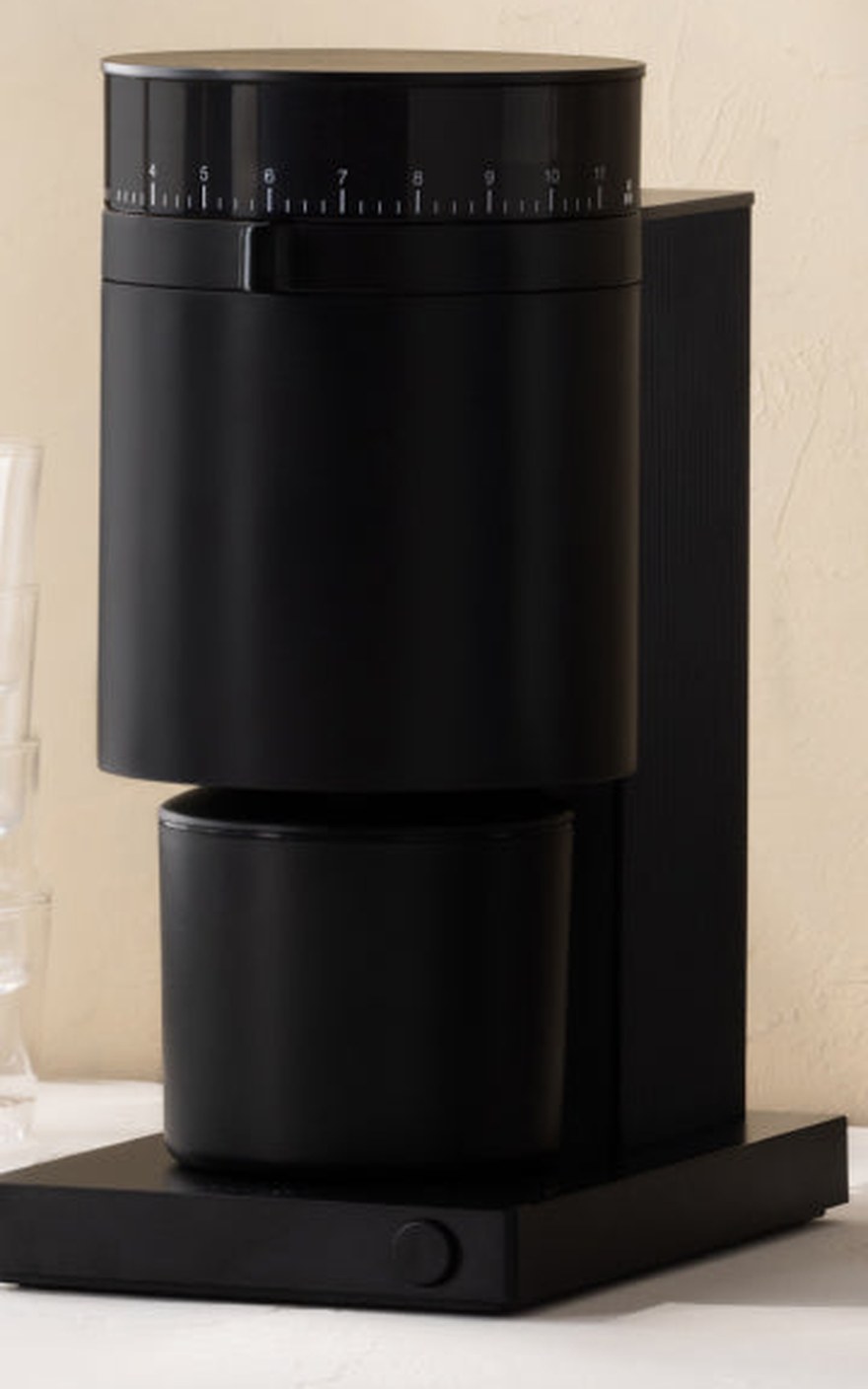
Fellow Opus (Original, 2023)
- 40 mm C6-40 Burly Burrs — a named, six-blade steel conical set
- 41 stepped settings (ring numbered 1–11) plus an inner micro-adjust ring under the load bin
- Timed auto-stop cycles — one press 30 seconds, two 60, three 90 — plus a manual mode
- Load bin up to 110 g with a volumetric dosing lid; magnetic catch cup with a portafilter dosing insert
- Discontinued: Fellow sells it no longer — dealer leftovers, marketplace offers and used machines only
Choose the Fellow Opus 2 if…
You are buying new, at anything like the going rate. On specifications it is the better machine in almost every row below.
Espresso is a daily habit and you dial in by taste. A stepless dial finds settings a stepped ring reaches only by disassembly.
Static and retained grounds are your complaint. The upgraded ionizer and impeller path were designed as the direct answer.
Choose the original Fellow Opus if…
You have found one verified — new-old-stock at a dealer, or a used machine you can inspect — at a clear saving over the Opus 2. That saving is the entire case.
You value noted, repeatable settings and timed one-button cycles — the 30/60/90-second presets are something the Opus 2 does not offer.
As an Amazon Associate I earn from qualifying purchases at no extra cost to you.
Specifications: The Specs That Actually Matter
Every figure below is from Fellow’s own published data: the Opus 2 product page and manual, and for the original, its manual (US model APAAUS), gear guide and launch specifications.
| Specification | Fellow Opus 2 Conical Burr Grinder | Fellow Opus Conical Burr Grinder (2023) |
|---|---|---|
| Model identity | Opus 2, models OP01AANA (standard) and OP02AANA (wooden upgrades) — the current Opus, on sale since 2026 | Opus Conical Burr Grinder, US model APAAUS — the 2023 original; discontinued and replaced by the Opus 2 |
| Burr set | 48 mm conical, stainless steel (unnamed set) | 40 mm conical C6-40 Burly Burrs, six-blade stainless steel; Fellow also sells an Opus 40 DLC Brew Burrs upgrade set for this model |
| Adjustment system | Stepless side dial — continuous, no clicks, with 48 marked reference settings | Stepped outer ring: 41 settings (numbers 1–11, four minor increments between each) plus an inner micro-adjust ring under the load bin |
| Grind range | Espresso to cold brew; Fellow publishes no micron range (roughly 200–1200 microns per retailer specification sheets) | Espresso to cold brew; Fellow publishes no micron range (dealer sheets cite under 200 microns at the fine end) |
| Motor | 300 W, 3.0 A (US version, per Fellow’s manual) | 150 W, 1.25 A (US version, per Fellow’s manual rating); 6.0 Nm of torque per Fellow’s published copy |
| Burr speed | Not published by Fellow (roughly 400 RPM per retailer specification sheets) | 350 RPM — published in Fellow’s launch specifications and carried in dealer spec tables |
| Published grind output | Fellow cites about 9 seconds to grind an espresso shot; no output rate published | No output rate published |
| Dosing format | Single-dose load bin, 100 g; grind guide printed on the lid; stops automatically when the bin empties | Single-dose load bin, up to 110 g; volumetric dosing lid with 20 g and 40 g compartments and the grind guide underneath; timed auto-stop presets of 30, 60 and 90 seconds, a 2-minute long press, and a manual mode |
| Catch cups / grounds bin | Two magnetic catch cups: 100 g brewed coffee, 30 g espresso (fits 54 mm and 58 mm portafilters) | One magnetic catch cup, 100 g grinds capacity per the manual, plus a catch cup insert for portafilter dosing |
| Retention & static handling | Upgraded ionizer and an internal impeller that moves grounds through the path — designed for near-zero retention | First-generation anti-static ionizer (the mechanism shared with the Ode Gen 2 at launch); no impeller |
| Duty cycle | Manual caps use: under 45 seconds per grind cycle, at least 60 seconds’ rest between cycles, no more than 3 minutes’ grinding in any 10 | Manual guidance: cycles under 2 minutes with at least 90 seconds’ rest between continuous cycles, and no more than 6 minutes’ grinding in any 10 |
| Dimensions (L × W × H) | 206 × 130 × 267 mm (8.1 × 5.1 × 10.5 in) | 210 × 129 × 268 mm (8.3 × 5.1 × 10.6 in) |
| Weight | 2.27 kg / 5.0 lb (Fellow manual) | 2.27 kg / 5.0 lb (Fellow manual) |
| Noise engineering | No decibel figure or noise feature published by Fellow | No decibel figure published by Fellow |
| Warranty | 2-year limited warranty, extendable on registration | 2-year limited warranty per Fellow’s manual; Fellow’s documentation extended US cover to 3 years with registration |
The generation note: the two machines share a silhouette, a footprint and a name, and listings blur them constantly. Three checks separate them in seconds. The grind ring: numbered 1–11 around the top of the body on the original, a scale ring around the middle with a side knob on the Opus 2. The specification block: 40 mm and 41 settings means 2023; 48 mm and stepless means the current model. Fellow’s own store sells only the Opus 2 new.
The power note: the original’s motor is often quoted at 140 W in launch-era coverage. Fellow’s manual for the US model (APAAUS) rates it at 150 W and 1.25 A, and the manual governs here. Either way, the Opus 2’s manual rating is double.
The channel note: because the original is discontinued, its Amazon listing no longer works like a normal product page. The listing for the standard Matte Black configuration is still live and still transacts — price trackers record continuing third-party sales, new and used — but there is no Amazon-sold stock and recent crawls show no featured offer; what moves through it now is marketplace inventory. The buttons in this guide link that listing as it is. Check the seller and condition before paying.
The capacity note: the original’s two capacities are inverted in some dealer tables. Fellow’s manual gives the catch cup a 100 g grinds capacity; the 110 g figure is the load bin’s maximum fill, per Fellow’s product copy and dealer data.
The Differences That Actually Matter
1. The Burr Set Grew — 40 mm C6-40 to 48 mm
The original Opus grinds on a named set: the 40 mm C6-40 Burly Burrs, a six-blade steel conical design. The Opus 2 grinds on a 48 mm stainless conical set Fellow has not given a name. Twenty percent more diameter is the single most physical change between the generations — the successor’s burr is simply a bigger cutting assembly.
On paper that buys throughput and headroom rather than a different cup character — both are conicals aimed at the same spread.
The original counters with something the successor lacks: a published upgrade path. Fellow still sells its factory 40 mm replacements — and an Opus 40 DLC Brew Burrs set purpose-built to tilt the 2023 machine toward filter brewing.
2. Stepless Dial vs Stepped Ring — and the Ring Under the Bin
This is the difference you feel every morning. The original adjusts in two layers. The outer ring clicks through 41 settings, numbered 1 to 11 with four minor increments between each number. Beneath the load bin sits a second, blue inner ring that micro-adjusts the grind and recalibrates the zero point as the burrs wear.
Wear compensation is a feature most grinders skip — but it is also friction. Fine work at espresso means emptying and removing the load bin to reach the second ring, then restoring your setting afterwards.
The Opus 2 abolishes the second ring: its side dial turns continuously — stepless, no clicks — with 48 marked references around it. Espresso resolution is effectively unlimited.
The honest cost: a stepless dial has no home position. Repeatability becomes a habit of noting where the marker sat, where the original’s clicks made it memory. That trade — access against index — is the largest single score gap in this comparison.
3. Motor Power Doubled — 150 W to 300 W
Fellow’s own manuals make this the cleanest generational number. The original’s US model (APAAUS) is rated at 150 W and 1.25 A. The Opus 2’s manual rates 300 W and 3.0 A. Double the rating, on the manufacturer’s own paper.
Fellow publishes one output figure across both generations: the Opus 2 grinds an espresso shot in about nine seconds. The original offers no equivalent claim.
The original publishes what its successor will not: a burr speed — 350 RPM, with 6.0 Nm of torque, per Fellow’s launch specifications. For the Opus 2 only retailer sheets hazard a figure (roughly 400 RPM), and it is not Fellow’s claim.
4. Static Was the Original’s Weakness — and the Sequel’s Brief
The original Opus carried a genuine anti-static system for 2023: an ionizer that neutralised grounds as they exited the chute — the same mechanism Fellow launched in the Ode Gen 2, and a headline feature at the time.
Its maintenance reality is documented by Fellow itself: the chute needs cleaning to keep the system working at its best. A first-generation solution that asked for upkeep.
The Opus 2 attacks the problem twice over: the ionizer is upgraded, and an internal impeller moves grounds through a short path instead of letting them cling — designed for near-zero retention, and the scorecard’s second-largest gap.
5. Workflow: Timed Cycles vs Auto-Stop — and the Lid That Measured
Score one for the older machine first. Its auto-stop is timed: one press grinds 30 seconds, two presses 60, three 90, a long press runs two minutes, and a manual mode grinds while the button is held. For repeatable batch work that is a genuinely useful automation the Opus 2 does not have.
The original also dosed by volume: its load-bin lid is a measuring tool with 20 g and 40 g compartments. The Opus 2 prints the guide on its lid but doses nothing with it.
The successor’s answer is state, not schedule: fill the 100 g bin, and the machine stops itself when the bin empties — built for single dosing rather than timed batches. Both generations dose by magnet, too: the original’s catch cup carries an insert for portafilter dosing, where the Opus 2 supplies a dedicated second cup shaped for 54 mm and 58 mm portafilters.
Which workflow wins depends on your ritual. Timed cycles favour repetition; auto-stop and a shaped espresso cup favour the single-dose espresso drinker Fellow now designs for.
Brew-Method Fit Guide
The pairing grid below matches coffee jobs to the machine that serves them better.
| Your routine | Better fit | Why |
|---|---|---|
| Espresso, dialled in by taste and adjusted daily | Fellow Opus 2 | A stepless dial never strands a setting between clicks — the original’s fine work needs the hidden inner ring |
| Espresso at a fixed, repeatable setting | Either | The Opus 2’s dial resolution wins on paper; the original’s clicks return to a noted setting exactly |
| Moka pot and AeroPress, mid-range daily grinding | Either | Both cover the range comfortably; the original’s timed cycles suit a fixed morning dose |
| Drip and batch brewing | Fellow Opus (Original) | Timed cycles, a volumetric dosing lid and a looser duty cycle — bought at a discount, it is the batch tool |
| Pour over and French press, chasing clarity | Fellow Opus (Original) | The same conical range, plus Fellow’s DLC brew-burr upgrade set made for this machine’s filter work |
| Cold brew, coarse and in quantity | Either | Both reach coarse settings; the original’s longer permitted cycles help with quantity |
| Single dosing with zero tolerance for mess | Fellow Opus 2 | Upgraded ionizer, impeller path and auto-stop were designed for exactly this ritual |
| Buying your first serious grinder, to keep for years | Fellow Opus 2 | The current platform: current manuals, parts pipeline and support horizon |
Our call: two jobs in eight go to the original — batch workflow and the burr-upgrade path — and its price is a channel fact on top. Everything espresso-led, single-dose or ownership-led goes to the Opus 2, which is what a generational replacement is supposed to look like.
Decided between the generations?
Current platform and the stepless dial — or the 2023 original at leftover-market money.
The 30-Second Decision
| If this sounds like you… | Buy | One-line reason |
|---|---|---|
| You are buying new and want the better grinder | Fellow Opus 2 | Bigger burrs, stepless dial, double the motor rating, better statics |
| Espresso dial-in is your daily ritual | Fellow Opus 2 | Continuous adjustment, and no ring hiding under the load bin |
| You found a verified original at a clear saving | Fellow Opus (Original) | The same brew range for leftover-market money — the discount is the case |
| You own an original and your routine works | Keep the original | The upgrade fixes specific complaints; if they are not yours, spend nothing |
| Repeatable timed doses matter more than resolution | Fellow Opus (Original) | 30/60/90-second one-button cycles the successor dropped |
| The listing just says “Opus” and the price looks current | Neither — check the generation | Numbered top ring and 40 mm specs mean the 2023 machine |
What You Gain. What You Give Up.
Fellow Opus 2
You gain: the current platform and its full support horizon. A 48 mm burr set and a stepless dial that ends the two-ring ritual. A motor rated at double the original’s wattage with a manufacturer-cited nine-second espresso grind. The upgraded ionizer and impeller path, a dedicated espresso cup, and auto-stop dosing.
You give up: the original’s timed grind presets and measuring lid. The published burr speed — Fellow prints none — and the stepped ring’s written-down repeatability. And you pay the current-model price.
Fellow Opus (Original)
You gain: the same espresso-to-cold-brew range in the same footprint, from a named burr set with factory replacements and a filter-burr upgrade. Timed one-button cycles, a volumetric dosing lid, a wear-compensating calibration ring — and, bought well, a substantial saving over its successor.
You give up: current-model status. The original is discontinued: no new Fellow stock, a marketplace-only channel, support reduced to documentation and burrs. You also give up the speed, the stepless dial and the static fix — the three things the Opus 2 was built to be.
Pros and Cons
Fellow Opus 2 — Pros
- 48 mm conical burrs; full espresso-to-cold-brew range
- Stepless dial — espresso resolution no stepped grinder matches
- 300 W motor; Fellow cites about nine seconds per espresso shot
- Upgraded ionizer plus impeller path, designed for near-zero retention
- Two magnetic cups, including a 54/58 mm espresso cup
- The current model: sold new everywhere, longest support horizon
Cons
- Stepless dial demands note-taking to repeat a setting
- No timed grind presets — the original’s 30/60/90-second cycles are gone
- Manual duty-cycle cap: short cycles, rests between
- No published burr speed or micron range
- Standard finish skips the variants’ wood and metal trim
Fellow Opus (Original) — Pros
- Named C6-40 burr set; factory replacements and a DLC brew-burr upgrade
- 41 clicks plus a micro-adjust ring that also recalibrates for burr wear
- Timed auto-stop presets (30/60/90 seconds) and a manual mode
- Volumetric dosing lid; portafilter insert for the catch cup
- Published burr speed (350 RPM) and torque (6.0 Nm)
Cons
- Discontinued — no new stock from Fellow; marketplace and used only
- Espresso fine-tuning hides under the load bin on the inner ring
- Slower at fine settings; half the successor’s motor rating
- First-generation anti-static: the chute needs cleaning to stay effective
- Single catch cup; portafilter dosing is an insert, not a shaped cup
Check the Generation, the Seller and the Box
Check the generation before anything else. Numbered ring (1–11) around the top of the body and no side knob: original. Scale ring around the middle with a knurled side knob: Opus 2. A specification block saying 40 mm or 41 settings is the original; 48 mm or stepless is the Opus 2. A listing that mixes the two sets of numbers is mislabelled — walk away.
Check the colour configuration on the original. The standard retail configuration — the launch model, and the one our buttons link — is Matte Black. The Matte White version arrived later in 2023 as a separate listing; it is the same grinder in a different finish and should never be priced as a different model.
Check the seller and the condition on the original. There is no Amazon-sold stock and no featured offer on its listing; offers are marketplace offers. Distinguish new-old-stock (sealed, from a dealer clearing the model) from used, and price them differently. On a used machine the wear items are the burrs and the catch cup — both replaceable.
Check the warranty position. Fellow’s manual warrants the original for two years from the original consumer purchase, with claims requiring a receipt from an authorised retailer. A sealed unit from an authorised dealer carries that cover from your purchase date; a private used sale may carry none — price that difference against a new Opus 2.
Check the box contents. The original should arrive with its load-bin lid (the measuring one), the magnetic catch cup and the portafilter dosing insert. The Opus 2 should arrive with both magnetic catch cups and a cleaning brush. A box missing its insert or its second cup is incomplete or mislabelled, whichever generation it is.
The Upgrade Path Test
For owners of the original, this is the section that matters — and the honest answer is conditional.
Upgrade if your friction is on Fellow’s own fix list. Slow grinding at espresso settings, the remove-the-bin inner-ring ritual, static that returns the week after you clean the chute: the Opus 2 was designed against exactly those three complaints, with a doubled motor rating, a single stepless dial and an upgraded ionizer over an impeller path. If that list is your list, the upgrade is real.
Stay if it is not. The original’s inner ring recalibrates the zero point as its burrs wear — a longevity feature, not just a quirk — and Fellow still sells the burrs, including the DLC brew set that tilts the machine toward filter. An original that dials in well has years left, and its replacement buys refinement, not a new capability: the brew range is identical.
For new buyers the path runs one way: the Opus 2 is the platform Fellow supports going forward. The original’s path from here is self-reliance — documentation, burrs, and the used market’s depth.
When to Skip Both
Honesty cuts both ways — some coffee drinkers should buy neither generation of Opus.
Skip both if you want the grinder to dose for you: the Opus 2 automates only its stop, the original’s timed cycles still ask you to dose by hand, and neither is a grind-by-weight machine.
Skip both for café, office or event duty. Both are household appliances with duty-cycle limits written into their manuals — the successor’s are the stricter of the two.
Skip both if brewed-coffee clarity is your single pursuit. These are conical all-rounders; a purpose-built flat-burr filter grinder is the honest recommendation there.
And skip the original specifically at price parity. Its entire case is the saving; at the Opus 2’s price it has no case at all.
Warranty and Long-Term Support
On paper the warranty terms are level. The Opus 2 carries a two-year limited warranty, extendable by registering the product with Fellow. The original’s manual carries the same two-year limited warranty, and Fellow’s warranty documentation extended US cover to three years with registration. A leftover original bought new from an authorised dealer starts that clock at your purchase; a used one may have none left to start.
Beyond the term, the support stories diverge by generation. For the Opus 2, Fellow publishes the manual, gear guides and cleaning and burr-removal documentation, while stating that the base contains no user-serviceable parts — repair is an authorised-service matter.
For the original, Fellow keeps its full gear guide live — adjustment-ring tuition, cleaning schedules, troubleshooting — and continues to sell its burrs, standard and DLC brew alike. A better end-of-line story than most discontinued appliances get — but when the burr stock goes, the model is finished.
Final Verdict
The Fellow Opus 2 is the grinder to buy.
It wins by a clear generational margin, because the things it improves are the things a grinder does every day. Its burrs are bigger. Its dial adjusts continuously, so espresso settings are found instead of excavated from under a load bin. Its motor is rated at twice the original’s wattage with a manufacturer-cited nine-second shot. Its anti-static and retention systems are the newer engineering, aimed at the original’s best-documented weakness.
Buy the Opus 2 if you are purchasing new, upgrading from the original with espresso frustrations, or simply want the better Opus. At the going rate there is no contest to adjudicate.
View on Amazon — Fellow Opus 2
Buy the original Opus only as a deliberate value play: verified new-old-stock or a sound used machine, at a saving large enough to pay for its age.
Bought that way it is a genuinely capable all-rounder. Bought any other way, it is the previous generation at the current generation’s money.
View on Amazon — Fellow Opus (Original)
Frequently Asked Questions
Is the original Fellow Opus discontinued?
Yes. Fellow released the Opus 2 in 2026 as its replacement and no longer sells the original new — its own store lists the Opus 2 only, and the original survives in Fellow’s documentation as a support gear guide. Remaining new units are dealer leftovers and marketplace stock.
What actually changed from the Opus to the Opus 2?
Nearly everything mechanical. The burrs grew from 40 mm to 48 mm conical. The stepped outer ring plus hidden inner micro-adjust ring became a single stepless side dial with 48 marked references. The motor rating doubled, from 150 W to 300 W on the two manuals’ figures. The ionizer was upgraded, an impeller grind path added, timed grind presets dropped for auto-stop, and the box gained a second, espresso-specific catch cup.
How can I tell the two grinders apart in a listing?
Three checks. Look at the ring: numbered 1–11 around the top of the body means the original; a scale ring around the middle with a knurled side knob means the Opus 2. Read the specification block: 40 mm burrs and 41 settings is the 2023 machine; 48 mm and stepless is the current one.
I own the original Opus. Is the Opus 2 worth upgrading to?
It depends entirely on your complaints. If espresso dial-in means removing the load bin to reach the inner ring, if fine grinding feels slow, or if static mess returns faster than you clean the chute, the Opus 2 was designed against precisely those three things — upgrade. If your original dials in well and behaves, keep it: the brew range is identical, and Fellow still sells its burrs, including a DLC set for filter brewing.
Can I still buy the original Opus new?
Only as leftover stock: its Amazon listing carries no Amazon-sold stock and no featured offer, so what remains is marketplace inventory — sealed dealer units and used machines — with price trackers recording continuing third-party sales of both kinds. Verify the seller and condition before paying.
Which grinder is better for espresso?
The Opus 2, on adjustment and speed. Its stepless dial never strands a setting between clicks, and Fellow cites roughly nine seconds per espresso shot. The original genuinely reaches espresso — that was its founding claim — with 41 stepped settings plus the inner micro-adjust ring for fine work, and published figures of 350 RPM and 6.0 Nm of torque.
Sources & Verification
Fellow Opus 2 official product page (fellowproducts.com) — 48 mm stainless steel conical burrs, stepless dial, 48 marked settings, upgraded ionizer, impeller retention design, two catch cups, 2-year warranty • Fellow Opus 2 Safety and Maintenance manual (789-00291) — OP01AANA/OP02AANA: 120 V, 300 W, 3.0 A, 2.27 kg, duty-cycle limits, auto-stop, 2-year limited warranty • Fellow Opus gear guide (fellowproducts.com) — original’s box contents, outer and inner adjustment rings, timed auto stop, anti-static maintenance • Fellow Opus Safety and Maintenance manual (US model APAAUS) — 120 V, 150 W, 1.25 A, 2.27 kg / 5.0 lb, 210 × 129 × 268 mm, 100 g grinds capacity, 2-year limited warranty • Fellow warranty information — original Opus at 2 years standard, 3 years with registration • Fellow launch specifications via Daily Coffee News (February 2023) — C6-40 burrs at 350 RPM with 6 Nm of torque, anti-static mechanism shared with the Ode Gen 2, 110 g hopper • Authorised-dealer data (Whole Latte Love) • Amazon listing data for both models, used for ASIN verification only. Specifications verified November 2026.

James Wilson
James has been testing coffee gear and small kitchen appliances for over a decade and writes Honestly Compared's coffee and grinder guides. His rule for every comparison: the verdict has to survive the spec sheet, not the marketing page.