
Fellow Opus 2 vs DF64 Gen 2: Which Should You Buy?
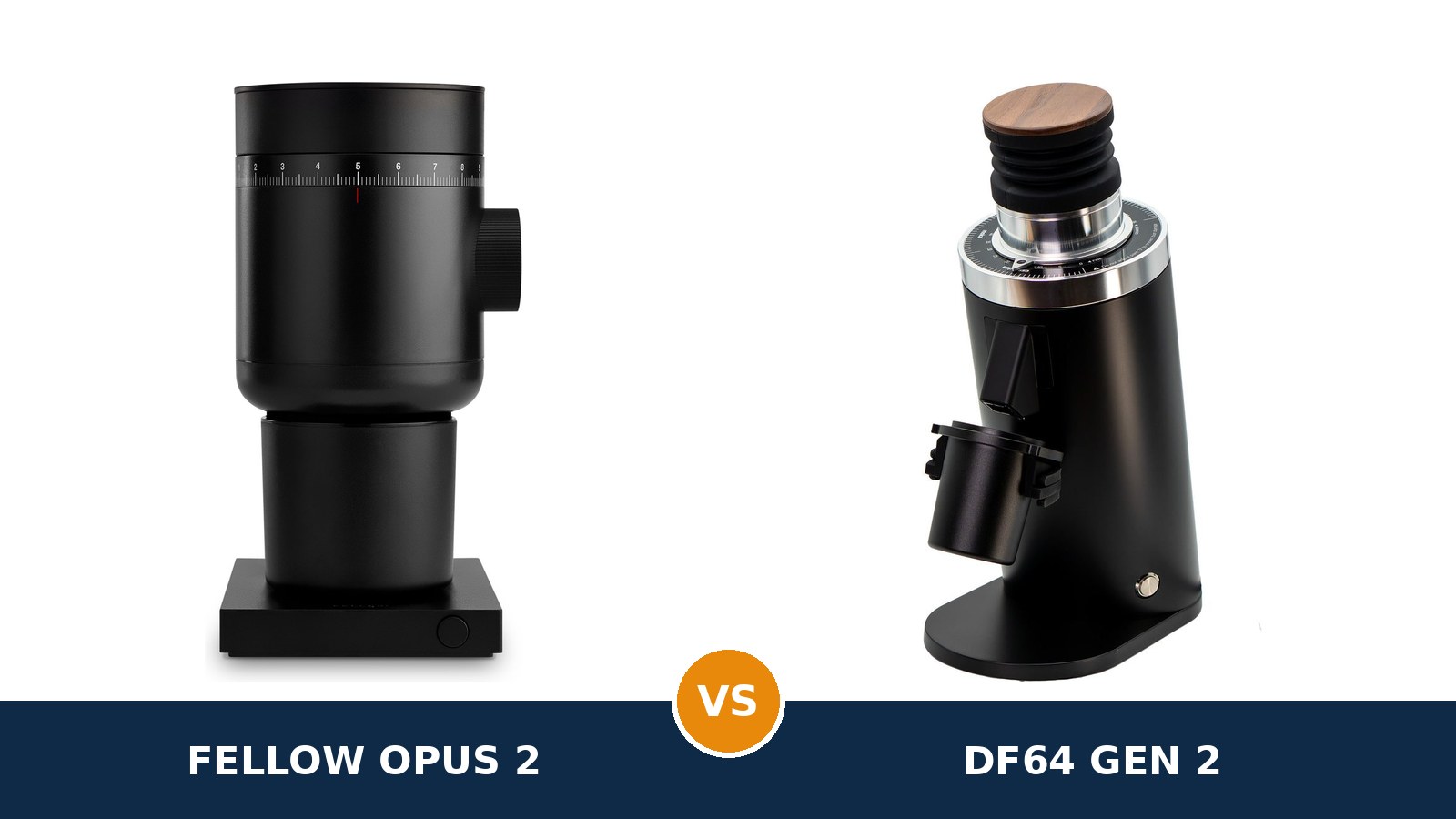
Two single-dose grinders that both promise espresso-to-brew range with almost no stale coffee left inside — one a sealed, design-led appliance, the other an open platform built around the most upgradeable burr size in home coffee.
Both names need pinning down before anything else, because both hide more than one machine. The bare “Opus” here is the Opus 2 Conical Burr Grinder — Fellow’s current model, released in 2026 to replace the original Opus: 48 mm stainless conical burrs, a stepless side dial with 48 marked reference settings, and a 300 W motor. The original 2023 Opus (40 mm burrs, 41 stepped settings, an inner micro-adjust ring) is a different, discontinued grinder, walled off by name throughout this guide.
The “DF64” needs the same treatment, and gets it here in the open. The DF name covers a family: the original DF64 of 2021, the DF64V with variable-speed drive, and the DF64P and DF64E variants. The bare “DF64” in this comparison is the DF64 Gen 2 — the current mainstream model sold under that exact name in US retail, badged DF64 II by MiiCoffee and DF64 Gen 2 by Turin and DF64Coffee. It is a complete redesign of the original: 64 mm flat burrs, a plasma ionizer in the exit chute, an anti-popcorn disc, and a three-position upper burr carrier that opens for cleaning without tools.
One warning that applies to the whole DF line: the sellers’ version numbers do not line up. The current build revision — revised inner chute, ionizer probes around the grounds path, a convex anti-popcorn blocker — is labelled V2.6 by MiiCoffee and Gen 2.7 by Turin. Same hardware, different badges. Check features, not version numbers; the buying guide below lists the features to check.
The DF64’s hardware reaches the US through MiiCoffee, Turin (Espresso Outlet) and DF64Coffee; this guide treats their published specifications as the manufacturer record. Where the distributors disagree, the conflict is printed, not buried.
Key Takeaways
- The DF64 Gen 2 wins overall, narrowly. A 64 mm flat-burr platform, the only quantified retention claim in the pairing, and an all-metal body edge out the Fellow on the published specifications.
- The Opus 2 is the calmer daily tool. Auto-stop when the dose is done, two magnetic catch cups, no bellows ritual, and a two-year warranty — double the DF64’s distributor term.
- Both dials are stepless; only one helps you return. The Opus 2 carries 48 marked reference settings. The DF64’s chrome collar is continuous, with a metal indicator you can set to true zero.
- Retention is attacked two different ways. The DF64 claims under 0.1 g and gives you a bellows to prove it. The Opus 2 uses an impeller grind path and an ionizer, and publishes no figure.
- The DF64 is a platform; the Opus 2 is finished. The 64 mm burr seat accepts SSP and coated aftermarket sets. Fellow sells the Opus 2 as a sealed appliance with no user-serviceable parts in the base.
Quick Verdict
Buy the DF64 Gen 2 if espresso leads and you like headroom. It is the more capable grinder on paper.
Its 64 mm flat burrs sit in the deepest upgrade ecosystem in home coffee. Its distributor publishes the full mechanical picture — 250 W, a fixed 1,400 RPM, a retention claim under 0.1 g — and its aluminium body opens without tools for cleaning and burr swaps. If you can see yourself trying a second burr set one day, this is the only one of the two that lets you.
Buy the Fellow Opus 2 if you want the routine, not the project. It is the more polished single-doser.
Weigh, pour, press one button: the grinder stops itself when the dose is through, the catch cup snaps on magnetically, and the ionizer and impeller path handle static and stale grounds without a bellows puff. It is smaller, a third of the weight, and covered for two years instead of one.
The Scorecard
Scores below are derived directly from the manufacturer and distributor specifications compared in this guide. They are a reading aid, not benchmark results. Neither Fellow nor the DF64’s distributors publish a decibel figure for these grinders, so no noise score appears.
| Category | Fellow Opus 2 | DF64 Gen 2 | ||
|---|---|---|---|---|
| Burr set | 8 / 10 | 8.5 / 10 | ||
| Adjustment & espresso resolution | 9.5 / 10 | 8.5 / 10 | ||
| Dosing & workflow | 8 / 10 | 7.5 / 10 | ||
| Motor & published output | 8.5 / 10 | 8 / 10 | ||
| Retention & static control | 9 / 10 | 9.5 / 10 | ||
| Brew-method range | 8 / 10 | 8.5 / 10 | ||
| Build, footprint & capacity | 7 / 10 | 8 / 10 | ||
| Overall | 8.3 / 10 | 8.4 / 10 | ||
The pattern is a split decision: the DF64 wins the hardware rows — burrs, retention, range, build — while the Opus 2 wins adjustment references, workflow and published output. One row explains most of the gap: the DF64 is the only grinder here whose maker puts a number on retention.
At a Glance: Who Each Grinder Fits
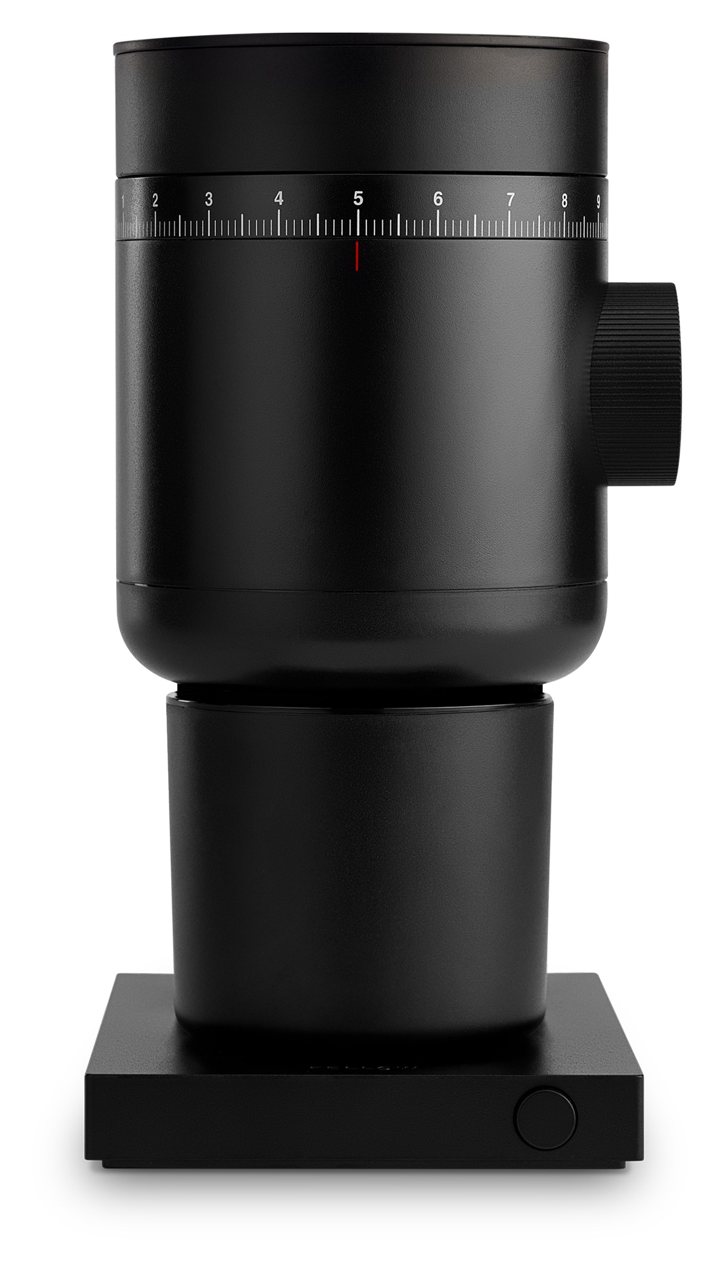
Fellow Opus 2
- 48 mm stainless steel conical burrs, espresso to cold brew
- Stepless side dial with 48 marked reference settings — nothing hides between clicks
- 300 W motor; Fellow cites roughly nine seconds for an espresso shot
- Single-dose 100 g load bin, auto-stop, ionizer and impeller grind path
- Two magnetic catch cups: 100 g brew cup and 30 g espresso cup for 54 mm and 58 mm portafilters
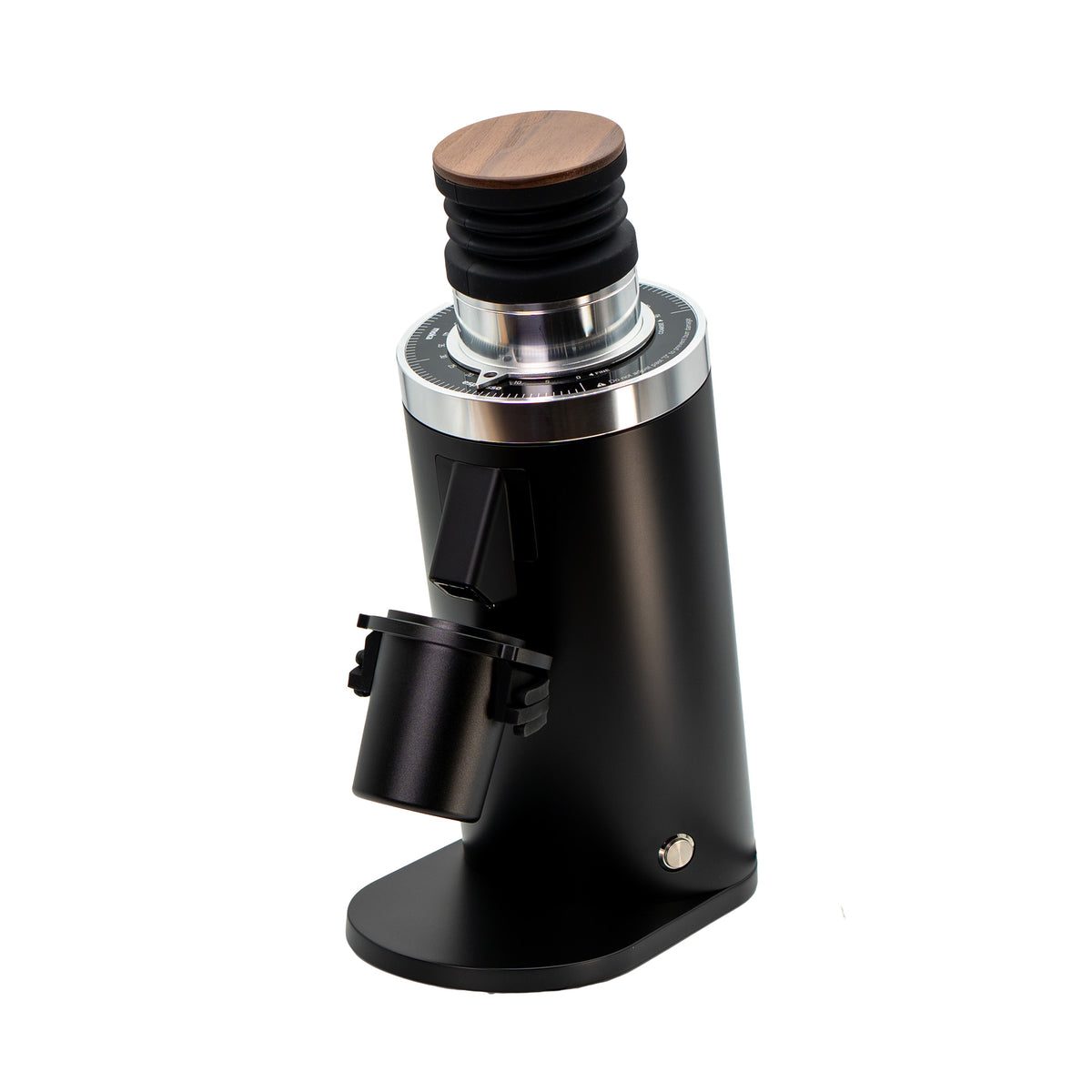
DF64 Gen 2
- 64 mm flat burrs in stainless steel, with DLC and Red Titanium options and an SSP upgrade path
- Stepless collar with a chrome-wrapped dial and a metal indicator that can be set to true zero
- 250 W AC motor at a fixed, published 1,400 RPM
- Manufacturer retention claim under 0.1 g, plasma ionizer in the chute, bellows and anti-popcorn disc
- 58 mm aluminium dosing cup, aluminium body, tool-free opening for cleaning and burr swaps
Choose the Fellow Opus 2 if…
Your mornings run on routine. Weigh the dose, close the lid, press the button — the grinder stops on its own and the cup is already magnetically parked.
You switch beans and brew methods constantly. The 100 g load bin, two purpose-sized catch cups and a dial you can read at a glance suit a varied counter.
Space and warranty matter. At 267 mm tall and 2.27 kg it fits under cabinets the DF64 cannot, and its cover runs two years.
Choose the DF64 Gen 2 if…
Espresso is the main event and filter is the side dish. The 64 mm flat platform was designed espresso-first, with the range to cover the rest.
You want a grinder that can grow. A second burr set — coated, or an SSP geometry — turns the same machine into a different grinder.
You maintain your own gear. The burr chamber opens without tools, the burrs are a standard 64 mm fitting, and the distributors sell the parts.
As an Amazon Associate I earn from qualifying purchases at no extra cost to you.
Specifications: The Specs That Actually Matter
Every figure below is from published manufacturer or official-distributor data: Fellow’s Opus 2 product page and Safety and Maintenance manual (789-00291), and the DF64 Gen 2 pages and manual of its US distributors MiiCoffee and Turin (Espresso Outlet). Where the distributors disagree, the conflict is printed under the table.
| Specification | Fellow Opus 2 | DF64 Gen 2 |
|---|---|---|
| Burr set | 48 mm conical | 64 mm flat |
| Burr material & options | Stainless steel | Stainless steel stock; DLC and Red Titanium factory options by seller; SSP burr sets fit |
| Adjustment | Stepless side dial | Stepless collar, chrome-wrapped dial |
| Settings reference | 48 marked reference settings on the dial | Numbered dial markings; metal indicator can be set to the true zero point |
| Motor | 300 W (3.0 A), 120 V / 60 Hz | 250 W AC, 100–120 V / 60 Hz (US model) |
| Burr speed | Not published by Fellow (retailer sheets list ~400 RPM) | 1,400 RPM, fixed — published |
| Published output | ~9 seconds per espresso shot (Fellow’s claim) | No output-rate figure published |
| Dosing format | Single-dose load bin | Single-dose bellows hopper |
| Hopper / bin capacity | 100 g load bin | 50 g with bellows fitted (Turin manual); see note below |
| Catch vessel | Two magnetic catch cups — 100 g brew cup and 30 g espresso cup (54 mm / 58 mm portafilters) | 58 mm food-grade aluminium dosing cup; portafilter rest fitted |
| Retention | Impeller grind path; Fellow describes a near-zero-retention design, no figure published | Manufacturer claim: under 0.1 g (“True Zero Retention”), with bellows to clear the chamber |
| Static control | Integrated ionizer | Plasma generator (ionizer) in the exit chute |
| Auto-stop | Yes — stops when the load bin empties | 45-second auto-stop (Turin documentation) |
| Dimensions | 206 × 130 × 267 mm | 254 × 132 × 305 mm (10 × 5.2 × 12 in) |
| Weight | 2.27 kg (5.0 lb) | ~15 lb (6.8 kg) |
| Body | Plastic (standard model) | Aluminium, powder-coated |
| Warranty | 2-year limited, extendable on registration | 1 year, via the US distributor |
Three honesty notes on this table. First, capacity: MiiCoffee rates the DF64’s hopper at 30 g without the bellows and 80 g with it, while Turin’s manual rates the bellows hopper at 50 g. The table prints the manual figure; single doses of 18–22 g fit comfortably under every version of the number. Second, dimensions: MiiCoffee’s page lists 9 × 5 × 14 in, but Turin’s manual, Espresso Outlet and the Amazon listing data all agree on 10 × 5.2 × 12 in, so that is the figure used. Third, grind range: neither maker publishes a micron range for these grinders — Fellow’s roughly 200–1,200 micron figure circulates in retailer sheets, not Fellow documents, and no equivalent figure exists for the DF64 at all.
The Differences That Actually Matter
1. A 64 mm flat platform against a 48 mm conical
The burrs are the whole argument. The DF64’s 64 mm flat set is the standard competition size: the same seat accepts the stock stainless burrs, coated DLC or Red Titanium variants, and the SSP aftermarket catalogue. Each swap genuinely re-voices the grinder, which is why the DF64 anchors so many upgrade paths.
The Opus 2’s 48 mm conical set is a fixed proposition — but a deliberate one. Conical geometry is forgiving to feed and to drive, and Fellow has tuned the whole machine around this one burr set rather than offering options. You are buying a finished recipe instead of a platform.
On published specification the DF64 takes the row: bigger burrs, named options, an ecosystem. What the table cannot tell you is that the Opus 2’s burr set is the one its maker optimised for. Both statements are true; the scorecard scores the paper.
2. Two stepless dials, two philosophies of return
Neither grinder clicks. The difference is how each one helps you find a setting again. The Opus 2 prints 48 marked reference settings around its side dial, so a working espresso setting can be written down, left for a week of filter brewing, and dialled back to the same mark.
The DF64’s collar is a chrome-wrapped stepless ring with a metal indicator that can be re-set to the burrs’ true zero point — a tuner’s feature the Opus 2 does not offer. In exchange it asks you to work in turns and fractions from zero rather than numbered references.
For espresso resolution itself, both are continuous: there is no “between clicks” failure mode on either machine. The Opus 2 wins the row on repeatability for households that log settings; the DF64 answers the expert who calibrates to zero and works by feel.
3. Retention: a published number against an engineered path
This is the DF64’s strongest card. MiiCoffee publishes a retention claim of under 0.1 g — “True Zero Retention” — and designs for it openly: a plasma ionizer in the exit chute, an anti-popcorn disc to keep the feed even, and a bellows with a wooden lid so you can puff the last grounds out of the chamber.
The Opus 2 attacks the same problem inside a sealed body. An internal impeller moves grounds through the grind path, an integrated ionizer handles static, and Fellow describes the result as near-zero retention. There is nothing to puff and nothing to open — but also no published figure to hold the design to.
One number beats none on paper, so the DF64 scores the row 9.5 to 9.0. Read the workflow difference honestly, though: the DF64’s figure is achieved with the bellows step included, and the Opus 2 gets its result while asking nothing of you.
4. Workflow: the button against the ritual
The Opus 2 is built around a single press. Load up to 100 g, and the grinder runs until the bin empties and stops itself — with a manual duty cycle behind it (under 45 seconds per cycle, a minute’s rest between cycles). The two magnetic catch cups finish the job: a 100 g brew cup, and a 30 g espresso cup sized for 54 mm and 58 mm portafilters.
The DF64’s routine has more hands in it. Beans go under the bellows, the metal power button starts a fixed-speed grind, a 45-second auto-stop backstops you, and the bellows puff clears the chamber into a 58 mm aluminium dosing cup that sits on the fitted portafilter rest.
Neither routine is hard. The Fellow’s is shorter, and it scores the row — 8.0 to 7.5 — while the DF64’s ritual is exactly the part its owners tend to enjoy.
5. Motors: 300 W unpublished against 250 W in the open
Fellow rates the Opus 2 at 300 W and 3.0 A in its safety manual, and supports it with a claim of roughly nine seconds for an espresso shot. What Fellow does not publish is burr speed: the ~400 RPM figure in retailer sheets is attributed data, not a Fellow specification.
The DF64 publishes less power and more truth. Its 250 W AC motor runs at a fixed 1,400 RPM, printed by MiiCoffee and Turin alike. No output-rate figure is published for it, so the Fellow’s nine-second claim stands unanswered on paper.
The row splits down the middle: the Opus 2 scores it on wattage and the shot-time claim; the DF64 earns its 8.0 on the only fully published speed here. Fixed speed is also a boundary — RPM as a variable belongs to the separate DF64V.
6. Build and ownership: appliance against instrument
The Opus 2 is 2.27 kg of matte plastic on the standard model, 267 mm tall — it fits under cabinets, moves with one hand, and cleans with a wipe. Fellow backs it with a two-year limited warranty, extendable on registration, and states plainly that the base has no user-serviceable parts.
The DF64 is roughly three times the weight in powder-coated aluminium, 305 mm tall. Its burr chamber opens without tools — the three-position upper carrier and wave spring are designed for cleaning and burr changes — and its distributors sell parts and burrs as a normal line of business. Its warranty, though, is one year through the distributor, half the Fellow’s term.
So the ownership trade is exact: the Opus 2 doubles your cover and asks for no maintenance; the DF64 halves the cover and hands you the tools. The build row goes to the metal grinder, 8.0 to 7.0; the warranty row in the support section below goes the other way.
Brew-Method Fit Guide
Both grinders are sold as espresso-to-brew all-rounders. This table scores the fit per method from the published specifications — burr platform and available burr sets, adjustment style, dosing format and capacity.
| Brew method | Fellow Opus 2 | DF64 Gen 2 |
|---|---|---|
| Espresso | Stepless dial with 48 references; 30 g espresso cup in the box | 64 mm flat platform; burr swaps (SSP, coated) to re-voice shots; 58 mm dosing cup |
| Moka pot | Fine-end control with a readable dial; small doses suit the load bin | Capable; the bellows routine is more ceremony than a moka pot needs |
| Pour-over | Ionizer and impeller keep the catch cup clean between methods | Brew-oriented 64 mm burr options make this a genuine second specialty |
| Batch drip | 100 g load bin covers a full pot’s dose in one load | 50 g bellows hopper means a mid-pot reload for large batches |
| French press & cold brew | Coarse end covered per Fellow’s stated range | Manual rates the range to French press; coarse settings sit far from burr touch |
The shape of the table is the shape of the pairing: the DF64 leans espresso-and-experiment, the Opus 2 everyday-and-easy, and neither is out of its depth anywhere here.
Ready to check today’s price?
Both grinders sell through Amazon — the Opus 2 from Fellow’s listing, the DF64 Gen 2 from its official seller. Prices move, so check the live figure on the grinder that fits how you brew.
View on Amazon — Fellow Opus 2View on Amazon — DF64 Gen 2The 30-Second Decision
| If this sounds like you… | Buy this |
|---|---|
| “I want espresso headroom and the option to change burrs later.” | DF64 Gen 2 — the 64 mm platform |
| “I want to press one button and have the grinder stop itself.” | Fellow Opus 2 — auto-stop, magnetic cups |
| “I write my settings down and go back to them.” | Fellow Opus 2 — 48 marked references |
| “Retention numbers matter to me — show me a figure.” | DF64 Gen 2 — under 0.1 g, manufacturer-stated |
| “My counter is small and my warranty should be long.” | Fellow Opus 2 — 267 mm tall, two-year cover |
| “I maintain my own equipment and expect parts to exist.” | DF64 Gen 2 — tool-free opening, distributor parts |
What You Gain. What You Give Up.
Choosing the Fellow Opus 2
You gain: the calmest single-dose routine in the class — auto-stop, two magnetic cups, an ionizer and impeller doing the retention work invisibly. A dial you can log and return to. Two years of warranty, a 267 mm height, and a footprint that suits small kitchens.
You give up: the platform. One burr set, no swaps, no user-serviceable parts in the base, and no published burr speed or retention figure to verify the engineering against. When you outgrow it, you replace it.
Choosing the DF64 Gen 2
You gain: the 64 mm flat-burr platform with its full upgrade ecosystem, the only quantified retention claim here, an aluminium body that opens without tools, and a distributor record that publishes wattage, RPM and capacity in the open.
You give up: polish and cover. The bellows is a step you perform every dose, the warranty is one year through a distributor rather than two from the maker, and at ~15 lb and 305 mm tall it claims real counter territory.
Pros and Cons
Fellow Opus 2 — pros
- Auto-stop and two magnetic catch cups make single-dosing nearly hands-free
- 48 marked references on a stepless dial — fine control you can return to
- Two-year warranty, double the DF64’s term
- Smallest and lightest here: 206 × 130 × 267 mm, 2.27 kg
Cons
- No published burr speed or retention figure
- One burr set, no upgrade path, no user-serviceable parts in the base
- Manual duty-cycle cap behind the auto-stop convenience
DF64 Gen 2 — pros
- 64 mm flat platform: stock, coated and SSP burr options
- Published retention claim under 0.1 g, plasma ionizer, bellows included
- Fully published motor record: 250 W, fixed 1,400 RPM
- Aluminium body; burr chamber opens without tools
Cons
- One-year distributor warranty
- Bellows step is part of every dose
- Seller version labels (V2.6, Gen 2.7) make listings confusing to check
- ~15 lb and 305 mm tall — the bigger counter commitment
Check the Generation, the Voltage and the Burrs
Confirm it is a Gen 2 DF64. The current model has a plasma generator in the exit chute, an integrated anti-popcorn disc, a chrome-wrapped dial with a metal indicator, and a metal power button. The original 2021 DF64 has none of the ionizer hardware. If a listing’s copy does not mention the plasma generator, it is not the grinder in this guide.
Do not be confused by the version labels. MiiCoffee sells the current build as DF64 II (V2.6), Turin as Gen 2.7, DF64Coffee simply as Gen 2. These are seller badges on the same current hardware — revised inner chute, ionizer probes around the grounds path, convex anti-popcorn blocker. A listing saying Gen 2, II, V2.6 or 2.7 can all be the right machine; check the feature list, not the number.
Check the voltage before anything else. The DF64 is sold in 110 V US and 220 V versions, sometimes in near-identical listings. This guide covers the US 100–120 V model. A white listing flagged 220–240 V exists in the same marketplace — do not buy it for a US kitchen.
Know which burrs are in the box. Stock fitment is the custom stainless steel set. DLC and Red Titanium are factory options on some listings, and SSP sets are a separate purchase fitted afterwards. A listing priced well below the field is worth a second read of its burr line.
Check the Opus 2 the same way. The current grinder’s specification reads 48 mm burrs, stepless dial, 300 W, model codes OP01AANA (black) and OP02AANA. If a listing says 40 mm, 41 settings or 140 W, it is the discontinued original Opus under a familiar name.
The Upgrade Path Test
This is where the pairing stops being close. The DF64 Gen 2 is the rare grinder that gets better without being replaced: a coated burr set for longevity, an SSP geometry for a different cup profile, each a modest spend against the price of a new grinder. Its ceiling is set by the 64 mm format itself — one of the highest ceilings in home coffee.
The Opus 2’s upgrade path is a trade-in. Fellow offers no burr options or internal parts for it, so stepping up means a different grinder — a flat-burr machine like the DF64, or Fellow’s filter-focused Ode line. Buy it because it is right now, not because it grows.
Neither answer is wrong. They are different ownership shapes: the DF64 amortises, the Opus 2 simply serves. The test is which shape matches how you have treated every grinder you have owned so far.
When to Skip Both
You brew from a loaded hopper, not by the dose. Both of these are single-dose machines. A hopper-fed grinder with a timer — the Encore ESP pattern — fits a household drip routine better than either.
You never pull espresso. Both spend money on espresso-capable adjustment you will not use. A filter-only grinder such as Fellow’s Ode Gen 2 puts the whole budget into brewed coffee.
You want motor speed as an ingredient. The DF64 Gen 2 is fixed at 1,400 RPM and the Opus 2 does not even publish its speed. Variable RPM lives in the DF64V line — a different model, deliberately not this one.
You want to grind by hand. A premium hand grinder covers travel and small daily doses with no counter footprint at all, and both of these machines would be furniture beside it.
Warranty and Long-Term Support
The Opus 2 carries a two-year limited warranty, extendable when you register the product — the strongest term in this pairing. Fellow’s boundary is equally clear: the base has no user-serviceable parts, so long-term support means Fellow’s service channel, not your workbench.
The DF64 Gen 2 carries one year of warranty through its US distributor — MiiCoffee states the term on its product page, and Turin/Espresso Outlet support their sales the same way. What the shorter term trades against is openness: the grinder opens without tools, its burrs are a standard 64 mm fitting available from multiple makers, and its distributors stock parts as ordinary business.
Read the two offers as philosophies: Fellow insures the machine for longer and keeps the keys; the DF network insures it for less time and hands you the keys on day one. Over five years the second arrangement usually serves owners better; over two, the first is objectively stronger.
Final Verdict
The DF64 Gen 2 wins this comparison 8.4 to 8.3, and the margin is the platform. On published specifications it has the bigger, more flexible burr set, the only quantified retention claim, the fully published motor record, and the metal body that opens for its owner. It is the grinder for the espresso drinker who expects to keep learning.
The Fellow Opus 2 is the better appliance, and for many households that is the better buy. It removes steps the DF64 keeps, returns to its settings by number, fits smaller counters, and doubles the warranty. If your honest self-assessment is “I want great coffee without a new hobby,” take the Fellow and do not look back.
Both buttons below go to the verified listings for the exact models in this guide — the Opus 2 (OP01AANA generation) and the DF64 Gen 2 in its US-voltage form.
View on Amazon — Fellow Opus 2 View on Amazon — DF64 Gen 2
Frequently Asked Questions
Which DF64 is this comparison about?
The DF64 Gen 2 — stated openly, because the name covers several machines. It is the current mainstream model sold as DF64 Gen 2 by Turin and DF64Coffee and as DF64 II by MiiCoffee: 64 mm flat burrs, a plasma ionizer, an anti-popcorn disc and a fixed 1,400 RPM motor. The original 2021 DF64, the variable-speed DF64V and the DF64P and DF64E are different grinders and are not covered here.
Are the DF64 V2.6 and the Turin Gen 2.7 different grinders?
No. The DF line’s sellers do not align their version numbers. The current build — revised inner chute, ionizer probes around the grounds path, convex anti-popcorn blocker — is labelled V2.6 by MiiCoffee and Gen 2.7 by Turin. Same hardware; check the feature list rather than the badge when you compare listings.
Is the “Opus” here the original Opus or the Opus 2?
The Opus 2 — Fellow’s current model, released in 2026 to replace the original. It has 48 mm stainless conical burrs, a stepless side dial with 48 marked references and a 300 W motor. The original 2023 Opus (40 mm burrs, 41 stepped settings plus an inner ring, 140 W) is discontinued and walled off by name throughout this guide.
Which grinder is better for espresso?
On paper, the DF64 Gen 2. It was designed espresso-first around a 64 mm flat platform, and its burr seat accepts alternative sets — coated factory options and SSP geometries — that let you re-voice shots as your taste develops. The Opus 2 is genuinely espresso-capable with finer day-to-day dial-in references, but its burr set is the only one it will ever have.
Which grinder retains fewer stale grounds?
The DF64 publishes the claim: under 0.1 g, backed by a plasma ionizer, an anti-popcorn disc and the included bellows. The Opus 2 uses an internal impeller and an ionizer, and Fellow describes the design as near-zero retention without publishing a figure. The DF64 wins the published record; the Opus 2 achieves its result with no bellows step.
Can both grinders handle French press and cold brew?
Yes. Turin’s manual rates the DF64’s stepless range from espresso-fine to French-press coarse, and Fellow states the Opus 2’s range as espresso to cold brew. Neither maker publishes a micron range for these models, so the honest statement is method coverage, not a micron figure.
Which is easier to live with day to day?
The Opus 2. It stops itself when the dose is ground, its catch cups park magnetically, it needs no bellows step, and it is a third of the DF64’s weight. The DF64 asks a little more of you each morning and gives you a platform, tool-free access and replaceable burrs in return.
What should I check before buying a DF64 Gen 2?
Three things. The feature list: plasma generator, anti-popcorn disc, metal indicator — if they are absent, it is the original DF64. The voltage: buy the 100–120 V US model, not a 220 V listing. And the burrs: stock stainless steel is standard; DLC and Red Titanium are options, and SSP sets are a separate purchase.
Sources & Verification
Fellow Opus 2 official product page (fellowproducts.com) — 48 mm stainless steel conical burrs, stepless dial, 48 marked settings, ionizer, impeller retention design, two catch cups, 2-year warranty • Fellow Opus 2 Safety and Maintenance manual (789-00291) — OP01AANA/OP02AANA specifications: 120 V, 300 W, 3.0 A, 2.27 kg, duty-cycle limits, automatic stop • MiiCoffee official DF64 II product page (miicoffee.shop) — 64 mm custom stainless flat burrs, plasma generator, anti-popcorn disc, True Zero Retention claim under 0.1 g, 58 mm aluminium dosing cup, 30 g / 80 g hopper ratings, 250 W motor at 1,400 RPM (comparison table), 100–120 V US model, 1-year warranty, version history V2.3–V2.6 • Turin / Espresso Outlet DF64 Gen 2 documentation and manual — 50 g bellows hopper, 45-second auto-stop, 10 × 5.2 × 12 in, ~15 lb, burr options • Amazon listing data for both models, used for ASIN verification only. Specifications verified November 2026.

James Wilson
James has been testing coffee gear and small kitchen appliances for over a decade and writes Honestly Compared's coffee and grinder guides. His rule for every comparison: the verdict has to survive the spec sheet, not the marketing page.