
Fellow Opus 2 vs Baratza Encore ESP: Which Should You Buy?
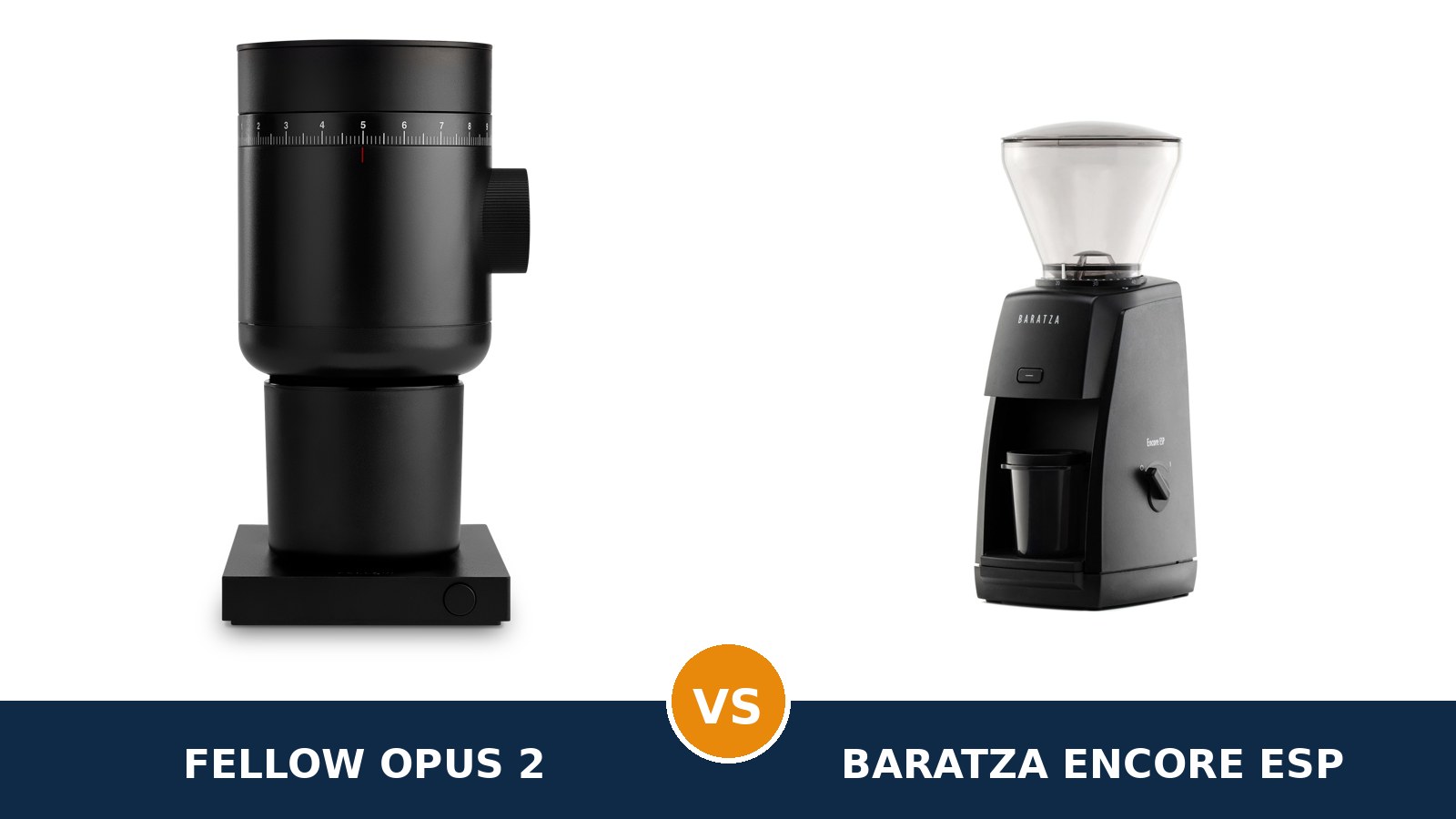
Two all-purpose grinders, both built to cover espresso and brewed coffee from one machine — and two completely different ideas about how to get there.
First, the Fellow name, because it needs pinning down before anything else. The bare “Opus” in this comparison is the Opus 2 Conical Burr Grinder — Fellow’s current model, released in 2026 to replace the original Opus. Fellow’s own product page uses the shorthand the same way, asking “Should I get the Opus 2 or the Ode 2?”
The original Opus (2023) is a different, discontinued machine — 40 mm burrs, a stepped dial with an inner micro-adjust ring, a 140 W motor. It is walled off by name throughout this guide, and nothing from it appears below. If a listing’s specification says 40 mm or 41 settings, it is the old grinder, whatever the headline claims.
With that settled, the contest is clean. The Opus 2 is the design-led single-doser: 48 mm conical burrs, a stepless dial, an ionizer and an impeller grind path. The Encore ESP is the mechanic’s grinder: a named burr set from a specialist maker, a dual-range dial engineered around espresso, and a spare-parts catalogue behind it.
Every specification below comes from the manufacturers’ own published data. Where dealer tables disagree with those documents, the manufacturer wins, and the conflict is noted.
Key Takeaways
- The Opus 2 wins overall, narrowly. A stepless dial, a 300 W motor and a two-year warranty edge out the Baratza on the published specifications.
- The Encore ESP has the better-documented burr set. Its M2 burrs are named, hardened alloy steel, made by Etzinger — and shared with the pricier Virtuoso+.
- Adjustment is the philosophy split. The Opus 2 turns continuously with no clicks. The ESP clicks through 40 settings, the first 20 dedicated to espresso at roughly 20 microns each.
- Workflow splits the other way. The Opus 2 is single-dose only, with a duty-cycle cap in its manual. The ESP’s 300 g hopper feeds batch after batch.
- Ownership is a split decision. Fellow doubles the warranty term; Baratza answers with the best spares and repair ecosystem in the class.
Quick Verdict
Buy the Fellow Opus 2 for most espresso-drinking households. It is the more complete all-rounder on paper.
Its stepless dial never leaves the right espresso setting hiding between two clicks. Its 300 W motor carries Fellow’s claim of roughly nine seconds for an espresso shot. Its ionizer and impeller path are the newer answer to static and stale grounds, and its warranty runs two years.
Buy the Baratza Encore ESP if you value repeatability and repairability over polish. It is the espresso specialist’s tool.
Its first 20 settings are a dedicated espresso micro-range, factory calibrated on every unit. Its burr set is a named, documented component. And when something wears out in year four, Baratza will sell you the part and publish the guide to fit it.
The Scorecard
Scores below are derived directly from the manufacturer specifications compared in this guide. They are a reading aid, not benchmark results. Neither manufacturer publishes a decibel figure for these grinders, so no noise score appears.
| Category | Fellow Opus 2 | Baratza Encore ESP | ||
|---|---|---|---|---|
| Burr set | 8 / 10 | 8.5 / 10 | ||
| Adjustment & espresso resolution | 9.5 / 10 | 9 / 10 | ||
| Dosing & workflow | 8 / 10 | 6.5 / 10 | ||
| Motor & published output | 8.5 / 10 | 8 / 10 | ||
| Brew-method range | 8 / 10 | 8 / 10 | ||
| Build, footprint & capacity | 7 / 10 | 7.5 / 10 | ||
| Warranty, support & repairability | 8 / 10 | 8.5 / 10 | ||
| Overall | 8.1 / 10 | 8.0 / 10 | ||
The pattern is a near-tie. The Encore ESP wins the rows about documentation and longevity; the Opus 2 wins the rows about adjustment, power and the daily grind.
At a Glance: Who Each Grinder Fits
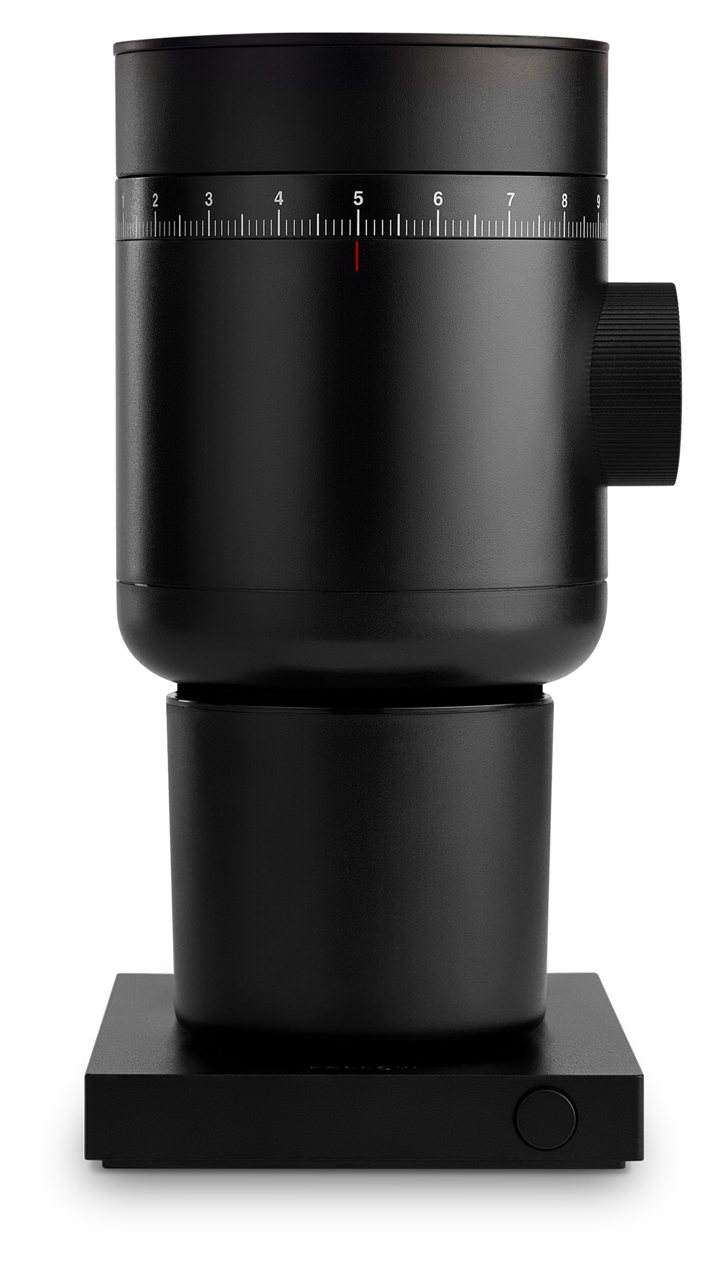
Fellow Opus 2
- 48 mm stainless steel conical burrs, espresso to cold brew
- Stepless side dial with 48 marked reference settings — nothing hides between clicks
- 300 W motor; Fellow cites roughly nine seconds for an espresso shot
- Single-dose 100 g load bin, auto-stop, ionizer and impeller grind path
- Two magnetic catch cups: 100 g brew cup and 30 g espresso cup for 54 mm and 58 mm portafilters
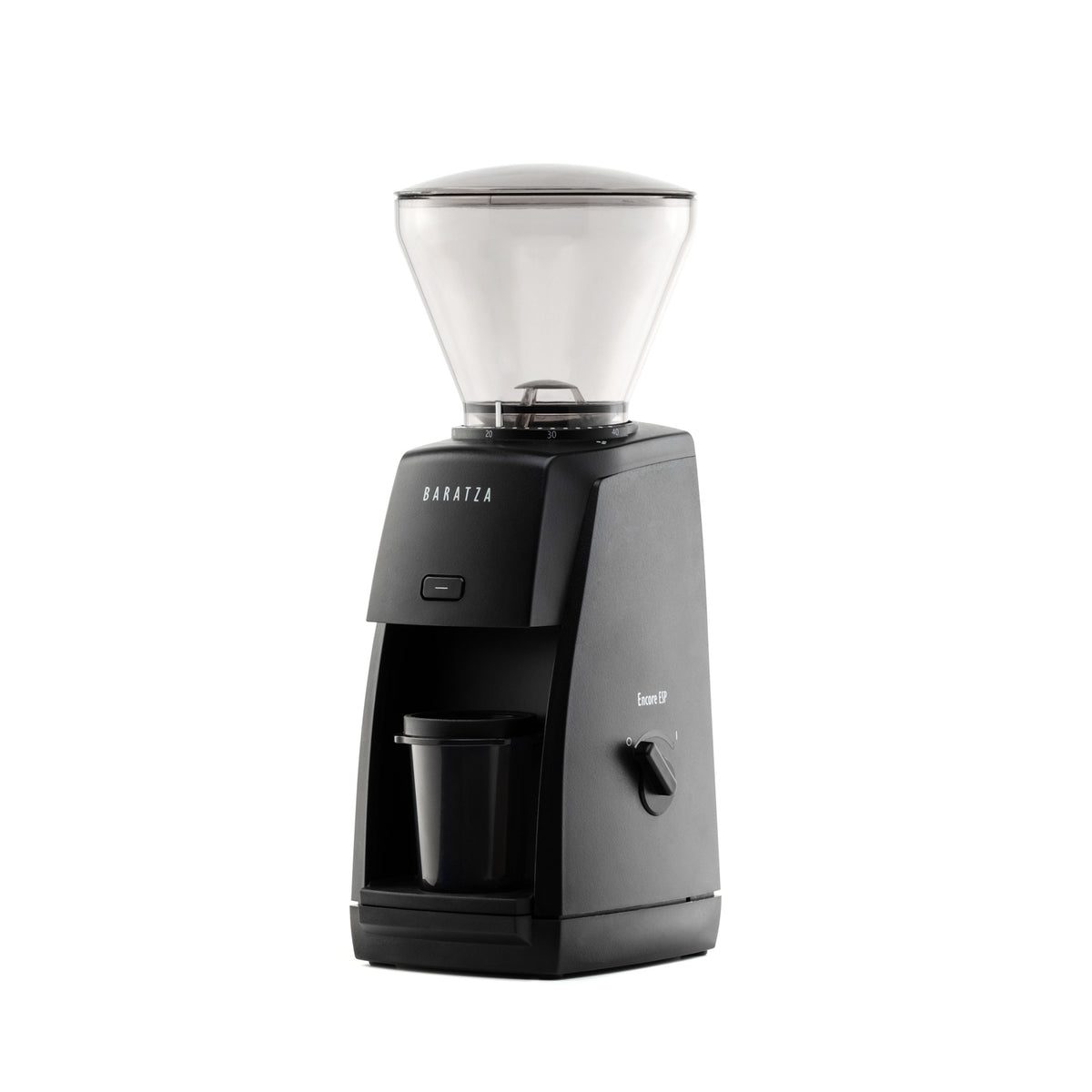
Baratza Encore ESP
- 40 mm M2 conical burrs in hardened alloy steel, made by Etzinger — shared with the Virtuoso+
- 40 stepped settings: #1–20 a dedicated espresso micro-range, #21–40 macro for brewed coffee
- 70 W gear-reduced motor, published 550 RPM and 1.3–2.2 g/sec output
- 300 g hopper and 120 g grounds bin, plus an anti-static dosing cup in the box
- 1-year US warranty backed by published parts diagrams and a full spares catalogue
Choose the Fellow Opus 2 if…
Espresso is a daily habit and you dial in by taste. A stepless dial lets you move in increments no stepped grinder can offer.
You single-dose and rotate beans. The load bin, auto-stop, ionizer and impeller path are built for exactly that rhythm.
Counter height is tight or the grinder moves around. At 267 mm tall and 2.27 kg, it is the smaller, lighter object by a wide margin.
Choose the Baratza Encore ESP if…
You want to write a setting down and return to it exactly. Forty clicks, twenty of them reserved for espresso, each one repeatable.
You brew batches. A 300 g hopper and no published duty-cycle cap suit a household drip routine in a way a 100 g single-dose bin cannot.
You keep appliances for a decade. Baratza’s parts catalogue and repair guides are the strongest ownership story in this price class.
As an Amazon Associate I earn from qualifying purchases at no extra cost to you.
Specifications: The Specs That Actually Matter
Every figure below is from the manufacturers’ own published data: Fellow’s Opus 2 product page and Safety and Maintenance manual, and Baratza’s Encore ESP product sheet (v2.2).
| Specification | Fellow Opus 2 Conical Burr Grinder | Baratza Encore ESP (ZCG495) |
|---|---|---|
| Model identity | Opus 2, models OP01AANA (standard) and OP02AANA (wooden upgrades) — the current Opus; the 2023 original is discontinued | Encore ESP, model ZCG495 (120 V US build) — not the standard Encore, not the Encore ESP Pro |
| Burr set | 48 mm conical, stainless steel | 40 mm conical M2, hardened alloy steel, made by Etzinger (Liechtenstein); the set is shared with the Virtuoso+ |
| Adjustment system | Stepless side dial — continuous, no clicks, with 48 marked reference settings | Stepped collar, 40 settings: #1–20 micro-steps of about 20 microns for espresso, #21–40 macro; factory calibrated per unit |
| Grind range | Espresso to cold brew; roughly 200–1200 microns (retailer specification sheets — Fellow publishes no micron range) | Espresso at #1–20, then pour-over, drip, French press and cold brew across #21–40 (Baratza documentation) |
| Motor | 300 W, 3.0 A (US version, per Fellow’s manual); burr speed not published by Fellow | 70 W DC gear-reduced motor |
| Published grind output | Fellow cites about 9 seconds to grind an espresso shot; no output rate published | 1.3 g/sec at setting #10 to 2.2 g/sec at setting #30; 550 RPM burr speed — fully published |
| Dosing format | Single-dose load bin, 100 g; grind guide printed on the lid; stops automatically when the bin empties | Hopper-fed, 300 g bean hopper; on/off knob and pulse button — dosing is by weight or by eye |
| Catch cups / grounds bin | Two magnetic catch cups: 100 g brewed coffee, 30 g espresso (fits 54 mm and 58 mm portafilters) | 120 g grounds bin, plus an anti-static dosing cup included for weighed espresso doses |
| Retention & static handling | Upgraded ionizer and an internal impeller that moves grounds through the path — designed for near-zero retention | Anti-static treatment centred on the dosing cup; no ionizer fitted |
| Duty cycle | Manual caps use: under 45 seconds per grind cycle, at least 60 seconds’ rest between cycles, no more than 3 minutes’ grinding in any 10 | No comparable cycle cap published in Baratza’s product sheet |
| Dimensions (L × W × H) | 206 × 130 × 267 mm (8.1 × 5.1 × 10.5 in) | 13 × 15 × 34 cm (5.1 × 5.9 × 13.4 in) |
| Weight | 2.27 kg / 5.0 lb (Fellow manual) | 3.1 kg |
| Materials | Standard model carries no premium-material trim in Fellow’s own comparison table; OP02AANA versions add a wood lid and weighted metal dial | ABS plastic body |
| Noise engineering | No decibel figure or noise feature published by Fellow | No decibel figure published in Baratza’s product sheet |
| Warranty | 2-year limited warranty, extendable on registration | 1-year US warranty; published parts diagrams, repair guides and a complete spare-parts catalogue |
The name note: three naming traps surround this comparison. First, “Opus” unqualified means the Opus 2 in current retail — the original Opus (40 mm C6-40 burrs, 41 stepped settings plus an inner micro-adjust ring, 140 W) was replaced in 2026. Second, the Encore ESP is not the standard Encore: different burrs, different adjustment, espresso-capable where the standard machine is not. Third, it is not the newer Encore ESP Pro (ZCG595) either — a separate, stepless model with a timer, compared elsewhere on this site. Nothing from those three machines appears in this guide.
The power note: some dealer tables print “140 W, 1.3 A” against the Opus 2 — figures belonging to Fellow’s earlier grinders, pasted into the wrong column. Fellow’s Opus 2 manual rates models OP01AANA/OP02AANA at 120 V, 300 W and 3.0 A, and the manual governs.
The dimensions note: the Opus 2 manual’s specification block prints its dimensions in a garbled order; Fellow dealer data agrees on 206 × 130 × 267 mm, used here. Listing mirrors also show an 8.25 lb “listed weight” — that is the packaged weight; the manual’s 2.27 kg is the machine.
The grind-range note: Fellow publishes no micron range for the Opus 2; the roughly 200–1200 micron span comes from retailer sheets, printed with that source attached. Baratza, by contrast, publishes its ESP output and burr speed outright.
The Differences That Actually Matter
1. The name — why “Opus” had to be settled first
Start here, because Fellow’s generational change invites an expensive mistake. The Opus 2 is not a trim level of the original Opus; it is a redesign — bigger burrs, a different adjustment system, a motor rated at more than twice the wattage.
The original still circulates through listings, wearing a nearly identical silhouette. Its tells are in the specification block: 40 mm burrs, “41+ settings”, an inner ring under the load bin.
The same discipline applies on the Baratza side. An Encore is not an Encore ESP, and an Encore ESP is not an Encore ESP Pro. Three machines, three burr-and-adjustment combinations, one surname. Match the full model name before anything else.
2. Adjustment — a dial with no clicks, against a dial that is all clicks
This is the deepest divide in the comparison, and it is philosophical as much as mechanical.
The Opus 2’s side dial turns continuously through the whole range. The 48 numbers around it are reference marks, not stops. For espresso, that is a real advantage: the setting your beans want is always reachable, never stranded halfway between two detents.
The Encore ESP answers with structure. Its 40 clicks divide into a dedicated espresso micro-range (#1–20, each step moving the burrs roughly 20 microns) and a macro range for brewed coffee. Every unit is factory calibrated, and every setting can be written down and repeated exactly.
Neither is a compromise version of the other. Choose the Opus 2 if you dial in by taste. Choose the ESP if your household runs on noted settings and repeatability — or if a stepless dial’s drift when knocked would drive you mad.
3. Burr sets — 48 mm of stainless against a named 40 mm specialist set
The Opus 2’s burrs are the larger hardware: 48 mm conical, stainless steel, a substantial step up from the original Opus’s 40 mm set. Fellow publishes the size and material — and stops there. The set carries no name, no named maker, no published geometry claims.
The Encore ESP’s burrs are smaller and better documented. The M2 set is hardened alloy steel, manufactured by Etzinger in Liechtenstein, and shared with Baratza’s own Virtuoso+ — a grinder positioned a class above.
Judgement: on diameter, the Fellow wins. On pedigree and documentation, the Baratza wins — and documentation is what lets you buy the identical replacement burr in five years. We score the row to the ESP, narrowly; the Opus 2’s size advantage shows up in the motor row instead, where Fellow’s speed claim lives.
4. Motors and published output — 300 W and a stopwatch claim, against the fully documented 70 W
The paper gap looks decisive: 300 W for the Opus 2 against 70 W for the Encore ESP. Read it properly and it narrows.
The ESP’s 70 W is a gear-reduced DC motor, and Baratza publishes what it does: 550 RPM at the burr, 1.3 g/sec at a filter setting rising to 2.2 g/sec at #30. Every number an owner might want is on the sheet.
Fellow publishes the Opus 2’s wattage (in the manual) and one performance claim: roughly nine seconds to grind an espresso shot — a dramatic improvement on the original Opus, which was notably slow at fine settings. It publishes no burr speed and no output rate.
One honest limit belongs here: the Opus 2’s manual caps its duty cycle — under 45 seconds per cycle, a minute’s rest between cycles, three minutes of grinding in any ten. The ESP’s sheet publishes no such cap. For one or two drinks it will never matter; for a brunch crowd, it might.
5. Dosing and workflow — weigh-in single doses, against a hopper that is always ready
The Opus 2 is a single-dose machine to its bones. Beans live in a canister, not on the grinder. You weigh a dose, drop it in the 100 g load bin, and the grinder stops itself when the bin empties.
Its two magnetic cups finish the workflow: a 100 g cup for brewed batches, and a 30 g espresso cup shaped to dose straight into 54 mm and 58 mm portafilters. It is the tidier espresso routine of the two.
The Encore ESP is hopper-fed and manual. The 300 g hopper stays loaded; the controls are an on/off knob and a pulse button. No timer, no auto-stop — dosing discipline is yours, by scale or by eye, softened by the included anti-static dosing cup.
Score the row to the Opus 2 for espresso workflow — and note the reversal for batch filter brewing, where the hopper wins outright.
6. Retention and static — an ionizer and an impeller, against a treated cup
Both grinders promise the single-doser’s bargain: what you weigh in is what lands in the cup, with nothing stale carried into tomorrow’s dose.
The Opus 2 keeps it with active hardware. An upgraded ionizer works on static at the chute, and an internal impeller physically moves grounds through the grind path — Fellow describes the result as near-zero retention. It is the newer, more thorough system on paper.
The Encore ESP’s answer is simpler: anti-static treatment centred on its dosing cup, and a conventional grind path. Baratza publishes no retention figure and fits no ionizer.
Call it on design intent, as published: the Opus 2’s system is the more engineered of the two. The ESP’s counter is not in this row — it is in the parts catalogue, where a worn component is a replaceable line item.
7. Size, weight and build — the tall one and the small one
These grinders occupy counters very differently. The Encore ESP stands 34 cm tall and weighs 3.1 kg. The Opus 2 is shorter (267 mm) and nearly a kilo lighter at 2.27 kg.
Materials are a wash with a footnote. Both standard models are plastic-bodied; Fellow’s own table reserves “premium materials” for the Opus 2’s wooden-upgrade variants, with identical grinding hardware underneath.
Net: the Opus 2 is easier to place, move and store. The ESP’s extra size is its 300 g hopper — the workflow difference wearing physical form.
Brew-Method Fit Guide
The fastest way to choose is to start from what you brew. This table is the whole comparison in one view.
| Your brewing | Fellow Opus 2 | Baratza Encore ESP | Our call |
|---|---|---|---|
| Espresso, unpressurised baskets | Excellent — stepless dial, espresso cup included | Excellent — dedicated #1–20 micro-range | Opus 2, for continuous fine-tuning |
| Espresso, pressurised baskets | Excellent | Excellent | Dead tie |
| Pour-over | Good — conical all-rounder covers it | Good — stepped settings repeat exactly | Dead tie; pick on workflow |
| Drip and batch brewing | Workable — 100 g loads, duty-cycle cap | Excellent — 300 g hopper, always ready | Baratza Encore ESP |
| AeroPress and moka pot | Excellent | Excellent | Dead tie |
| French press and cold brew | Excellent | Excellent | Dead tie |
| A mixed household — espresso and filter | Excellent — one grinder, full range | Excellent — one grinder, full range | Opus 2, unless you batch-brew daily |
| Single-dosing and rotating beans | Excellent — ionizer, impeller, auto-stop | Good — dosing cup helps; hopper design at heart | Fellow Opus 2 |
| Owners who repair their own gear | Manuals published; no user-serviceable base parts | Excellent — parts diagrams and spares catalogue | Baratza Encore ESP |
Read rows one and four together — they are the decision. Espresso-first points at the Opus 2; batch brewing at the Encore ESP.
Ready to check today’s price?
Both grinders sell through Amazon. Prices move, so check the live figure on the grinder that fits how you brew.
View on Amazon — Fellow Opus 2View on Amazon — Baratza Encore ESPThe 30-Second Decision
| If this sounds like you… | Buy this |
|---|---|
| “I dial in espresso by taste and hate landing between clicks.” | Fellow Opus 2 — stepless dial |
| “I write my settings down and expect to return to them exactly.” | Baratza Encore ESP — 40 calibrated clicks |
| “I single-dose, rotate beans weekly, and hate static mess.” | Fellow Opus 2 |
| “A full drip pot every morning is the household rhythm.” | Baratza Encore ESP (300 g hopper) |
| “My cabinets are low and my counter is small.” | Fellow Opus 2 (267 mm tall, 2.27 kg) |
| “I keep appliances for ten years and fix them myself.” | Baratza Encore ESP |
| “I want the longer warranty in writing.” | Fellow Opus 2 (2 years) |
What You Gain. What You Give Up.
Fellow Opus 2
You gain: continuous stepless adjustment with 48 marked references. A 300 W motor and a manufacturer-cited nine-second espresso grind. The more thorough retention and anti-static system, an espresso cup that doses into your portafilter, a two-year warranty, and the smaller, lighter footprint.
You give up: click-stop repeatability — returning to a setting means finding your mark. You give up hopper-fed batch convenience, accept a manual duty-cycle cap, and trade Baratza’s documented burr pedigree for a larger but unnamed burr set.
Baratza Encore ESP
You gain: a named M2 burr set by Etzinger, shared with a pricier sibling. A dedicated espresso micro-range with factory calibration on every unit. Fully published motor output data, a 300 g hopper for batch brewing, and the strongest spare-parts and self-repair ecosystem in the class.
You give up: continuous adjustment — the right setting can sit between clicks. You give up auto-stop, timed dosing and any ionizer, accept a one-year warranty, and carry the taller, heavier machine.
Pros and Cons
Fellow Opus 2 — Pros
- Stepless dial — espresso resolution no stepped grinder matches
- 48 mm conical burrs; full espresso-to-cold-brew range
- 300 W motor; Fellow cites about nine seconds per espresso shot
- Ionizer plus impeller path, designed for near-zero retention
- Two magnetic cups, including a 54/58 mm espresso cup
- 2-year warranty; smallest and lightest here
Cons
- Stepless dial demands note-taking to repeat a setting
- Manual duty-cycle cap: short cycles, rests between
- Single-dose only — no hopper-fed batch workflow
- Burr set unnamed; no published burr speed or output rate
- Standard finish skips the variants’ wood and metal trim
Baratza Encore ESP — Pros
- M2 burrs by Etzinger — named, documented, shared with Virtuoso+
- Dedicated #1–20 espresso micro-range, factory calibrated
- Published 550 RPM and 1.3–2.2 g/sec output — nothing hidden
- 300 g hopper suits daily batch filter brewing
- Parts diagrams, repair guides and full spares catalogue
- Quick-release burr design for cleaning and replacement
Cons
- Stepped adjustment — fine settings can fall between clicks
- No timer, no auto-stop; dosing is manual
- No ionizer; anti-static rests on the dosing cup
- 1-year US warranty — half the Fellow’s term
- The taller, heavier machine of the two
Check the Generation, the Model Code and the Box
Check it is the Opus 2, not the original Opus. The 2023 machine still circulates through listings, and it is a different grinder: 40 mm C6-40 burrs, 41 stepped settings plus an inner micro-adjust ring, a 140 W motor. The Opus 2 has 48 mm burrs and a smooth side dial with no inner ring. If a specification block says 40 mm or 41 settings, it is the old machine, whatever the headline claims.
Check which Opus 2 you are pricing. Model OP01AANA is the standard machine; OP02AANA adds wooden upgrades — a wood load-bin lid and a weighted metal dial, with a built-in dosing compartment on select models. The burrs, motor and dial mechanism are identical. Buy the premium version for how it feels, not for performance.
Check it is the Encore ESP, not its siblings. The standard Encore shares the silhouette but not the burrs or the espresso micro-range. The Encore ESP Pro (ZCG595) adds stepless adjustment and a timer at a higher price. The machine in this guide is the ZCG495: the box and the base should carry that model code.
Check the box contents. The Encore ESP should arrive with its anti-static dosing cup alongside the 120 g grounds bin; the Opus 2 with both magnetic catch cups and a cleaning brush. A box missing its cup is incomplete or mislabelled, whichever side it is on.
Check the voltage. Both grinders are built in regional versions, and the ratings in this guide are the US builds (Opus 2: 120 V, 300 W; Encore ESP: 120 V). Buy the version made for your sockets; the warranty follows the territory.
The Upgrade Path Test
A grinder earns its money in year two, not week one.
The Encore ESP’s upgrade story is about staying. Its burr set is shared with the Virtuoso+, its wear parts are catalogue items, and its failure modes are documented by the maker. Owners stepping up usually keep the ESP for filter — or never replace it at all.
The Opus 2’s story is about range. It starts as the everything machine and grows with an espresso habit: the stepless dial and portafilter cup that feel like extras today become the workflow when technique improves. Its ceiling is every all-rounder’s — want flat-burr clarity or café throughput one day, and you will be shopping again.
The difference, in one line: Baratza documents the next decade of ownership; Fellow documents the better first two years. Choose which horizon is yours.
When to Skip Both
Honesty cuts both ways — some coffee drinkers should buy neither of these.
Skip both if you want the grinder to dose by time or weight for you. Neither has a grind-by-weight system; the ESP has no timer at all, and the Opus 2’s automation stops at auto-stop.
Skip both for café, office or event duty. Both are household appliances, and the Opus 2’s manual caps its grind cycles outright.
Skip the Opus 2 if your mornings are a full drip pot — the hopper-fed ESP exists for that rhythm. Skip the Encore ESP if stepped adjustment already frustrates you; twenty fine clicks are better than most, but they are still clicks.
And skip both if brewed-coffee clarity is your single pursuit: a purpose-built flat-burr filter grinder is the honest recommendation there.
Warranty and Long-Term Support
The warranty terms differ plainly. The Opus 2 carries a two-year limited warranty, extendable by registering the product with Fellow. The Encore ESP carries a one-year US warranty.
Beyond the term, the philosophies diverge. Fellow publishes the manual and gear guides and documents cleaning and burr removal, but states plainly that the base contains no user-serviceable parts — repair is an authorised-service matter.
Baratza publishes parts diagrams, repair guides and a complete spares catalogue, with a quick-release burr designed to come out for cleaning and replacement. It is the more owner-serviceable machine by a wide margin.
One caution applies to both: warranties are honoured by territory and voltage version, so buy the build made for your country.
Final Verdict
The Fellow Opus 2 is the grinder we would put on most counters.
It wins by a single point because the things it does better are the things a grinder does every day. Its dial adjusts continuously, so espresso settings are found, not approximated. Its motor is the stronger unit with a manufacturer-cited nine-second shot. Its anti-static and retention systems are the newer engineering, and its warranty runs twice as long.
Buy the Opus 2 for espresso-first and mixed households, single-dosers, and anyone whose settings live in their head and hands rather than in a notebook.
View on Amazon — Fellow Opus 2
Buy the Encore ESP if your brewing is batch filter with espresso on the side, if noted-and-repeated settings are your style, or if you intend to own the machine for a decade and fix what wears.
It loses on polish and paper performance, not on substance. In a repair-it-yourself household, the order of this page would read the other way round.
View on Amazon — Baratza Encore ESP
Frequently Asked Questions
Is the “Opus” in this comparison the original Opus or the Opus 2?
The Opus 2 — stated openly, because the names invite confusion. Fellow released the Opus 2 in 2026 to replace the original 2023 Opus, and no longer sells the original new. The Opus 2 has 48 mm stainless conical burrs, a stepless side dial and a 300 W motor; the original had 40 mm C6-40 burrs, 41 stepped settings plus an inner micro-adjust ring, and 140 W. This guide compares the Opus 2 throughout.
What changed from the original Opus to the Opus 2?
Nearly everything mechanical. The burrs grew from 40 mm to 48 mm conical, the stepped dial plus inner micro-adjust ring became a single stepless side dial with 48 marked references, the motor rating rose from 140 W to 300 W, the ionizer was upgraded, an impeller grind path was added for lower retention, and the box gained a second, espresso-specific catch cup.
Which grinder is better for espresso?
Both are genuinely espresso-capable — that is the premise of the pairing. The Opus 2 dials in more finely, because its stepless dial never strands a setting between clicks, and Fellow cites about nine seconds per shot. The Encore ESP counters with a dedicated #1–20 micro-range in roughly 20-micron steps, factory calibrated per unit — coarser resolution, but exactly repeatable.
Can the Encore ESP handle a daily drip pot?
Yes — that is its home advantage. The 300 g hopper stays loaded, there is no published duty-cycle cap, and the macro range covers drip and French press. The Opus 2 grinds the same methods well but loads 100 g at a time under a manual duty-cycle limit, so it suits the pot-a-day household less comfortably.
Is the Encore ESP the same as the Encore ESP Pro?
No. The ESP Pro (ZCG595) is a newer, separate model with stepless adjustment and a timer. The grinder in this guide is the Encore ESP (ZCG495): stepped dual-range adjustment and no timer. The standard Encore is a third machine again, with different burrs and no espresso micro-range.
Which grinder retains fewer stale grounds?
On published design, the Opus 2. Its internal impeller moves grounds through the grind path and Fellow describes the result as near-zero retention, with an ionizer handling static. The Encore ESP relies on its anti-static dosing cup and publishes no retention figure. Neither maker publishes a measured number, so this guide scores the designs as documented, not as tested.
How do the warranties and repairability compare?
The Opus 2 carries a two-year limited warranty, extendable on registration — double the Encore ESP’s one-year US term. Repairability runs the other way: Baratza publishes parts diagrams, repair guides and a full spares catalogue for the ESP, while Fellow states the Opus 2’s base has no user-serviceable parts. Buy the Fellow for the longer cover, the Baratza for the longer life.
Sources & Verification
Fellow Opus 2 official product page (fellowproducts.com) — 48 mm stainless steel conical burrs, stepless dial, 48 marked settings, ionizer, impeller retention design, two catch cups, Opus 1 comparison, 2-year warranty • Fellow Opus 2 Safety and Maintenance manual (789-00291) — OP01AANA/OP02AANA specifications: 120 V, 300 W, 3.0 A, 2.27 kg, duty-cycle limits, jam guidance, automatic stop, 2-year limited warranty • Baratza Encore ESP official product sheet v2.2 — M2 burrs by Etzinger, dual-range adjustment, factory calibration, dosing cup, 1.3–2.2 g/sec, 550 RPM, 300 g hopper, 120 g bin, 3.1 kg, 70 W, 1-year warranty • Baratza Encore ESP data via authorised dealers (Whole Latte Love) • Amazon listing data for both models, used for ASIN verification only. Specifications verified November 2026.

James Wilson
James has been testing coffee gear and small kitchen appliances for over a decade and writes Honestly Compared's coffee and grinder guides. His rule for every comparison: the verdict has to survive the spec sheet, not the marketing page.