
KINGrinder K6 vs 1Zpresso J: Which Should You Buy?
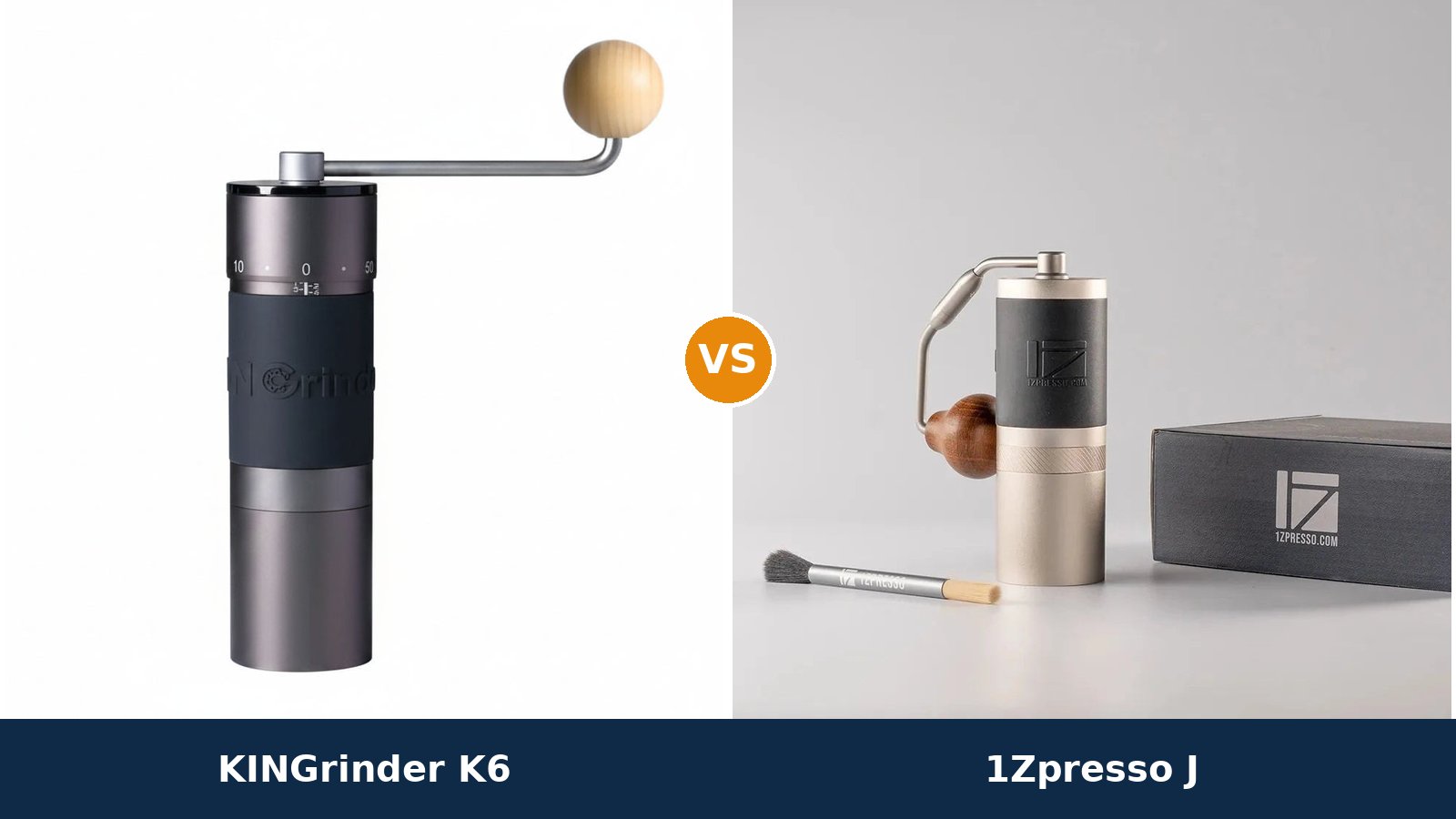
Read the headline specifications of these two grinders side by side and you could be forgiven for thinking someone printed the same sheet twice.
Both carry a 48 mm conical burr. Both hold 30–35 g of coffee in a catch cup that unscrews. Both are all-metal hand grinders with wooden knobs, aimed first at filter brewing.
So why does one of them win this comparison by a clear margin? Because the sheet diverges exactly where daily use lives: how you change the grind setting, how finely each click moves the burr, and what else the shaft is allowed to do. The K6 adjusts from a numbered collar on the outside of the body. The J hides its dial under the catch cup — and charges you a small ceremony for every adjustment.
One clarification before the details, because the J's name causes real buying mistakes. The J here is 1Zpresso's current J — internal dial, 25-micron clicks, the entry model in its present range. It is not the discontinued JX, and it is emphatically not the J-Ultra, the maker's espresso flagship.
Key Takeaways
- The hardware sheet is a near-tie. Identical 48 mm burr diameter, identical 30–35 g threaded catch cups, both filter-first in their makers' positioning.
- The K6 wins on adjustment, decisively. An external collar with 60 clicks per rotation at 16.6 microns, against an internal dial with 30 clicks at 25 microns — roughly double the settings at two-thirds the step.
- The K6 alone offers a powered escape hatch. Its 6.35 mm hex shaft is documented by KINGrinder for use with a cordless drill. It is also the lighter, slimmer grinder — 630 g and 55 mm against 705 g and 57 mm.
- The J wins on upkeep and documentation. Fully tool-free cleaning with factory-fixed burrs, and a published burr-life estimate its rival does not match.
- It finishes 8.4 to 7.8. The K6 takes the verdict on mechanism; the J remains a sound filter grinder let down by where its dial lives.
Quick Verdict
Buy the KINGrinder K6 if you want the better hand grinder of these two, full stop. It matches the J on burr size and capacity, then beats it at everything involving the adjustment system.
The collar sits outside the body, turns 60 clicks per rotation, and moves the burr 16.6 microns per click — about 240 settings in total. Add a dual-bearing shaft, a body 75 g lighter and 2 mm slimmer, and a hex shaft end that KINGrinder itself documents for drill drive. As a filter grinder that can also dial an espresso shot, it is the more capable machine.
Buy the 1Zpresso J if 1Zpresso's ownership record is what you value. It is a well-made filter grinder with a simple cleaning routine.
Its burrs are factory-calibrated and fixed, the whole grinder strips without tools, and 1Zpresso publishes a burr-life estimate of roughly 100–200 kg — paperwork KINGrinder does not offer. If you set a filter grind once and leave it for weeks, the J's buried dial stops being a daily tax. Just know you are accepting half the settings and coarser clicks for the privilege.
The Scorecard
Scores below are derived directly from the manufacturer specifications compared in this guide — burr diameter and material, adjustment location, clicks per rotation and microns per click, stated capacity, weight, body diameter and cleaning design. Treat them as a reading aid, not as lab results.
| Category | KINGrinder K6 | 1Zpresso J | ||
|---|---|---|---|---|
| Burr set | 9 / 10 | 8.5 / 10 | ||
| Adjustment system & precision | 9 / 10 | 6.5 / 10 | ||
| Espresso dialing | 8 / 10 | 6.5 / 10 | ||
| Filter brewing fit | 9 / 10 | 9 / 10 | ||
| Capacity & dosing | 8.5 / 10 | 8.5 / 10 | ||
| Portability & travel | 7.5 / 10 | 7.5 / 10 | ||
| Cleaning & maintenance | 7.5 / 10 | 8 / 10 | ||
| Overall | 8.4 / 10 | 7.8 / 10 | ||
Read the shape of the table, not just the totals. Two categories are dead level — filter fit and capacity — because the core hardware genuinely is. The K6's margin is built in the adjustment rows and the burr row's published detail, and it shows up every day you use the grinder.
At a Glance: Who Each Grinder Fits
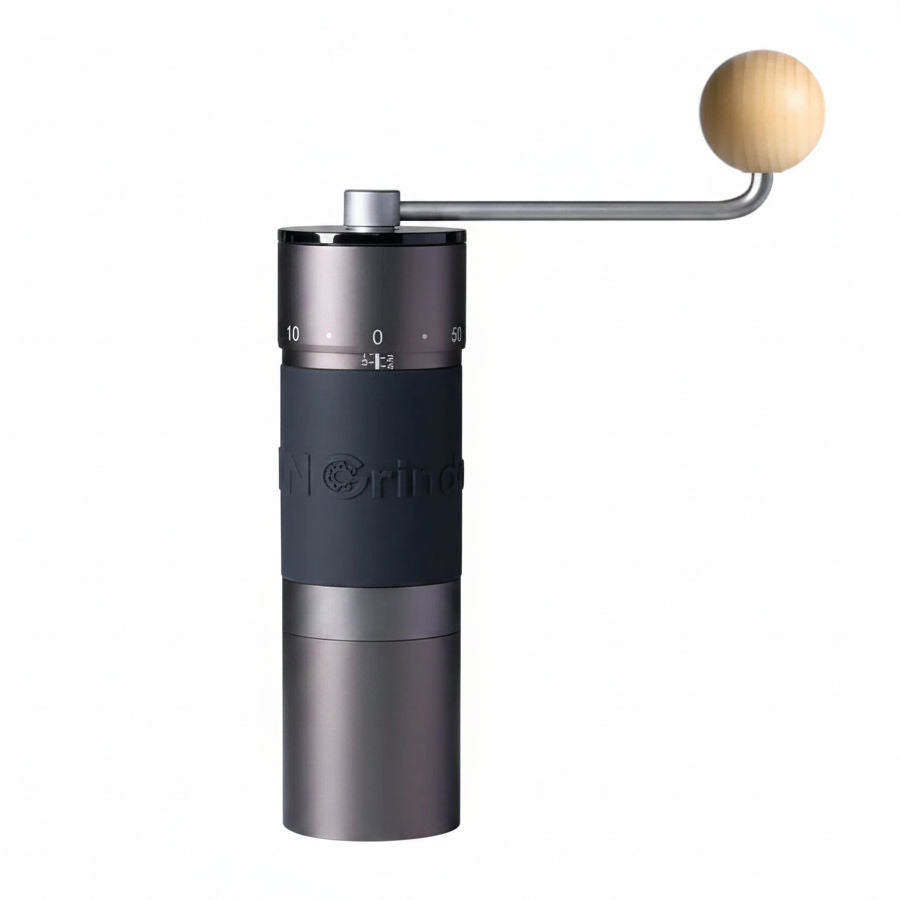
KINGrinder K6
- 48 mm conical burr, SUS420 stainless steel, heptagonal, uncoated
- External adjustment collar: 60 clicks per rotation, 16.6 microns per click
- Threaded catch cup, 30–35 g capacity
- 630 g; 55 mm body diameter; 6.35 mm hex shaft, drill-compatible
- Positioned by KINGrinder for pour-over and espresso
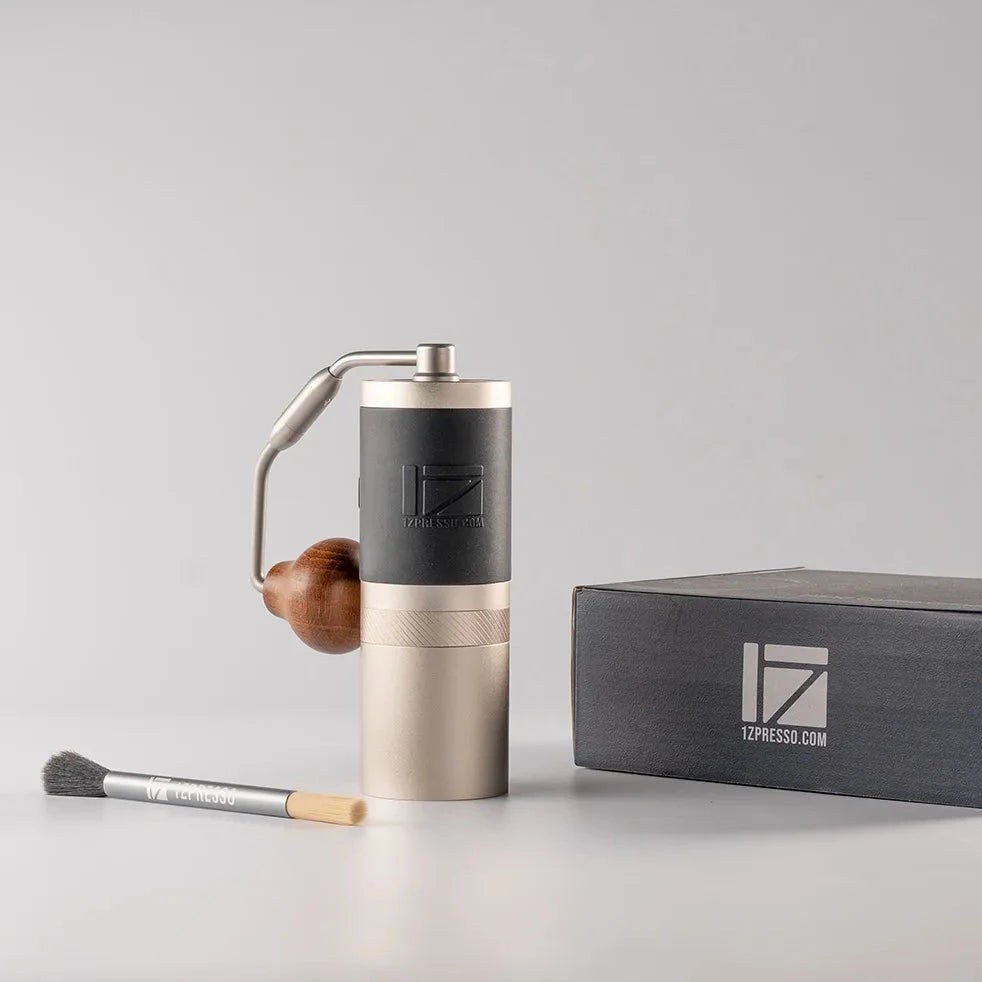
1Zpresso J
- 48 mm conical burr, stainless steel
- Internal numerical adjustment: 30 clicks per rotation, 25 microns per click
- Threaded catch cup, 30–35 g capacity
- 705 g; 57 mm body diameter; foldable crank handle
- Positioned by 1Zpresso primarily for pour-over
Choose the KINGrinder K6 if…
You change grind settings with any regularity. A collar on the outside of the body, in 16.6-micron steps, is a different quality of life from unscrewing a cup to reach a dial.
Your brewing is mostly filter but espresso shows up — the K6 covers both jobs with the finer click of the two. Or your kitchen occasionally grinds for a table of guests, and the documented drill drive appeals.
Choose the 1Zpresso J if…
You brew filter coffee at a settled setting and touch the dial rarely. The J's adjustment penalty is per-change, and a set-and-forget routine barely pays it.
You value ownership paperwork: a maker-published burr-life estimate and burrs that never need realigning after a clean.
As an Amazon Associate I earn from qualifying purchases at no extra cost to you.
Specifications: The Specs That Actually Matter
Every figure below is taken from the two makers' official product data — manuals, product pages and manufacturer listing data.
| Specification | KINGrinder K6 | 1Zpresso J |
|---|---|---|
| Burrs | 48 mm conical, SUS420 stainless steel, heptagonal, uncoated; hardness HRC57 | 48 mm conical, stainless steel |
| Adjustment system | External adjustment collar/nut at the top of the body — cup stays on | Internal numerical dial, beneath the catch cup |
| Clicks per rotation | 60 | 30 |
| Step size | 16.6 microns per click (maker's manual figure; listing copy rounds to 16) | 25 microns per click |
| Total settings | ~240 (60 across 4 rotations) | 120 (30 across 4 rotations) |
| Motor | None — hand crank/manual | None — hand crank/manual |
| Drive options | Hand crank, or a cordless drill on the 6.35 mm hex shaft (maker-documented) | Hand crank only |
| Catch cup | Threaded (screw-on) | Threaded (screw-on) |
| Capacity | 30–35 g (manual figure; see note below) | 30–35 g |
| Weight | 630 g (manual figure; see note below) | 705 g |
| Dimensions | 175 mm tall; body Ø 55 mm; handle 160 mm | 170 mm tall with handle; body Ø 57 mm |
| Materials | Anodised aluminium alloy body and crank, silicone grip sleeve, polycarbonate lid | 304 stainless steel, aluminium alloy, wooden handle knob |
| Handle | Straight handle, lifts off the hex shaft for packing | Foldable crank handle |
| Finishes | Iron Grey, Silver | Silver |
| In the box | Grinder, straight handle, lid, cleaning brush | Grinder with crank handle |
| Cleaning & calibration | Tool-free routine disassembly; deep strip of the burr set needs a circlip tool | Tool-free disassembly; burr factory-calibrated and fixed |
| Maker positioning | Pour-over and espresso (pour-over listed first in the maker's chart) | Primarily pour-over; can reach espresso fineness |
| Maker's starting settings | Extra fine 15–25 clicks; fine 25–60; medium 90–120; coarse 150+ | Settings counted in rotations and clicks from zero |
| Estimated burr life | Not published by the maker | ~100–200 kg of beans (maker's estimate) |
| Retention / static data | Not published by the maker | Not published by the maker |
| Warranty | 1-year warranty (maker's listing terms) | 1-year limited warranty |
The coating note — still worth reading before you buy a K6. K6 listings across the internet advertise a titanium-coated burr. KINGrinder's own documentation assigns that coating to its K4 and describes the K6's burr as uncoated SUS420 stainless at HRC57.
Which J is this? The current J: internal dial, threaded cup, 25-micron clicks, sold by 1Zpresso itself. The discontinued JX and JX-Pro are earlier generations, and the J-Ultra is a separate flagship — coated burr, external ring, 8-micron clicks.
Capacity note: the K6's 30–35 g comes from KINGrinder's manuals and its listing's specification block; the listing's headline says 25–35 g. We spec the manual figure.
Weight and height notes: the K6's 630 g is its manual specification-table figure; a distributor lists approximately 650 g, and the combined range manual prints an 18.5 cm shared height where the K6-specific manual says 175 mm. The J's 705 g is grinder weight from the maker's model data — the roughly 1.8 lb on its retail listing is packaged weight.
The Differences That Actually Matter
1. Adjustment — a collar on the outside against a dial on the inside
Everything else in this comparison orbits this one design decision.
Changing a setting is a twist. The printed scale reads 10, 0, 50 around the collar, the cup never moves, and the dose already ground stays where it belongs. Going from a V60 setting to an AeroPress setting takes seconds, one-handed.
The J asks more of you. Its numerical dial lives underneath the catch cup, so every adjustment runs the same sequence: unscrew the cup, turn the dial, screw the cup back on. It is not difficult. It is friction, repeated at exactly the moment you are trying to change something.
Friction compounds. Owners of internal-dial grinders learn to leave the setting alone; owners of external-collar grinders experiment. That behavioural difference is worth more than most spec-sheet lines — and it is why the adjustment category is not close.
2. Step size and settings count — 240 fine steps against 120 coarse ones
The two systems also divide their travel differently. The K6 turns 60 clicks per rotation and moves the burr 16.6 microns with each one, multiplying out to roughly 240 settings.
The J turns 30 clicks per rotation at 25 microns apiece — 120 settings in total. Half the stops, each half again as large: one J click covers the ground of one and a half K6 clicks.
At coarse filter settings the difference is academic, because the target zone for pour-over is wide and forgiving. It stops being academic the moment you work toward the fine end, which is the next section.
3. Espresso dialing — both arrive, one can steer
Neither grinder is an espresso specialist, and both makers are honest about the pecking order — 1Zpresso's own espresso flagship works at 8 microns per click. The question here is narrower: which can actually run a home espresso setup?
KINGrinder puts the K6's extra-fine band at 15–25 clicks from zero, with espresso around 30 clicks in its range manual. The range is genuinely there, and at 16.6 microns a one-click correction is a nudge a shot can absorb.
The J reaches espresso fineness too — 1Zpresso's data says so plainly. The problem is the steering. A 25-micron click is a coarse instrument where the gap between a choked puck and a gusher is a few microns, so dialing in becomes a sequence of overshoots. Add the cup-off, dial, cup-on routine to every correction and espresso starts to feel like homework.
An occasional espresso, both manage. A daily one, take the K6 — and if espresso becomes the main event, skip to the end of this guide.
4. Burrs — same diameter, different paperwork
For once, the headline is a tie. Both burrs measure 48 mm, both are conical, both are stainless steel. Anyone selling you this matchup as a burr-size fight is selling you nothing.
What separates them is how much the makers will put in writing. KINGrinder specifies the K6's burr fully: SUS420 stainless steel, a stated seven-sided heptagonal geometry, hardness HRC57 — and, despite an internet full of listings claiming otherwise, no coating; the titanium in its range belongs to the K4.
1Zpresso publishes the J's burr as 48 mm stainless steel and stops there — no hardness figure, no geometry claim of the kind it makes for its heptagonal models. We do not fill that silence with guesses. On published specifications the K6's burr is the better-documented component, which is what its scorecard edge reflects: documentation, not invented grind data. Neither maker publishes particle measurements, so none appear here.
5. The shaft — dual bearings and a drill socket
Under the handle, the K6 is built like a tool. Its 10 mm stainless shaft runs on dual bearings inside an integrated aluminium body, per its distributor's manufacturer data — the hardware behind a crank that stays wobble-free under load.
Then there is the end of that shaft: a 6.35 mm — quarter-inch — hex. KINGrinder's manual instructs you, in writing, to chuck it into a cordless drill: rated torque of 15 Nm or more in the manual, 15–25 Nm in the maker's listing data, grind set more than 15 clicks from zero so the burrs clear.
This is the K6's answer to the one honest objection to hand grinding — volume. Four guests no longer means four arm workouts. The J has no equivalent: its published drive options begin and end with the folding crank.
6. Size, weight and the travel question
The K6 is the smaller object on every axis that matters here: 630 g against 705 g, a 55 mm body against 57 mm. Seventy-five grams is little on a counter; across a long espresso dose or in a smaller hand, it is noticeable.
The handles take opposite approaches to packing. The J's crank folds flat against the body — tidy, attached, nothing to lose. The K6's straight handle lifts off its hex shaft, leaving a cylinder and a loose handle to stow.
Neither grinder ships with a carrying case, so neither earns a travel crown. Call the row what the scorecard calls it: level, with the K6 ahead on bulk and the J ahead on self-containment.
7. Cleaning and the paper trail
Here the J claws ground back. It comes apart entirely without tools, and its burr is factory-calibrated and fixed to the shaft — there is no alignment to disturb after a deep clean. Brush it out, reassemble, grind.
The K6's routine clean is also tool-free, and its manuals are thorough. But a full strip of its burr set means removing a circlip with a suitable tool, and KINGrinder advises against taking the burr set apart unless necessary. Depth is available; it is not casual.
The documentation gap runs the same way. 1Zpresso publishes an estimated burr life for the J — roughly 100–200 kg of beans — while KINGrinder publishes no equivalent figure for the K6. That is a paperwork difference, not a durability verdict. But a buyer planning years of use may prefer the maker who committed a number to print.
Brew-Method Fit Guide
Start from the cup, not the catalogue. This table compresses the comparison into the drinks you actually make.
| What you brew | KINGrinder K6 | 1Zpresso J | Our call |
|---|---|---|---|
| Pour-over first: V60, Kalita, Chemex | Excellent — maker's pour-over-first pick, published click chart | Excellent — 1Zpresso's pour-over model, big burr and cup | Tie — decide on the other rows |
| Espresso at home, daily | Good — 16.6-micron clicks on an external collar | Workable — reaches the fineness, 25-micron steps | K6, on dialing resolution |
| Espresso weekdays, filter weekends | Excellent — settings change from outside in seconds | Workable — every change means cup off, dial, cup on | K6 |
| AeroPress and moka pot | Excellent — mid-range is home territory | Excellent | Tie — buy on the other rows |
| Two-cup batches, 30 g and up | Excellent — 30–35 g in one load | Excellent — 30–35 g in one load | Tie — identical cups |
| Travel, camping, office drawer | Good — lightest here, handle lifts off; no case | Good — handle folds flat; no case, 75 g more | K6, on weight and bulk |
| Grinding for guests, occasionally | Excellent — maker-documented drill drive on the hex shaft | Workable — every dose by hand | K6 |
| Smaller hands, long grinding sessions | Excellent — 55 mm body, lightest here | Good — 57 mm body to grip | K6 |
The 30-Second Decision
| If this sounds like you… | Buy this |
|---|---|
| “I tweak my grind setting all the time and want it on the outside.” | KINGrinder K6 |
| “Espresso is creeping into my routine and I need clicks that can steer it.” | KINGrinder K6 |
| “My filter grind stays put for weeks — I barely touch the dial.” | 1Zpresso J |
| “I grind for guests and love the idea of a drill doing the work.” | KINGrinder K6 |
| “I want the lightest, slimmest grinder of the two for a drawer or a bag.” | KINGrinder K6 |
| “Published burr life and tool-free everything matter more to me than dials.” | 1Zpresso J |
Ready to check today’s price?
Each maker sells its own grinder on Amazon. Finishes and handle variants are separate listings — below are the K6 with the straight handle in Iron Grey and the J in Silver.
View on Amazon — KINGrinder K6View on Amazon — 1Zpresso JWhat You Gain. What You Give Up.
KINGrinder K6
You gain: the adjustment system this comparison is really about — external, numbered, 60 clicks per rotation at 16.6 microns — on hardware that ties the J for burr diameter and capacity while weighing 75 g less. A dual-bearing shaft, a second finish, and a maker-documented drill drive no rival here offers.
You give up: the J's ownership polish. No published burr-life estimate, a deep clean that needs a circlip tool, a handle that packs as a loose part, and warranty terms worth a read before you buy.
1Zpresso J
You gain: 1Zpresso's ownership record in this pairing: fully tool-free cleaning with a factory-fixed burr, a published burr-life estimate, and a foldable handle that never gets separated from the grinder.
You give up: adjustment convenience and resolution — a dial buried under a threaded cup, moving in 25-micron steps, with half the K6's settings. Published burr detail: no hardness or geometry figures. And 75 g.
Pros and Cons
KINGrinder K6 — Pros
- External collar: 60 clicks/rotation, 16.6 microns per click, ~240 settings
- 48 mm heptagonal burr in SUS420 stainless, HRC57, honestly uncoated
- 30–35 g capacity handles two-cup brews in one load
- Drill-compatible 6.35 mm hex shaft, documented by the maker
- Dual-bearing shaft in an integrated aluminium body
- Lightest and slimmest here: 630 g, 55 mm body
Cons
- Deep cleaning needs a circlip tool
- No published burr-life estimate
- Handle lifts off — a loose part when packing
- Listing ecosystem is messy — coating claims vary by seller
- Warranty is region-specific; parts shipping may fall to you
1Zpresso J — Pros
- 48 mm stainless burr — the joint-largest class here
- 30–35 g capacity handles two-cup brews in one load
- 1Zpresso's own pour-over pick in this price class
- Tool-free disassembly; burr factory-calibrated and fixed
- Maker publishes a burr-life estimate (~100–200 kg)
- Foldable handle; sold by 1Zpresso itself
Cons
- Adjustment hides under a threaded catch cup
- 25-micron clicks, 120 settings — half the K6's resolution
- Heaviest and widest of the two at 705 g / 57 mm
- No drill or powered option — hand cranking only
- No carrying case included
- Name collides with JX, J-Max and J-Ultra listings
Check the Coating Claim, the Handle and the Name
Check the coating claim on any K6 listing. If the page leads with a titanium-coated burr, it has copied the K4's specification. KINGrinder's manuals give the K6 an uncoated SUS420 burr at HRC57 — the grinder is the same either way.
Confirm the K6 variant on the listing page. The current grinder is the straight-handle model in Iron Grey — the listing this guide links — with a Silver finish sold as a separate listing. Older K6 stock circulates under an earlier listing generation; check the handle style in the photos matches the title.
Check which “J” the listing is actually selling. Today's J adjusts from inside and closes with a screw-on cup. Photos showing an external ring, a magnetic cup or a coated burr mean the listing is a J-Ultra wearing a shorter name — a different grinder at a different price. The reverse trap also exists: discontinued JX and JX-Pro units still circulate; they are close relatives, but buy one knowingly, as an older model.
Find zero the way each maker defines it. On the K6, zero is burrs just touching — collar turned clockwise until it tightens — and every published setting counts clicks from there. The J counts rotations and clicks from its own zero. Do it once, gently, on arrival, and write your working settings down.
Check what is in the box. A complete K6 kit is the grinder, straight handle, lid and cleaning brush. For the J, confirm the crank handle is present in the listing photos — it is the part that occasionally goes missing from marketplace returns.
The Upgrade Path Test
A hand grinder should be judged by its third year of service, not its first week.
Year one, both grinders feel like the correct purchase: fresh grounds, no motor, no counter space surrendered.
Year two is where they separate. On the K6, the collar invites experiments — new beans, new methods, small corrections — because each costs a twist. On the J, the buried dial quietly trains you to brew the same coffee the same way, which is either a discipline or a rut.
Know the ceiling of both. If espresso becomes the whole hobby, the answer in this class is 1Zpresso's J-Ultra at 8 microns per click. And if your future is grinding for a household every morning, that future is electric; the K6's drill shaft remains the only bridge either maker builds toward it.
When to Skip Both
Honesty cuts both ways: a slice of buyers is better served by neither grinder on this page.
Pass on both if espresso is your main drink. The specialist in this class is 1Zpresso's J-Ultra — external ring, 8 microns per click across 100 clicks per rotation, coated 48 mm burr, magnetic cup. It costs more than either grinder on this page, and for a daily espresso drinker it is the correct spend. Buying the K6 as a “close enough” espresso grinder is how people end up owning two grinders within a year.
Pass on both, too, if you routinely grind more than 35 g at once. Neither cup stretches past a two-cup brew; batch brewers need a bigger hopper class entirely.
And pass on both if hand cranking itself is the objection. The K6's drill fitting softens that for occasional volume, but a drill on the counter every morning is an electric grinder with extra steps.
And give the J a miss specifically if your brewing is already half espresso. Its coarse steps and buried dial will not stop you making espresso — they will make every correction a chore, which is most of the hobby.
Warranty and Long-Term Support
On paper this section is close: both grinders carry a one-year warranty — KINGrinder's as stated in its own listing terms, 1Zpresso's as a limited warranty. Read the fine print, though: KINGrinder notes that shipping costs for replacement parts may fall to the customer.
Channel decides how painless a claim is. KINGrinder's distributors state plainly that its warranty is region-specific — buy through an authorised channel in your region. 1Zpresso sells through its own storefront and a wide authorised-retailer network, and its burrs are fixed and factory-calibrated, which removes the most common hand-grinder support issue — user-introduced misalignment — entirely.
Documentation is part of support, too. KINGrinder publishes thorough manuals, drill guidance included, but no burr-life figure.
1Zpresso publishes manuals plus the 100–200 kg burr-life estimate. Neither maker publishes retention figures for these models.One habit serves both: never wash the burrs with water — brush and blower only, as both manuals instruct.
Final Verdict
The KINGrinder K6 is the hand grinder we would buy of these two.
The matchup looked like a tie because the headline hardware is a tie — same burr diameter, same cup, same threaded closure. It is decided one layer down, where the K6 is better engineered for daily use: an external collar at 16.6 microns per click, double the J's settings, a dual-bearing shaft, 75 g less weight, and a drill option in reserve. Its 8.4 is built entirely from published specifications, the same way the J's 7.8 is.
The J is not a bad grinder. It is a good filter grinder with the cleanest maintenance routine here and the better paperwork — and for a set-and-forget brewer, those virtues are real. It loses because its adjustment system belongs to an earlier generation of hand-grinder design, and adjustment is the thing you touch most.
Buy the K6 if you brew across methods, change settings often, entertain the espresso idea, or ever grind for guests. Buy it with your eyes open about the burr: the uncoated SUS420 is a good burr — it was never titanium, and it does not need to be.
View on Amazon — KINGrinder K6
Buy the J if filter coffee at a settled setting is your whole routine, and you value tool-free cleaning and a published burr-life estimate over dial placement.
Frequently Asked Questions
Does the KINGrinder K6 have a titanium-coated burr?
It does not — whatever the listing claims. In KINGrinder's own manual specification table, the titanium coating sits on the K4's row; the K6's burr is SUS420 stainless steel, heptagonal, HRC57, and its manual calls it uncoated.
Which is better for espresso, the K6 or the J?
The K6, of these two. Its clicks move the burr 16.6 microns against the J's 25, and its collar adjusts from outside without removing the cup — both advantages land where espresso dialing is unforgiving. The J genuinely reaches espresso fineness, but every correction is a coarse step through a cup-off, dial, cup-on routine. The class ceiling is the J-Ultra at 8 microns per click.
Which is better for pour-over?
A genuine tie. Both makers position these grinders pour-over first, both carry 48 mm burrs, and both cups hold 30–35 g for two-cup brews. Choose on adjustment style and ownership, not on filter performance claims neither maker quantifies.
Can the KINGrinder K6 really be driven by a drill?
Yes — it is a feature KINGrinder documents itself, not a hack. The shaft ends in a 6.35 mm (quarter-inch) hex; the manual calls for a drill rated at 15 Nm of torque or more (listing data says 15–25 Nm) and warns to set the grind more than 15 clicks from zero first, so the burrs have clearance. Work to the manual's numbers. The J has no equivalent option.
Is the 1Zpresso J the same grinder as the J-Ultra?
No — the shared letter is where the resemblance ends. Today's J is the entry model: an internal dial at 25 microns per click, a threaded catch cup, an uncoated 48 mm burr, pour-over positioning. The J-Ultra is the espresso flagship, with an external ring at 8 microns per click across 100 clicks per rotation, a titanium-coated 48 mm burr and a magnetic 35–40 g cup. A “J” listing whose photos show an external ring is selling the J-Ultra.
Which grinder is better for travel?
Neither is a travel specialist — no case ships with either. The K6 is 75 g lighter (630 g against 705 g) and slimmer (55 mm against 57 mm), and its handle lifts off the shaft for packing. The J's handle folds flat and can never be left behind. Between these two, the K6 packs less bulk.
How long do the burrs last on these grinders?
Only one maker says. 1Zpresso estimates roughly 100–200 kg of coffee for the J's burrs — many years at a home pace. For the K6 there is no published burr-life estimate to quote, and we will not invent one; its burr is SUS420 stainless at a stated HRC57. The J's burrs are factory-calibrated and fixed, so neither grinder asks you to realign anything after cleaning — the K6 simply advises against full burr-set disassembly unless necessary.
Sources & Verification
KINGrinder K6 instruction manual (maker's document, filed under the K6's Amazon listing) — 48 mm stainless burr, uncoated; dimensions 175 mm height, 55 mm diameter, 160 mm handle; box contents • KINGrinder combined K2/K4/K6 manual — specification table: SUS420 heptagonal burr, HRC57, titanium coating assigned to the K4 only; 60 clicks per round at 0.0166 mm; 30–35 g capacity; 630 g; drill guidance (6.35 mm hex chuck, 15 Nm or more, set beyond 15 clicks) • KINGrinder exterior-adjustment quick manual — settings: extra fine 15–25 clicks, fine 25–60, medium 90–120, coarse 150+ • KINGrinder manufacturer listing data (sold by KINGrinder) — 1-year warranty terms, Iron Grey straight-handle identity • Cape Coffee Beans (official KINGrinder distributor) — cross-check: 240 settings, threaded catch cup, dual-bearing shaft, tool-free routine disassembly • 1Zpresso official model comparison chart and J instruction manual — burr size, internal adjustment at 25 microns per click, 120 settings, capacity, burr-life estimate • Rogue Wave Coffee (authorised 1Zpresso distributor) — J model data and warranty terms • Honest Coffee Guide model chart, compiled from manufacturer data — J totals (705 g, threaded cup), cross-check • Amazon listing data for both models, used for ASIN verification only. Specifications verified November 2026.

James Wilson
James has been testing coffee gear and small kitchen appliances for over a decade and writes Honestly Compared's coffee and grinder guides. His rule for every comparison: the verdict has to survive the spec sheet, not the marketing page.