
KINGrinder K6 vs 1Zpresso Q: Which Should You Buy?
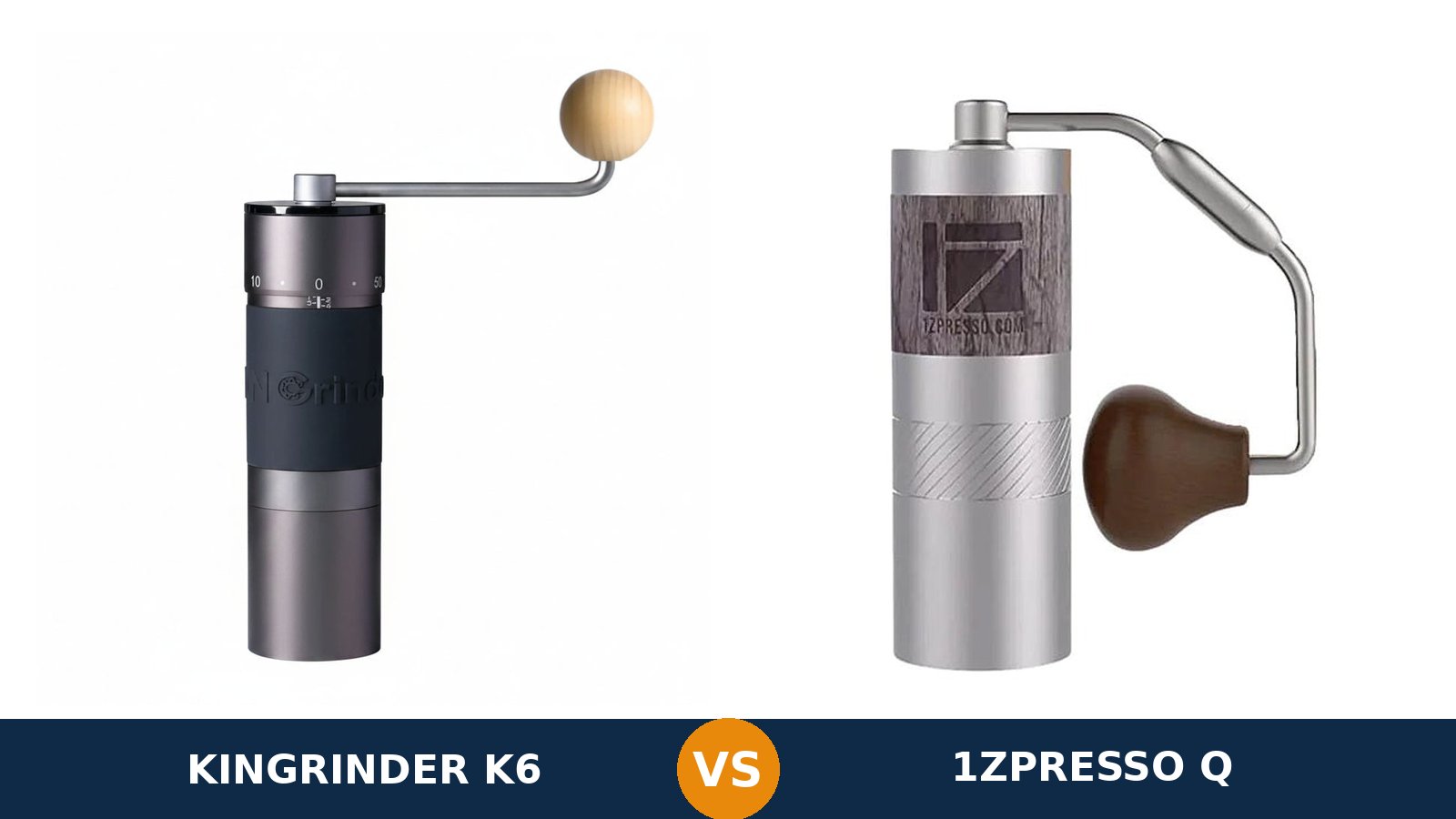
One grinder was built to do everything. The other was built to disappear into a bag. That is the whole tension in this matchup, and it shows up in almost every row of the spec sheet.
The KINGrinder K6 is the workhorse pattern: a 48 mm burr, an external collar you can turn without opening anything, and a cup that takes a two-cup dose in one load. A home-counter machine that happens to be portable.
The 1Zpresso Q is the minimalist pattern: a 38 mm burr in a body slim enough to nest inside an AeroPress plunger, a dial hidden under the catch cup, a handle that folds flat. A travel machine that happens to grind very well at home.
Both use heptagonal stainless burrs and carry one-year warranties. The question is which set of compromises matches the way you actually brew.
Every specification below comes from the two makers’ own published data — product pages, manuals and manufacturer listing data.
Key Takeaways
- The K6 wins the hardware rows. A 48 mm burr against 38 mm, an external collar against an internal dial, a 30–35 g cup against 15–20 g, and espresso range the Q does not claim.
- The Q wins the travel rows, decisively. 480 g against 630 g, a 46 mm body that nests inside an AeroPress, and a handle that folds completely flat.
- On paper it starts level: 8.4 to 8.4. Each grinder scored 8.4 overall in its own earlier comparison on this site — a tie this shared card has to break honestly, espresso row included.
- The Q’s burr is smaller, not worse. 1Zpresso rates the same 38 mm heptagonal set for 100–200 kg of coffee and positions the whole Q Series pour-over first.
- The K6 hides one party trick. Its hex shaft is drill-compatible, documented in KINGrinder’s own manual — a feature no other grinder in this class publishes.
Quick Verdict
Buy the KINGrinder K6 if your grinder lives on a counter and your brewing has range. It is the more capable machine in this pairing by almost every mechanical measure.
A 48 mm burr, an external collar at 16.6 microns per click, a cup that swallows a two-cup dose, and a maker who claims espresso outright. If one grinder has to cover a household’s pour-over today and its espresso curiosity tomorrow, this is the one built for that brief.
Buy the 1Zpresso Q if your grinder lives in a bag, a drawer or a small kitchen. It concedes the spec sheet and wins the life around the spec sheet.
It is 150 g lighter, far slimmer, and packs flat with its handle folded. For one person brewing filter coffee wherever they land, it gives up remarkably little in the cup.
The Scorecard
Scores below are derived directly from the manufacturer specifications compared in this guide — burr diameter and material, adjustment location, clicks per rotation and microns per click, stated capacity, weight, body diameter and box contents. They are a reading aid, not benchmarks.
| Category | KINGrinder K6 | 1Zpresso Q | ||
|---|---|---|---|---|
| Burr set | 9 / 10 | 8.5 / 10 | ||
| Adjustment system & precision | 9 / 10 | 8 / 10 | ||
| Espresso dialing | 8 / 10 | 4 / 10 | ||
| Filter brewing fit | 9 / 10 | 9 / 10 | ||
| Capacity & dosing | 8.5 / 10 | 7.5 / 10 | ||
| Portability & travel | 7.5 / 10 | 8.5 / 10 | ||
| Cleaning & maintenance | 7.5 / 10 | 8.5 / 10 | ||
| Overall | 8.4 / 10 | 7.7 / 10 | ||
The shape of that table is the story. The K6 leads four rows, the Q leads two, and filter fit — the job both were designed around — is dead level. Espresso is the widest gap, and it is a gap of intent, not quality: one maker claims the method, the other declines it.
Why does the Q sit at 7.7 here when it scored 8.4 against the Q Air? Because this card carries an espresso row the Q Series comparison had no reason to include — two filter-only siblings do not need one. Face a grinder that covers espresso and the row belongs on the card. The Q’s filter-side marks are unchanged: 9.0 for filter fit, 8.5 for its burr set.
At a Glance: Who Each Grinder Fits
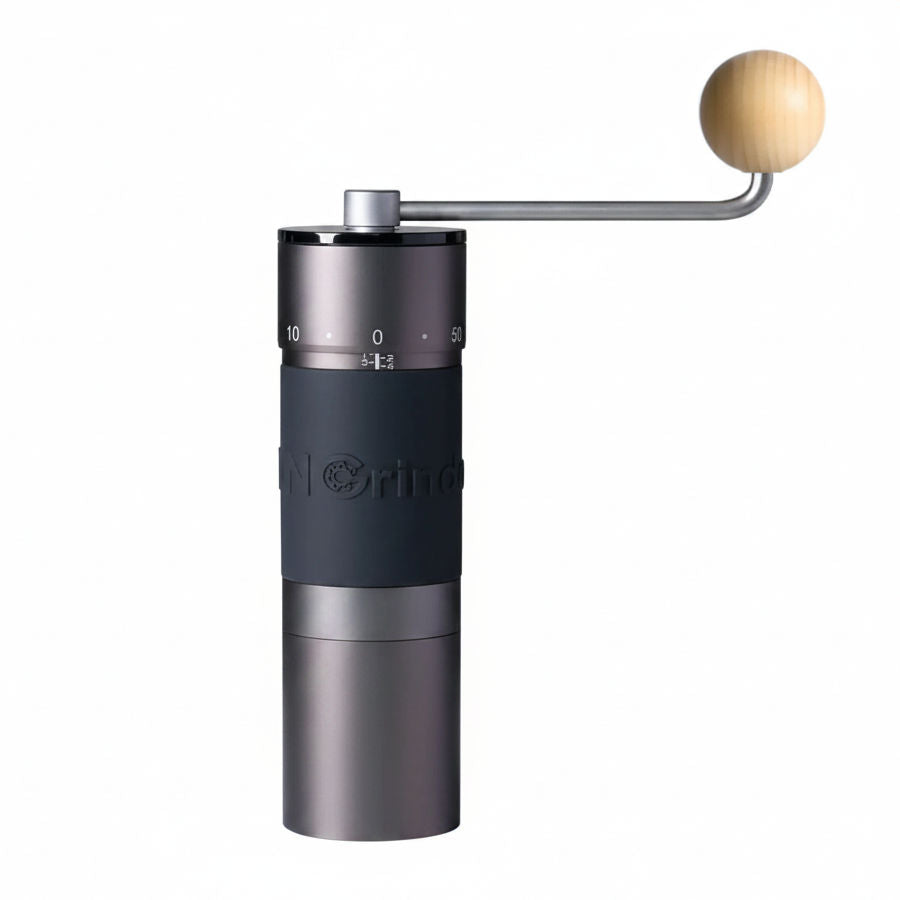
KINGrinder K6
- 48 mm conical burr, SUS420 stainless steel, heptagonal, uncoated
- External adjustment collar: 60 clicks per rotation, 16.6 microns per click
- Threaded catch cup, 30–35 g capacity
- 630 g; 55 mm body diameter; 6.35 mm hex shaft, drill-compatible
- Positioned by KINGrinder for pour-over and espresso
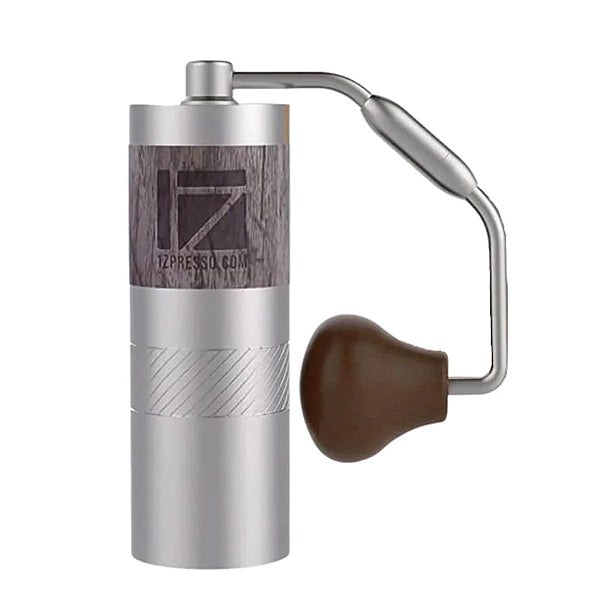
1Zpresso Q
- 38 mm heptagonal stainless steel conical burr, 420 stainless
- Internal numbered dial: 30 clicks per rotation, 0.025 mm per click
- Aluminium body and aluminium catch cup, 15–20 g
- 480 g; 46 mm body; handle folds flat, nests in an AeroPress
- Positioned by 1Zpresso for pour-over first
Choose the KINGrinder K6 if…
You brew at home, across methods. The bigger burr, bigger cup and external collar are advantages you will use every day, and the espresso range is there when you want it.
You grind for two. A 30–35 g load covers a two-cup pour-over in one pass; nothing about the K6 makes you grind twice for breakfast.
Choose the 1Zpresso Q if…
Your coffee kit travels, or your kitchen storage is a single drawer. The Q is the grinder that fits the life around the coffee: slimmer, lighter, flat-packing.
You brew filter for one and you brew it well. Pour-over, AeroPress, French press, moka — the Q’s whole brief — at a dose size that matches a single generous cup.
As an Amazon Associate I earn from qualifying purchases at no extra cost to you.
Specifications: The Specs That Actually Matter
Every figure below is taken from the two makers’ official product data, cross-checked against authorised retailers. Where sources disagree, we say so in the notes under the table.
| Specification | KINGrinder K6 | 1Zpresso Q |
|---|---|---|
| Burrs | 48 mm conical, SUS420 stainless steel, heptagonal, uncoated; hardness HRC57 | 38 mm conical, heptagonal, 420 stainless steel |
| Adjustment system | External adjustment collar at the top of the body — no need to remove the catch cup | Internal numbered dial under the catch cup |
| Clicks per rotation | 60 | 30 |
| Step size | 16.6 microns per click (maker’s manual figure; listing copy rounds to 16) | 25 microns per click (0.025 mm, maker’s click data) |
| Motor | None — hand crank/manual | None — hand crank/manual |
| Catch cup | Threaded (screw-on), 30–35 g capacity | Aluminium receiver, 15–20 g capacity |
| Capacity | 30–35 g (manual figure; see note below) | 15–20 g |
| Weight | 630 g (manual figure; see note below) | 480 g |
| Dimensions | 175 mm tall; body Ø 55 mm; handle 160 mm | 14.5 × 16 × 4.6 cm; body Ø 46 mm — nests inside an AeroPress plunger |
| Materials | Anodised aluminium alloy body and crank, silicone grip sleeve, polycarbonate lid | Aluminium alloy body and receiver, 420 and 304 stainless steel, wooden knob, silicone leather grip sleeve |
| Handle | Straight handle, lifts off the hex shaft for packing | Foldable crank handle with wooden knob |
| Drive options | Hand crank, or a cordless drill on the 6.35 mm hex shaft (maker-documented) | Hand crank only |
| Finishes | Iron Grey, Silver | Silver |
| In the box | Grinder, straight handle, lid, cleaning brush | Grinder with fitted grip sleeve; no case bundled |
| Cleaning & calibration | Tool-free routine disassembly; deep strip of the burr set needs a circlip tool | Tool-free disassembly; burrs factory-calibrated and fixed |
| Maker positioning | Pour-over and espresso (pour-over listed first in the maker’s chart) | Pour-over first; maker’s manual also lists French press, cold brew, moka pot and drip |
| Estimated burr life | Not published by the maker | ~100–200 kg of beans (maker’s rating) |
| Warranty | 1-year warranty (maker’s listing terms) | 1-year limited warranty |
A note on the Q’s name, stated openly. 1Zpresso’s current Q Series page lists the Q2 S, the Q and the Q Air; the plain “Q2” name belongs to an earlier generation of the same design, and the metal grinder sold under Q-series searches at US retail today is the current Q. That is the grinder in the right-hand column, and the buttons link the manufacturer’s current Q listing. The discontinued original Q2 — which also shipped with a pentagonal burr — is not part of this comparison.
The coating note. Many K6 listings describe a titanium-coated burr. KINGrinder’s own manual disagrees: the coating belongs to the K4; the K6’s burr is SUS420 stainless steel, heptagonal, HRC57, uncoated. The manual governs.
Capacity note: KINGrinder’s manuals state 30–35 g; the listing’s headline says 25–35 g. We spec the manual figure.
Weight and height notes: the K6’s 630 g is the figure in KINGrinder’s manual specification table (its South African distributor lists approximately 650 g); height is 175 mm in the K6’s own manual, against 18.5 cm in the combined range manual. We print the K6-specific figures. The Q’s 480 g comes from 1Zpresso’s Q Series comparison table; the 465 g in some write-ups is the Q2 S’s weight from the same table.
The Differences That Actually Matter
1. Burrs — 48 mm against 38 mm, same seven sides
Both makers cut their burrs with seven faces. Heptagonal geometry is where the similarities end and the measuring starts.
The K6’s burr is 48 mm across; the Q’s is 38 mm. Ten millimetres is a large gap at this scale — full-size class against travel class.
A larger burr presents more cutting surface per revolution. That is the spec-sheet basis for the K6’s broader brief: a chamber sized for 30–35 g loads, and a maker comfortable claiming espresso alongside filter.
The Q’s answer is efficiency of a different kind. Its burr is the newer heptagonal revision 1Zpresso describes as easier to grind with, fitted to a dual-bearing shaft, and rated by the maker for roughly 100–200 kg of coffee.
Materials are close: SUS420 at a stated HRC57 on the K6, 420 stainless on the Q. Neither maker publishes particle-distribution data, so none appears here — on published specifications, diameter takes the row, and longevity data goes to the Q.
2. Adjustment — outside against inside
This is the deepest workflow divide in the pairing. The K6 adjusts from outside: a collar at the top of the body, turned with the catch cup left in place, read against its numbered scale.
The Q adjusts from inside. Unscrew the catch cup, turn the numbered dial beneath it, screw the cup back on. Every adjustment costs you the cup, every time.
The arithmetic runs the same way. The K6 turns 60 clicks per rotation at 16.6 microns per click. The Q turns 30 clicks per rotation at 25 microns per click.
The K6’s steps are finer and its dial travels twice as many per turn. For a brewer who changes settings often, the external collar is the better tool — and it is not especially close.
The Q’s defence is that its dial is numbered and repeatable. Note the setting once and you return to it exactly. What it cannot do is let you nudge a setting mid-dose or glance at it with the cup on.
3. Espresso — claimed by one, declined by the other
Espresso is where this comparison stops being a contest of degrees. KINGrinder claims it outright: its range chart positions the K6 “Pour over, Espresso”, its settings guide starts the extra-fine band at 15–25 clicks from zero, and espresso sits around 30 clicks in the manual’s own chart.
1Zpresso makes no such claim for the Q. The Q Series is positioned pour-over first, and the manual’s listed methods are pour-over, French press, cold brew, moka pot and drip. Espresso is simply absent from the brief.
The hardware explains the positioning. Espresso dialing lives on fine, repeatable steps; the Q’s 25-micron clicks through an internal dial are a filter tool, and 1Zpresso sells external-dial models for the espresso job.
None of this makes the Q a worse grinder. It makes it a narrower one. If espresso is even a someday ambition, the K6’s range is a real asset; if it is genuinely never, the Q loses nothing by declining it.
4. Capacity — a two-cup load against a one-cup dose
The K6’s threaded cup takes 30–35 g. The Q’s receiver takes 15–20 g. One of these numbers describes a two-person breakfast; the other describes a single generous cup.
For a solo brewer, the Q’s dose is not a limitation — it is the design: single-dose in, single-dose out, sized to the AeroPress-and-V60 life the grinder was built around.
For anyone brewing for two, the arithmetic is unforgiving. Every shared pot means grinding twice on the Q, every morning, forever. The K6 loads once.
Capacity is the row where “who is it for” matters more than “which is better”. Match the cup to the household, not to the spec sheet.
5. Size, weight and the shape of a packed bag
Now the Q’s home turf, and it is not close. The Q weighs 480 g; the K6 weighs 630 g. The Q’s body is 46 mm across; the K6’s is 55 mm.
That 46 mm is a designed number: the Q Series body nests inside an AeroPress plunger, turning two pieces of travel kit into one cylinder of space. The K6 has no equivalent — it is a full-size grinder that can be carried.
Packing widens the gap. The Q’s handle folds flat, so the packed object is a plain cylinder. The K6’s straight handle lifts off its shaft, which helps, but the result is a cylinder plus a loose handle.
At home, most of this evaporates: 150 g and 9 mm are nothing on a counter. In a carry-on, a bikepacking bag or a desk drawer, they are the entire decision.
6. The drill option — the K6’s documented party trick
The K6’s shaft ends in a 6.35 mm hex, and KINGrinder’s manual tells you, in writing, to chuck it into a drill: 15 Nm or more of rated torque (15–25 Nm in its listing data), grind set beyond 15 clicks from zero.
This is specified, not tolerated. For a household that hand-grinds happily all week and faces guests on Sunday, it converts cranking at volume into a non-issue.
The Q has no equivalent, and its slim travel brief would not want one. Score this section by your Sundays: irrelevant to the traveller, potentially decisive for the host.
7. Cleaning, calibration and the daily routine
Both grinders are dry-clean machines: brush and blower, never water — KINGrinder’s manual says so explicitly, and the routine is the same on the Q.
The difference is in what a deep clean asks of you. The K6 strips without tools for a routine brush-out, but removing its burr set means taking out a circlip with a suitable tool, and the maker advises against doing it unless necessary.
The Q follows 1Zpresso’s range-wide pattern: it comes apart by hand, and its burrs are factory-calibrated and fixed in place, so there is nothing to realign when it goes back together. Routine ownership is simply lighter-touch.
One shared discipline: write your settings down. The K6’s counted collar and the Q’s numbered dial both repeat only as well as your notebook does.
Brew-Method Fit Guide
Start from what you drink. This table is the whole comparison in one view — and it is really two questions: how many methods, and how many people.
| What you brew | KINGrinder K6 | 1Zpresso Q | Our call |
|---|---|---|---|
| Pour-over first: V60, Kalita, Chemex | Excellent — maker’s pour-over-first pick, 48 mm burr | Excellent — the maker’s primary design target | Tie — choose on size and capacity |
| AeroPress | Very good — mid-range is home territory | Excellent — nests inside the plunger it was designed around | Q, for travel kits; K6 at home |
| Espresso at home | Good — maker-claimed range, 16.6-micron clicks | Not the design brief — pour-over first | K6, by default — it is the only claimant |
| French press / cold brew | Excellent — coarse end of the range | Excellent — coarse end of the same range | Tie |
| Moka pot | Very good — fine end of the filter range | Good — inside the maker’s listed methods | Tie — buy on the other rows |
| Two-cup batches, 30 g and up | Excellent — 30–35 g in one load | Tight — 15–20 g cup, split every batch | K6 |
| Travel, camping, office drawer | Good — handle lifts off for packing, but no case | Excellent — 480 g, slim body, folding handle | Q |
| Grinding for guests, occasionally | Excellent — maker-documented drill drive on the hex shaft | Workable — every dose by hand, in 15–20 g loads | K6 |
Read the espresso row honestly: it is not that the Q grinds espresso badly — it is that its maker never asked it to. Everything else on the table is a matter of fit.
The 30-Second Decision
| If this sounds like you… | Buy this |
|---|---|
| “I brew at home and I want one grinder for every method I own.” | KINGrinder K6 |
| “Espresso might happen this year. I do not want to re-buy.” | KINGrinder K6 |
| “I grind for two people most mornings.” | KINGrinder K6 |
| “My coffee kit flies with me, and space is argued over.” | 1Zpresso Q |
| “I brew filter for one, and I brew it properly.” | 1Zpresso Q |
| “My kitchen storage is one drawer, total.” | 1Zpresso Q |
Ready to check today’s price?
Both grinders are current models sold by their makers on Amazon. Below are the K6 in Iron Grey with the straight handle, and the Q in silver.
View on Amazon — KINGrinder K6View on Amazon — 1Zpresso QWhat You Gain. What You Give Up.
KINGrinder K6
You gain: the bigger burr and cup in this pairing, an external collar you can turn without opening the grinder, maker-claimed espresso range, and a drill drive no rival here offers.
You give up: portability as a design virtue: 630 g, a 55 mm body, a handle that comes off rather than folding away, and no case in the box. You also give up published longevity data — KINGrinder states no burr-life estimate.
1Zpresso Q
You gain: the travel-first form done properly — 480 g, a 46 mm body that nests in an AeroPress, a folding handle, an aluminium body and receiver, and a burr set with a published service-life rating. It is the smaller object in every dimension that matters to a bag.
You give up: range and throughput: a 38 mm burr, a one-cup dose, an internal dial you must open the grinder to reach, and any claim on espresso. The Q is a specialist wearing an all-rounder’s price tag — buy it for the specialism.
Pros and Cons
KINGrinder K6 — Pros
- 48 mm heptagonal burr in SUS420 stainless, HRC57
- External collar: 60 clicks per rotation at 16.6 microns
- 30–35 g capacity handles two-cup brews in one load
- Maker-claimed espresso range with a published settings guide
- Drill-compatible 6.35 mm hex shaft, documented by the maker
- Dual-bearing shaft in an anodised aluminium body
Cons
- 630 g and a 55 mm body — a full-size grinder to carry
- Straight handle lifts off for packing; no case in the box
- Threaded catch cup unscrews for every dose
- Deep cleaning needs a circlip tool
- No burr-life estimate published by the maker
1Zpresso Q — Pros
- 480 g and a 46 mm body that nests inside an AeroPress
- Foldable crank handle packs completely flat
- Aluminium body and aluminium catch cup
- Numbered internal dial: 30 clicks per rotation, repeatable settings
- Burr set rated by the maker for ~100–200 kg of coffee
- Silicone leather anti-slip grip sleeve
Cons
- 38 mm burr — 10 mm narrower than the K6’s
- 15–20 g dose splits every two-cup brew
- Internal adjustment means removing the cup to change settings
- Not positioned for espresso by its maker
- Silver is the only finish
Check the Coating Claim, the Handle and the Q’s Generation
Check the coating claim on the K6. If a listing leads with a titanium-coated burr, it has copied the K4’s spec sheet. The K6’s burr is uncoated SUS420 at HRC57 — do not pay a coating premium.
Check which K6 the listing is selling. The current grinder is the straight-handle model in Iron Grey — the listing linked here — with Silver sold as a separate listing. Older stock circulates under an earlier listing; confirm the handle style in the photos.
Check the Q’s generation. Three metal variants sit behind Q-series searches: the discontinued original Q2, the Q2 S, and the current Q. The listing linked here is the current Q: model Q, newer heptagonal burr, 480 g. Match those three facts before you match a price.
Check the burr word on any Q listing. The word that matters is “heptagonal”: the original Q2 also shipped with a pentagonal burr, and old stock does not always say which is inside. If a listing will not confirm it, skip the listing.
Check what is in the box. A complete K6 kit is the grinder, straight handle, lid and cleaning brush — no case. Neither grinder bundles a travel case at this level, so budget for one if it will fly.
Check the seller. KINGrinder’s warranty is region-specific — buy through a channel that can honour it where you live. Both grinders are sold by their makers on Amazon.
The Upgrade Path Test
Judge a hand grinder by its third year, not its first week.
Year one, both grinders cover their brief and feel like the correct purchase. The differences are workflow seconds and packing shapes.
Year two, your habits harden. If they harden at home, around variety, the K6’s collar, cup and range are what you live with. If they harden around travel and single-cup filter, the Q is still exactly the right size, with decades of rated burr life left.
Know where each path leads. The Q owner’s upgrade is a step up the 1Zpresso range — external adjustment, a bigger burr, the X-Ultra’s formula — usually triggered when espresso curiosity arrives. The K6 owner’s upgrade is more often a second, espresso-specialist grinder, or the electric jump.
Know the published longevity picture, because it is asymmetric. 1Zpresso commits to a figure: roughly 100–200 kg for the Q’s burr set. KINGrinder publishes no equivalent for the K6 — a documentation gap, not a durability verdict, but a buyer planning a decade is entitled to notice it.
When to Skip Both
Honesty cuts both ways. There are buyers neither of these grinders serves.
Skip both if espresso is already your main drink. The K6 covers it honestly, but a daily espresso habit wants finer steps — 1Zpresso’s J-Ultra works at 8 microns per click and exists for exactly that reader.
Skip both if you routinely grind more than 35 g at once. Both cups top out around a two-cup brew; batch brewers need a hopper class neither grinder belongs to.
Skip both if hand cranking itself is the objection. The K6’s drill option softens it for occasional volume, but a drill on the counter every morning is an electric grinder with extra steps.
And skip the Q specifically if your household brews for two every morning: a 15–20 g dose turns shared coffee into a twice-ground chore.
Warranty and Long-Term Support
On paper, this section is a tie: both grinders carry a one-year warranty — 1Zpresso’s limited warranty, and KINGrinder’s as stated in its own listing terms. Read those terms, though: KINGrinder notes that shipping costs for replacement parts may fall to the customer, depending on the case.
Channel matters for both. 1Zpresso sells through its own storefront and a wide retailer network. KINGrinder’s warranty is region-specific — buy through an authorised channel in your region; buy grey-market and you rely on the seller’s goodwill.
Support also means documentation. 1Zpresso publishes burr-life estimates and detailed manuals; KINGrinder publishes thorough manuals but no burr-life figure. Neither maker publishes retention or noise data for these grinders.
One habit serves both: never wash the burrs with water — brush and blower only.
Final Verdict
On specifications, the KINGrinder K6 is the more capable grinder of these two — and this is the rare matchup where the headline hides how conditional that sentence is.
The K6 wins the rows that describe a machine: the bigger burr, the external collar, the two-cup cup, the espresso range, the drill shaft. For a home brewer, that is most of what a grinder is.
The Q’s 7.7 needs its footnote, stated openly: it scored 8.4 against its own sibling, on a card with no espresso row. Against a grinder that claims espresso, the row exists, and the Q pays for a method it never pursued. On filter coffee — its actual brief — it matches the K6.
Buy the K6 if the grinder lives at home, brews across methods, or serves more than one person. It is the workhorse of this pairing, and the safer single-grinder answer for most households.
View on Amazon — KINGrinder K6
Buy the Q if the grinder travels, lives in a drawer, or serves one person’s filter habit. You are not buying a lesser grinder; you are buying a narrower one, superbly packaged.
Just check the generation before you order — current Q, heptagonal burr, 480 g — and the small grinder will be exactly the one you meant to buy.
Frequently Asked Questions
Which is better for pour-over, the K6 or the Q?
A genuine tie. Both makers position their grinder pour-over first, both use heptagonal burrs, and both cover the full filter range. The K6 adds capacity and an external dial; the Q adds portability and a published burr-life rating. Choose on the life around the brewing.
Can the 1Zpresso Q grind for espresso?
It is not the design brief. 1Zpresso positions the Q Series pour-over first, and espresso does not appear in the manual’s listed methods (pour-over, French press, cold brew, moka pot, drip). Its 25-micron clicks and internal dial are filter tools; the K6 is claimed for espresso by its maker.
Can the KINGrinder K6 grind for espresso?
Yes, on its maker’s own documentation. KINGrinder’s chart positions the K6 for pour-over and espresso, its quick manual starts the extra-fine band at 15–25 clicks from zero, and its range manual places espresso around 30 clicks. Its 16.6-micron steps are coarser than a dedicated espresso grinder’s — but the range and the intent are genuinely there.
Which grinder is better for travel?
The Q, and it is not close. It is 150 g lighter (480 g against 630 g), its 46 mm body nests inside an AeroPress plunger, and its handle folds flat. The K6’s handle lifts off for packing, but the grinder itself is full-size.
How much coffee does each grinder hold?
The K6 takes 30–35 g per load — a two-cup pour-over in one pass. The Q takes 15–20 g — one generous single cup. Brewing for more on the Q means grinding a second batch.
Is the 1Zpresso Q the same grinder as the Q2?
Effectively, at today’s retail — and this article says so openly. 1Zpresso’s current Q Series page lists the Q2 S, the Q and the Q Air; the plain Q2 was the earlier name of the metal design. The current Q (480 g, newer heptagonal burr) is the one compared and linked here. The original Q2 also shipped with a pentagonal burr — check for “heptagonal” on any listing.
Does the KINGrinder K6 have a titanium-coated burr?
No — whatever the listing says. KINGrinder’s manual gives the titanium coating to the K4; the K6’s burr is SUS420 stainless steel, heptagonal, HRC57, uncoated. A seller charging a premium for a coated K6 burr is describing a different model.
Which grinder should a beginner buy?
It depends where the beginner brews. At home, the K6: its external collar, capacity and wider method range make early mistakes cheaper to correct. On the move, the Q: a repeatable numbered dial, a single-cup dose, and a size that means it gets used instead of stored.
Sources & Verification
KINGrinder K6 instruction manual (maker’s document) — 48 mm stainless burr, uncoated; 175 mm height, 55 mm diameter, 160 mm handle • KINGrinder combined K2/K4/K6 manual — specification table: SUS420 heptagonal burr, HRC57, titanium coating assigned to the K4 only; 60 clicks per round at 0.0166 mm; 30–35 g; 630 g; drill guidance • KINGrinder exterior-adjustment quick manual — settings: extra fine 15–25 clicks, fine 25–60, medium 90–120, coarse 150+ • KINGrinder manufacturer listing data (sold by KINGrinder) — 1-year warranty terms, Iron Grey straight-handle identity • Cape Coffee Beans (official KINGrinder distributor) — cross-check: 240 settings, screw-in catch cup, tool-free disassembly • 1Zpresso Q Series official page and comparison table, Q instruction manual and manufacturer listing data (model Q, EAN-verified) • Amazon listing data for both models, used for ASIN verification only. Specifications verified November 2026.

James Wilson
James has been testing coffee gear and small kitchen appliances for over a decade and writes Honestly Compared's coffee and grinder guides. His rule for every comparison: the verdict has to survive the spec sheet, not the marketing page.