
Timemore Chestnut C3 vs KINGrinder K6: Which Should You Buy?
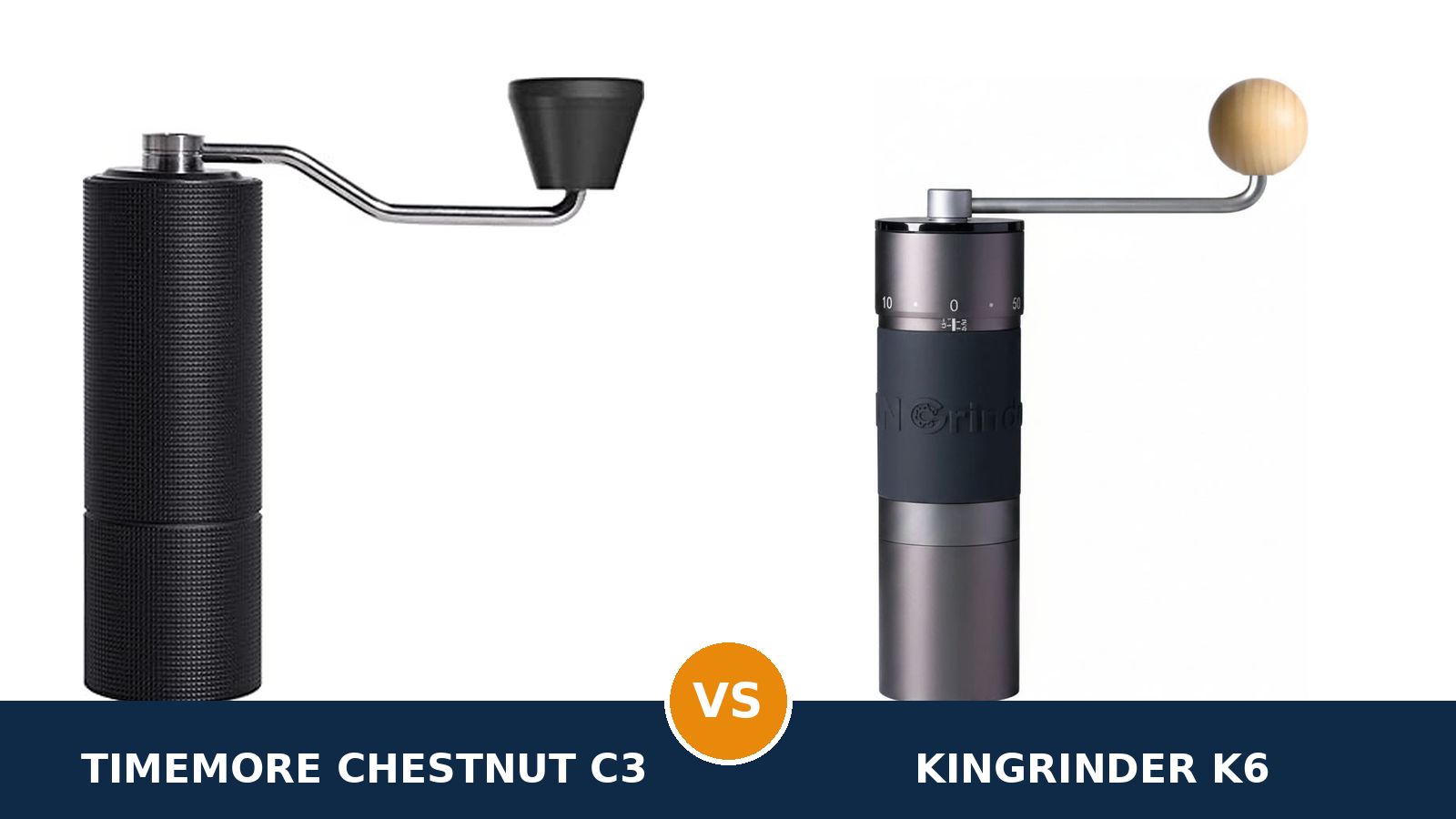
Both of these grinders are hand-cranked, about the same job, and built around a stainless conical burr. Neither has a motor. Everything else — the burr, the dial, the cup, the weight — pulls them apart.
The Timemore Chestnut C3 is the light, slim one: a 38 mm burr, an internal dial you set by counting clicks, and a body that disappears into a travel bag. The KINGrinder K6 is the hardware-heavy one: a 48 mm burr, an external numbered collar, a bigger cup, and a shaft its maker tells you to drive with a drill.
One determination first. The bare “C3” here is the base Chestnut C3 — classic dial, fixed crank handle, aluminium body with some plastic internal components. Not the C3 Pro (folding handle), the all-metal C3S, the C3 ESP (finer espresso dial), or the 30 g C3 Max. All share the same 38 mm S2C660 burr; the dial, build and cup are what change, and the variants are walled off by name throughout.
Every specification here comes from the two makers’ own published data — product pages, manuals and manufacturer listing data. The verdict is the one we would give a friend.
Key Takeaways
- The K6 wins the comparison, 8.4 to 6.8. Bigger burr, far finer adjustment, bigger cup — the hardware rows run its way.
- The adjustment gap is the story. The K6’s external collar clicks at 16.6 microns; the C3’s internal dial clicks at 83.3 — five times coarser, and you remove the cup to turn it.
- Espresso separates them completely. Timemore’s own chart gives the standard C3 two usable espresso clicks (7–8). The K6 works a whole espresso band.
- The C3 wins travel outright. Roughly 200 g lighter on any published figure, slimmer, shorter — and a carry pouch in the box.
- Filter brewing is the close row. The C3’s spike-to-cut burr was designed for it; the K6 still edges the row on burr size and capacity.
Quick Verdict
Buy the KINGrinder K6 if this grinder will live on your counter and brew everything. It is the more complete hand grinder of the two.
Its 48 mm burr is 10 mm wider than the C3’s, its external collar adjusts at a glance in 16.6-micron clicks, its cup takes 30–35 g in one load, and KINGrinder documents a drill drive for volume days — the whole brief the C3 only partly covers.
Buy the Timemore Chestnut C3 if the grinder travels, or filter coffee is the whole hobby. It is the lighter, slimmer, shorter grinder by every measure, its S2C burr is a genuine piece of engineering at this end of the market, and for pour-over, AeroPress and moka it asks nothing more of you. What it cannot do is dial espresso — its own manual gives that job two clicks.
The Scorecard
Scores below are derived directly from the manufacturer specifications compared in this guide — burr diameter and material, adjustment location, clicks per rotation and microns per click, stated capacity, weight, body diameter and box contents. They are a reading aid, not benchmarks. Both grinders are manual: no motor row, because there is no motor.
| Category | Timemore Chestnut C3 | KINGrinder K6 | ||
|---|---|---|---|---|
| Burr set | 7.5 / 10 | 9 / 10 | ||
| Adjustment system & precision | 5.5 / 10 | 9 / 10 | ||
| Espresso dialing | 4.5 / 10 | 8 / 10 | ||
| Filter brewing fit | 8.5 / 10 | 9 / 10 | ||
| Capacity & dosing | 6.5 / 10 | 8.5 / 10 | ||
| Portability & travel | 8.5 / 10 | 7.5 / 10 | ||
| Cleaning & maintenance | 6.5 / 10 | 7.5 / 10 | ||
| Overall | 6.8 / 10 | 8.4 / 10 | ||
The split is not subtle. The K6 wins burr, adjustment, espresso, capacity and cleaning. The C3 wins portability outright and stays close on filter fit.
At a Glance: Who Each Grinder Fits
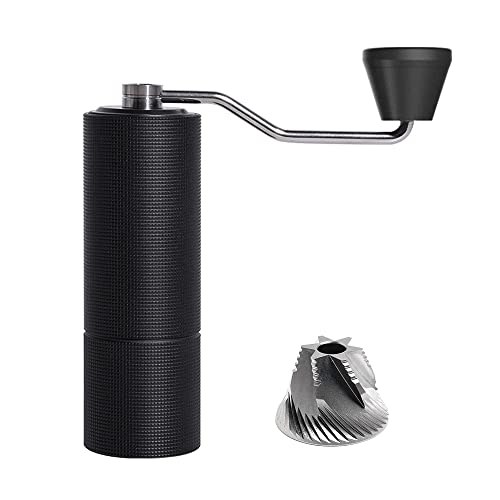
Timemore Chestnut C3
- 38 mm S2C660 conical burr, SUS420 stainless steel, patented spike-to-cut geometry
- Internal stepped dial: 12 clicks per rotation, 83.3 microns per click
- Threaded catch cup, 25 g capacity (maker’s manual figure)
- 430 g on the maker’s listing data; 147 mm tall, 52 mm body; carry pouch included
- Positioned by Timemore as the all-round starter in the C3 line
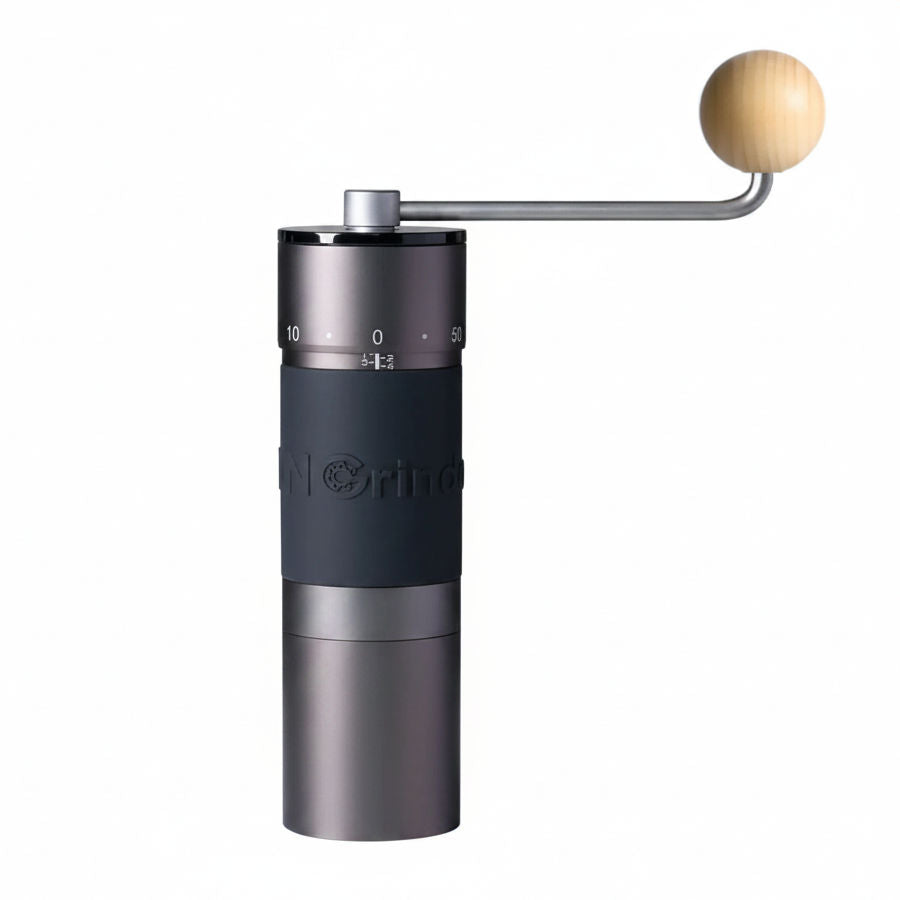
KINGrinder K6
- 48 mm conical burr, SUS420 stainless steel, heptagonal, uncoated
- External adjustment collar: 60 clicks per rotation, 16.6 microns per click
- Threaded catch cup, 30–35 g capacity
- 630 g; 55 mm body diameter; 6.35 mm hex shaft, drill-compatible
- Positioned by KINGrinder for pour-over and espresso
Choose the Timemore Chestnut C3 if…
The grinder goes in a bag — to the office, the campsite, the holiday rental. It is the lighter and smaller object here by a margin you feel every trip, and it arrives with a pouch to travel in.
Your brewing is pour-over, AeroPress, moka pot and French press, and it stays that way. Inside that brief, the C3’s burr and bearings do honest work, and its coarse dial never becomes the bottleneck.
Choose the KINGrinder K6 if…
One grinder has to cover espresso as well as filter — the K6 is the only one of these two that genuinely dials a shot — or you grind for two, or for guests: 30–35 g in one load, an external collar you can read without counting, and a documented drill option when the cranking adds up.
As an Amazon Associate I earn from qualifying purchases at no extra cost to you.
Specifications: The Specs That Actually Matter
Every figure below is taken from the two makers’ official product data — manuals, product pages and manufacturer listing data — cross-checked against authorised retailers. Where sources disagree, we say so in the notes under the table — and Timemore’s published figures for the C3 disagree more than most, so read the notes.
| Specification | Timemore Chestnut C3 | KINGrinder K6 |
|---|---|---|
| Burrs | 38 mm conical, S2C660 “spike to cut” geometry (patented), SUS420 stainless steel, HRC 55–58, 5-axis CNC machined | 48 mm conical, SUS420 stainless steel, heptagonal, uncoated; hardness HRC57 |
| Adjustment system | Internal stepped dial under the burr assembly — catch cup removed to adjust, clicks counted from burr lock | External adjustment collar/nut at the top of the body, numbered — catch cup stays on |
| Clicks per rotation | 12 | 60 |
| Step size | 83.3 microns per click (0.0833 mm, maker’s classic-dial figure) | 16.6 microns per click (maker’s manual figure; listing copy rounds to 16) |
| Total settings | ~36 steps (manual figure; usable band starts at click 7) | ~240 (60 across 4 rotations) |
| Catch cup | Threaded (screw-on, per the C3-series manual) | Threaded (screw-on) |
| Capacity | 25 g (manual figure; Timemore’s store table lists 20 g — see note) | 30–35 g (manual figure; see note below) |
| Weight | 430 g (maker’s listing data for the model; other published figures run higher — see note) | 630 g (manual figure; see note below) |
| Dimensions | 147 mm tall; body Ø 52 mm (series manual prints Ø 57 mm across the dial hardware); handle ~159 mm | 175 mm tall; body Ø 55 mm; handle 160 mm |
| Materials | Aluminium alloy body; some plastic internal components (listing materials: aluminium, polycarbonate, stainless steel) | Anodised aluminium alloy body and crank, silicone grip sleeve, polycarbonate lid |
| Handle | Fixed crank handle, detachable — lifts off the shaft (the folding handle belongs to the C3 Pro) | Straight handle, lifts off the hex shaft for packing |
| Motor | Not applicable — hand grinder | Not applicable — hand grinder |
| Drive options | Hand crank only | Hand crank, or a cordless drill on the 6.35 mm hex shaft (maker-documented) |
| Finishes | Black, Matt White | Iron Grey, Silver |
| In the box | Grinder, cleaning brush, carry pouch (dealer box list; the series manual names the brush) | Grinder, straight handle, lid, cleaning brush |
| Cleaning & calibration | Brush and air blower; maker advises against disassembling the burr set yourself | Tool-free routine disassembly; deep strip needs a circlip tool |
| Maker’s starting settings | Espresso 7–8 clicks; moka 10–13; pour-over 13–16; French press 16–20; do not grind at 0–6 clicks | Extra fine 15–25 clicks; fine 25–60; medium 90–120; coarse 150+ |
| Estimated burr life | Not published by the maker | Not published by the maker |
| Retention / static data | Not published by the maker | Not published by the maker |
| Warranty | 1 year (maker’s warranty card and store policy) | 1-year warranty (maker’s listing terms) |
Which C3 is this? The base Chestnut C3 with the classic dial. Its siblings share the 38 mm S2C660 burr and differ around it: the C3 Pro folds its handle, the C3S replaces the plastic internals with metal, the C3 ESP re-gears the dial to 0.0233 mm per click, and the C3 Max stretches the cup to 30 g. None of those figures is used in this guide.
Capacity note: the C3’s manuals print 25 g; Timemore’s store table lists 20 g. We spec the manual figure — a single-cup grinder either way, since the gap to the K6’s 30–35 g survives both readings. KINGrinder’s manuals and listing specification block state 30–35 g for the K6; its headline says 25–35 g.
Weight note: Timemore’s published C3 weights disagree: 430 g in the model’s listing data, ~470–474 g from dealers who weigh it, ~530 g in the C3-series manual — a figure matching the all-metal C3S’s listed weight. We print the base model’s own figure: on every published number, the C3 is 100–200 g lighter than the K6.
The coating note — read this before you buy a K6. A large share of K6 listings describe a titanium-coated burr. KINGrinder’s own manual disagrees: its specification table gives the titanium coating to the K4, and lists the K6’s burr as SUS420 stainless steel, heptagonal, HRC57, “uncoated”. The manual governs — nobody should pay a coating premium for one.
The Differences That Actually Matter
1. Burrs — 48 mm against 38 mm, the same steel family
Both burrs are SUS420 stainless at neighbour hardnesses — HRC57 for the K6, HRC 55–58 for the C3 — so steel is not the separator here. Diameter and geometry are.
The K6’s burr is 48 mm across — 10 mm wider than the C3’s 38 mm, a quarter more diameter and the cutting surface that goes with it: fewer turns per dose.
The C3’s answer is geometry rather than size. Its S2C660 burr carries Timemore’s patented “spike to cut” profile, scaled down from the S2C860 in the flagship Chestnut X, machined by 5-axis CNC and held on a double-bearing central shaft — the same arrangement the K6 uses. A well-engineered small burr. But on the published sheet, diameter takes the category — and neither maker publishes particle measurements, so no invented grind data appears here.
2. Adjustment — the widest gap on this page
This is where the comparison is actually decided. The K6 adjusts on an external collar at the top of the body: numbered, readable at a glance, 60 clicks per rotation at 16.6 microns each — changed with the catch cup in place, without counting anything.
The C3 adjusts on an internal dial underneath the burr assembly. To reach it you take the catch cup off. The dial is unnumbered, so the setting lives in your notebook as a click count from burr lock. It turns 12 clicks per rotation, each click moving the burr 0.0833 mm — 83.3 microns, five times the K6’s step.
Side by side: roughly 240 settings against roughly 36; repeatability by reading a number against repeatability by counting clicks under a removed cup. Set a grind once a month and the C3’s system is merely plain — change methods weekly and it is the daily friction of ownership.
3. Espresso dialing — two clicks is not a dial
Espresso is where step size stops being a spec-sheet nicety: the window between a choked shot and a fast one is a handful of microns.
Timemore’s own C3-series manual is admirably blunt about where the standard C3 stands. Its starting chart puts espresso at 7–8 clicks — two positions — and warns you not to grind at 0–6 clicks at all, to protect the burrs. The grinder reaches espresso fineness; it cannot split the window once you are there. Your remaining levers are dose and yield, not the dial.
KINGrinder’s guide gives the K6 an extra-fine band starting at 15–25 clicks, with espresso worked across the fine range beyond it — dozens of tunable positions at 16.6 microns each. Timemore agrees in its own catalogue: the C3 ESP exists precisely to re-gear this burr with a 0.0233 mm espresso dial. If espresso is your plan, buy that dial or buy the K6 — not the standard C3 and hope.
4. Filter brewing — the C3’s home turf, honestly scored
Now the row where the C3 stops apologising. The S2C burr’s spike-to-cut profile was designed for filter clarity, Timemore’s chart parks pour-over at 13–16 clicks, mid-dial, and the dual-bearing shaft keeps the small burr centred.
The K6 still takes the row, narrowly — 9.0 against 8.5 — on the larger burr and two-cup capacity. But if filter is your whole world, this is the row to weight, and on it the C3 is no compromise: a contender that happens to be lighter.
5. Capacity and dosing — one cup against two
The C3’s threaded cup is a single-cup vessel: 25 g by the manual, 20 g by Timemore’s store table. A 30 g two-cup V60 means grinding twice. The K6’s threaded cup takes 30–35 g in one load — same screw-on ritual at the end of the dose, since both cups thread and neither is magnetic — but one load covers the household’s standard brews.
Volume is also where the K6’s second drive lives. Its shaft ends in a 6.35 mm hex, and KINGrinder’s manual tells you, in writing, to chuck it into a cordless drill — rated torque of 15 Nm or more, grind set more than 15 clicks from zero. The C3’s crank is hand-only. Solo drinkers never meet this difference; hosts meet it every Sunday.
6. Size, weight and travel — the C3’s clean win
Measure the two grinders as luggage. The C3: 147 mm tall, a 52 mm body, 430–474 g across published figures. The K6: 175 mm tall, a 55 mm body, 630 g. The C3 is shorter, slimmer and lighter by 100–200 g on any published figure — in a carry-on, the difference between packing it and leaving it.
The box contents back the brief: a carry pouch with the C3; no case for the K6, its handle lifting off the shaft so the packed shape is a cylinder plus a loose handle. Neither handle folds — that is the C3 Pro. On a home counter this section is a footnote; everywhere else, the C3 takes it outright.
7. Cleaning and living with them
Both grinders are dry-clean only — brush and air blower, never water on the burrs — and both boxes include the brush. The ownership split is in how deep you are allowed to go.
KINGrinder lets you in: the K6 disassembles without tools for a routine brush-out, and a full burr strip is possible with a circlip tool. Timemore tells you the opposite — its series manual advises against disassembling the burr set yourself, reserving the procedure for unjamming a stuck burr.
Static is the other quiet difference. Neither maker publishes retention or static figures. But Timemore’s own C3S copy treats the standard C3’s plastic internals as the static-prone part of the design — the all-metal S is sold partly as the fix. Expect to brush the C3’s cup a little more often, and knock it a little more firmly.
Brew-Method Fit Guide
The fastest way to choose is to start from what you actually drink. This table is the whole comparison in one view.
| What you brew | Timemore Chestnut C3 | KINGrinder K6 | Our call |
|---|---|---|---|
| Pour-over first: V60, Kalita, Chemex | Excellent — S2C burr built for filter, pour-over band mid-dial | Excellent — 48 mm burr, two-cup capacity | K6 at home; C3 if it travels |
| Espresso at home, daily | Weak — maker’s chart gives espresso two clicks (7–8) | Good — 16.6-micron clicks across a real espresso band | K6, clearly |
| Espresso weekdays, filter weekends | Poor — the espresso half is the compromise | Very good — external collar, counted settings | K6 |
| AeroPress and moka pot | Excellent — mid-range is home territory | Excellent | Tie — buy on the other rows |
| Two-cup batches, 30 g and up | Tight — 20–25 g cup, grind in two loads | Excellent — 30–35 g in one load | K6 |
| Travel, camping, office drawer | Excellent — lightest and slimmest here, pouch included | Good — handle lifts off for packing, but no case | C3, clearly |
| Grinding for guests, occasionally | Workable — every dose by hand, in small loads | Excellent — maker-documented drill drive on the hex shaft | K6 |
Read the espresso row honestly. It is not that the C3 cannot reach espresso fineness — its manual charts it. It is that two clicks cannot steer a shot.
The 30-Second Decision
| If this sounds like you… | Buy this |
|---|---|
| “I brew pour-over almost every day and espresso rarely.” | KINGrinder K6 — or the C3, if it travels |
| “Espresso is half my brewing and I need clicks I can tune with.” | KINGrinder K6 |
| “The grinder comes travelling with me.” | Timemore Chestnut C3 |
| “I grind 30 g or more at a time for two people.” | KINGrinder K6 |
| “I want the lightest serious grinder for filter coffee.” | Timemore Chestnut C3 |
Ready to check today’s price?
Both are current models sold by their makers on Amazon. Finishes are separate listings — the C3 link is its Matt White finish, the listing under which Timemore files the C3’s official manual (black is the same grinder on its own listing); the K6 link is Iron Grey, straight handle.
View on Amazon — Timemore C3View on Amazon — KINGrinder K6What You Gain. What You Give Up.
Timemore Chestnut C3
You gain: the lightest, slimmest serious hand grinder in this comparison — 147 mm, 52 mm across, 100–200 g lighter than the K6 on any published figure — with a patented spike-to-cut burr, dual bearings, and a carry pouch in the box.
You give up: espresso dialing, almost entirely: an internal 83-micron dial its own manual charts at two espresso clicks. Plus 10 mm of burr, a third of the cup capacity, and user-serviceable internals.
KINGrinder K6
You gain: the bigger burr (48 mm, hardness-stated SUS420) and the bigger cup (30–35 g) in this pairing, an external numbered collar at 16.6 microns per click, and a maker-documented drill drive no rival here offers.
You give up: portability: 630 g, a 55 mm body, no case in the box, and a price rung above the C3’s.
Pros and Cons
Timemore Chestnut C3 — Pros
- Patented S2C660 spike-to-cut burr, 5-axis CNC, HRC 55–58
- Lightest and slimmest here: ~430–474 g, 52 mm body, 147 mm tall
- Dual ball bearings centre the shaft
- Carry pouch and cleaning brush included
- Genuinely strong at pour-over, AeroPress, moka and French press
Cons
- Internal dial: cup off to adjust, unnumbered, counted in clicks
- 83.3-micron steps — five times coarser than the K6’s
- Maker’s chart gives espresso just two clicks (7–8)
- 20–25 g capacity splits two-cup brews
- Maker advises against disassembling the burr set yourself
- Timemore’s own published weight and capacity figures disagree
KINGrinder K6 — Pros
- 48 mm heptagonal burr in SUS420 stainless, HRC57
- External numbered collar: 60 clicks per rotation, 16.6 microns per click
- 30–35 g capacity handles two-cup brews in one load
- Drill-compatible 6.35 mm hex shaft, documented by the maker
- Tool-free routine disassembly for cleaning
Cons
- 630 g and a 55 mm body — the heavier travel option
- No carrying case in the box
- Threaded catch cup unscrews for every dose
- Deep cleaning needs a circlip tool
- Listing ecosystem is messy — coating claims vary by seller
Check the Dial and the Variant Name, Not Just the Model Name
Check which C3 the listing is actually selling. C3, C3 Pro, C3S, C3 ESP and C3 Max sit side by side in search results and differ in exactly the parts this comparison turns on. The standard C3 has the classic dial and a fixed handle. A folding handle means Pro; an all-metal build means S; an espresso claim means the ESP dial.
Check the dial type twice if espresso matters. The classic dial moves 0.0833 mm per click; the ESP dial moves 0.0233 mm, and the two grinders look near-identical in photos. If a listing is vague about which dial is fitted, buy elsewhere.
Check which K6 the listing is selling. The current grinder is the straight-handle model in Iron Grey — the listing this guide links — with a Silver finish sold as its own separate listing. Older K6 stock circulates under an earlier listing; confirm the handle style in the photos matches the title.
Check what is in the box, and the seller. A complete C3 kit is the grinder, cleaning brush and carry pouch. A complete K6 kit is the grinder, straight handle, lid and cleaning brush — no case, so budget for one if it will travel. Both grinders are sold by their makers on Amazon and by authorised distributors elsewhere; KINGrinder’s warranty is region-specific, so buy through a channel that can honour it where you live.
The Upgrade Path Test
Judge a hand grinder by its third year, not its first week. Year one, both delight: fresh grounds on demand, no motor noise, no counter space surrendered. Year two, your habits harden — and the grinder that fits them wins retroactively.
If they harden around travel and filter, the C3’s weight and size are what you live with, and you will not miss the K6’s collar. If they harden around variety — or espresso — the C3’s internal dial taxes every change, and the K6’s collar is the upgrade you end up buying anyway.
Timemore’s own line maps the exits from the C3. The C3 ESP keeps the same burr and fixes the dial — the natural second grinder for a C3 owner who buys an espresso machine. The C3S keeps the dial and fixes the build, metal throughout. Above both, the class ceiling for espresso precision is 1Zpresso’s J-Ultra at 8 microns per click.
The published longevity picture is symmetric: neither maker publishes a burr-life estimate for these models. A documentation gap, not a durability verdict — SUS420 at these hardness figures is long-lived at hand-grinder pace. The dial and the workflow will choose your upgrade, not a worn burr.
When to Skip Both
Honesty cuts both ways. There are buyers neither of these grinders serves.
Skip both if espresso is your main drink and your budget is firm. The C3 gives you two clicks of window and the K6, for all its range, still steps at 16.6 microns. The honest espresso buys here are Timemore’s own C3 ESP — same burr, espresso dial — or the specialist class above it, 1Zpresso’s J-Ultra at 8 microns per click. Buying either grinder here as a “close enough” espresso grinder is how people end up owning two grinders in a year.
Skip both if you routinely grind more than 35 g at once — both cups top out around a two-cup brew — or if hand cranking itself is the objection. The K6’s drill option softens it for occasional volume, but a drill on the counter every morning is an electric grinder with extra steps.
And skip the standard C3 specifically if there is an espresso machine anywhere in your future. The ESP re-gearing exists because this dial cannot follow you there.
Warranty and Long-Term Support
On paper, this section is a tie: both grinders carry a one-year warranty — Timemore’s, stated on the warranty card packed with its Chestnut grinders and in its store policy, and KINGrinder’s as stated in its own listing terms. KINGrinder’s terms note that shipping for replacement parts may fall to the customer.
Channel matters for both. KINGrinder’s distributors state plainly that its warranty is region-specific — buy through an authorised channel in your region; buy grey-market and you rely on the seller’s goodwill. Timemore’s warranty documentation is thinner than its product documentation — keep the warranty card in the box.
Neither maker publishes retention or noise data, and neither grinder has a motor to make noise with. One habit serves both: never wash the burrs with water — brush and blower only.
Final Verdict
The KINGrinder K6 is the hand grinder we would buy of these two — and this one is not close.
It wins on the burr (48 mm against 38), on the adjustment system that defines daily life with a hand grinder (an external, numbered collar at 16.6 microns against an internal dial at 83.3, hidden under the catch cup), on capacity (30–35 g against a single-cup 20–25 g), and on espresso — the method the C3’s own manual effectively concedes. 8.4, earned across five of seven categories.
The C3’s 6.8 is not a failure; it is a narrower brief, honestly filled. It is the lightest and slimmest grinder here by a margin that matters in a bag, its S2C burr does real filter work, and for a pour-over drinker who travels, the verdict flips.
Buy the K6 if the grinder lives at home and brews everything: the biggest burr and cup in this pairing, a dial you can read, and a drill in reserve for guests.
Just buy it with your eyes open about the burr. The K6’s uncoated SUS420 is a good burr — it was never titanium, and it does not need to be.
View on Amazon — KINGrinder K6
Buy the C3 if the grinder travels with you, or your brewing is filter-only and your budget is at this rung: the spike-to-cut burr, dual bearings and half the K6’s footprint. The link below is Matt White, the listing under which Timemore files the C3’s official manual; black is the same grinder on its own listing.
Frequently Asked Questions
Is the standard Timemore C3 the same grinder as the C3 ESP?
No — they share the 38 mm S2C660 burr and little else that matters. The standard C3’s classic dial moves 0.0833 mm per click over 12 clicks per rotation; the ESP dial moves 0.0233 mm over 30 clicks per rotation, which is what makes it an espresso dial.
Which is better for espresso, the C3 or the K6?
The K6, by a wide margin. KINGrinder charts an extra-fine band from 15–25 clicks and an espresso-working fine range beyond it, at 16.6 microns per click. Timemore’s own chart gives the standard C3 espresso at 7–8 clicks and forbids 0–6 — it reaches the fineness but gives you two positions to steer with. Timemore’s own answer at this price is the C3 ESP.
Which is better for pour-over?
Close — the closest call in this comparison. The C3’s spike-to-cut S2C burr was designed for filter brewing and its pour-over band sits mid-dial. The K6 counters with a 48 mm burr and two-cup capacity. Filter-only and staying home: K6, narrowly. Filter-only and travelling: C3, and it is not close the other way.
How much coffee does the Timemore C3 hold?
Depends which of Timemore’s documents you read. The manuals print 25 g; Timemore’s store comparison table lists 20 g. We spec the manual figure; a single-cup grinder under either reading. The K6’s cup takes 30–35 g.
Which grinder is better for travel?
The C3. It is 147 mm tall against 175 mm, 52 mm across against 55 mm, lighter by 100–200 g on any published figure — and it ships with a carry pouch. The K6’s handle lifts off for packing, which helps, but there is no case in its box.
Can the standard C3 grind for espresso at all?
It can reach the range — Timemore’s manual charts espresso at 7–8 clicks and even troubleshoots espresso grinding. What it cannot do is adjust inside the range: two usable clicks, with dose and yield as your only other levers, is not dialling in. A daily espresso habit deserves the ESP dial or the K6.
Does the KINGrinder K6 have a titanium-coated burr?
No — whatever the listing says. KINGrinder’s own manual specification table gives the titanium coating to the K4; the K6’s burr is SUS420 stainless steel, heptagonal, HRC57, described in its own manual as uncoated.
Sources & Verification
Timemore Chestnut C3 instruction manual (maker’s document, filed under the C3’s Amazon listing) — S2C660 burr, 38 mm, HRC 55–58, ~36 steps, 25 g loading, double-bearing positioning, listing data (model C3, Matt White finish, 430 g) • Timemore Chestnut C3-series manual — classic dial 0.0833 mm per click at 12 clicks per rotation, ESP dial 0.0233 mm at 30 clicks, starting clicks (espresso 7–8, moka 10–13, pour-over 13–16, French press 16–20; do not grind at 0–6), threaded powder cup, do-not-disassemble guidance, one-year warranty card • Timemore model comparison via Slow Pour Supply, the maker’s US distributor — classic vs ESP dial figures • Passport Coffee (authorised dealer) — box contents, 25 g, ~474 g • KINGrinder K6 instruction manual and combined K2/K4/K6 manual — SUS420 heptagonal burr, HRC57, uncoated (titanium assigned to the K4 only); 60 clicks per round at 0.0166 mm; 30–35 g; 630 g; drill guidance; settings bands • Amazon listing data for both models, used for ASIN verification only. Specifications verified November 2026.

James Wilson
James has been testing coffee gear and small kitchen appliances for over a decade and writes Honestly Compared’s coffee and grinder guides. His rule for every comparison: the verdict has to survive the spec sheet, not the marketing page.