
ASRock B550 Phantom Gaming 4 vs MSI B550-A Pro: Which Should You Buy?
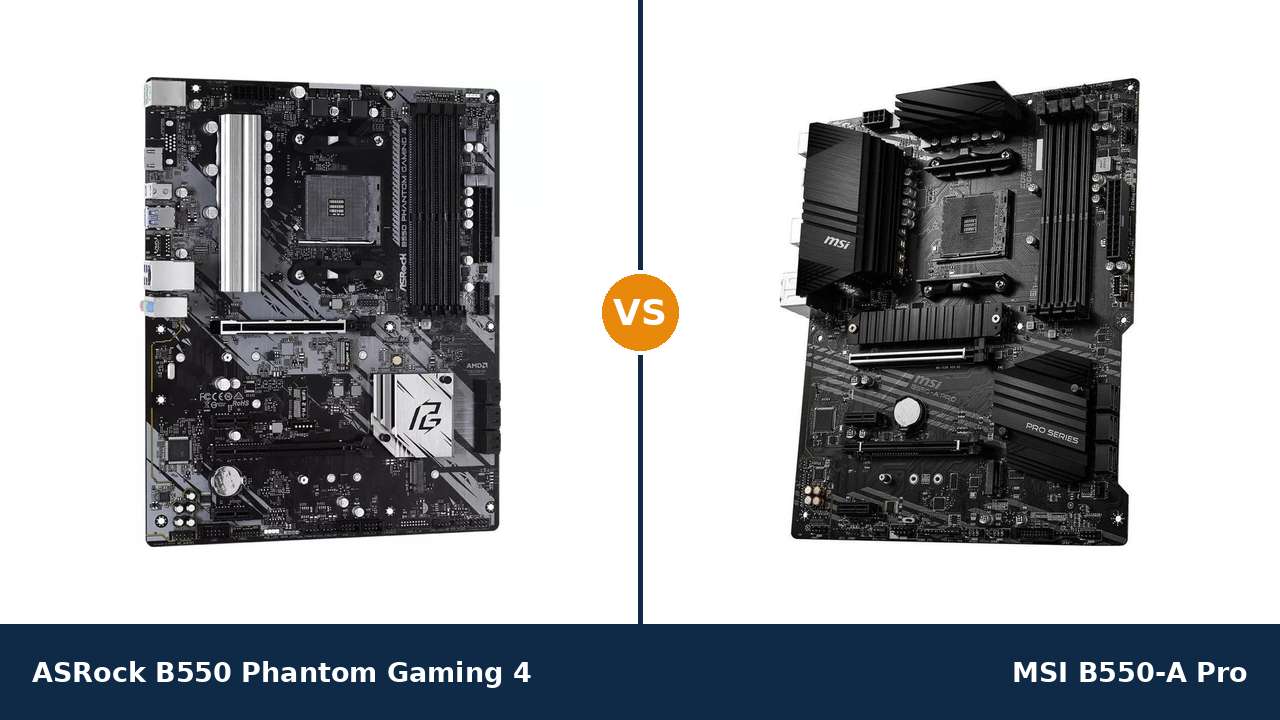
One of these boards has "Gaming" in its name. The other has "Pro". Neither word tells you which one is better.
Both are full-size ATX boards on the same B550 chipset, for the same AM4 socket, aimed at the same mainstream Ryzen builds. Both take four DDR4 sticks, two M.2 drives and six SATA drives.
Look closer and the priorities split cleanly. ASRock spent its budget on the audio codec, the memory ceiling and gaming trim. MSI spent its on power delivery, fast USB and a second M.2 slot that runs at full speed.
Every specification below comes from ASRock's and MSI's own published data. The verdict at the end is the one we would give a friend spending their own money.
Key Takeaways
- The MSI B550-A Pro is the stronger foundation. A 10+2+1 Duet Rail power design, USB 3.2 Gen 2 on the rear panel and a full-speed second M.2 slot.
- The Phantom Gaming 4 fights back on audio and memory. Its ALC1200 codec beats the A Pro's ALC892, and its 4733+ MT/s memory ceiling is the higher headline.
- APU builders should note the display outputs. The A Pro offers HDMI and DisplayPort; the Phantom Gaming 4 offers HDMI alone.
- Storage count, LAN and expansion layout are near-identical. Two M.2 slots, six SATA ports, gigabit Ethernet and the same four-slot layout on both.
- Neither board has Wi-Fi or 2.5G LAN. The Phantom Gaming 4 leaves an empty M.2 Key E slot; on the A Pro, wireless means a PCIe card.
Quick Verdict
Buy the MSI B550-A Pro for most builds. It wins the hardware that decides how a board ages.
Its power design is a clear class above: more phases, a doubler design and an extended heatsink. Its rear panel carries 10 Gb/s USB in both Type-A and Type-C. Its second M.2 slot runs at PCIe 3.0 x4, twice the width of the ASRock's.
Buy the ASRock B550 Phantom Gaming 4 if audio and memory headroom top your list. The ALC1200 codec is the better analogue audio chip, and ASRock rates the board for faster memory and lists ECC support.
It is also the pick if it is simply cheaper when you order. The platform underneath both boards is the same, and for a Ryzen 5 build the gaps narrow fast.
The Scorecard
Scores below are derived directly from the manufacturer specifications compared in this guide — phase counts, slot counts, port counts and supported standards. They are a reading aid, not benchmark results.
| Category | B550 Phantom Gaming 4 | B550-A Pro | ||
|---|---|---|---|---|
| Power delivery | 7 / 10 | 9 / 10 | ||
| Storage | 7 / 10 | 9 / 10 | ||
| Expansion | 8 / 10 | 8 / 10 | ||
| Memory | 9 / 10 | 8 / 10 | ||
| USB & front panel | 6 / 10 | 9 / 10 | ||
| Audio & networking | 8 / 10 | 6 / 10 | ||
| Display outputs (APU builds) | 5 / 10 | 8 / 10 | ||
| Overall | 7.1 / 10 | 8.1 / 10 | ||
The pattern repeats across the whole comparison. The A Pro wins on delivery — power, ports and slot bandwidth. The Phantom Gaming 4 wins on the two headline figures gamers read first: the audio codec and the memory speed.
At a Glance: Who Each Board Fits
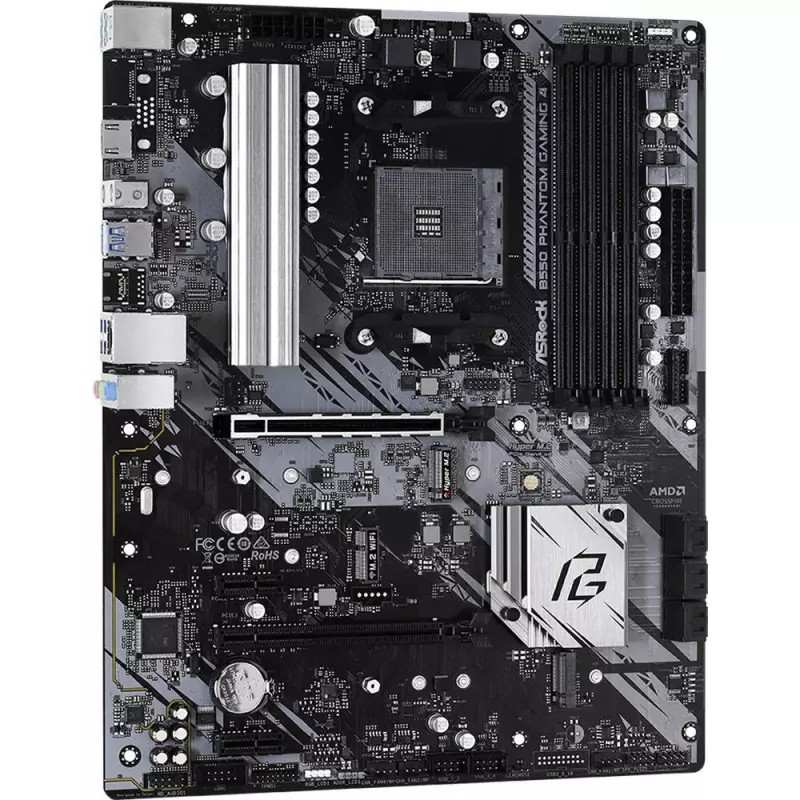
ASRock B550 Phantom Gaming 4
- 8-phase Digi Power with 50A chokes and XXL alloy heatsinks
- Realtek ALC1200 audio with Nahimic software
- DDR4 support rated to 4733+ MT/s (O.C.), ECC listed
- M.2 Key E slot ready for a Wi-Fi module you add yourself
- Post Status Checker LEDs for troubleshooting
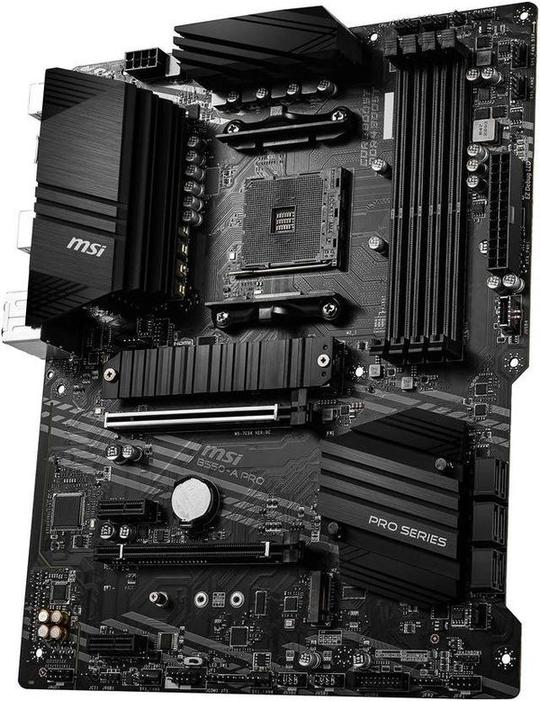
MSI B550-A Pro
- 10+2+1 Duet Rail power design with extended heatsink
- USB 3.2 Gen 2 Type-A and Type-C on the rear panel
- Second M.2 slot at full PCIe 3.0 x4, heatsink on the first
- HDMI and DisplayPort outputs for APU builds
- Eight fan headers and a Flash BIOS Button
Choose the B550 Phantom Gaming 4 if…
Analogue audio matters to you. You drive good headphones or speakers straight from the board, and the ALC1200 is the better chip for it.
You want the highest memory ceiling on paper, or ASRock's listed ECC support for a home-server build.
Or you plan to add Wi-Fi later using the empty Key E slot, and the board is the cheaper of the two when you order.
Choose the MSI B550-A Pro if…
You are building with a Ryzen 7, or might upgrade to one. The power design has more headroom everywhere it counts.
You move files to fast external drives, run an APU with two monitors, or plan a second NVMe drive at full speed.
You are keeping the board for years and want the extras — front USB-C header, eight fan headers, BIOS flashing without a CPU — already fitted.
As an Amazon Associate I earn from qualifying purchases at no extra cost to you.
Specifications: The Specs That Actually Matter
Every figure below is taken from ASRock's and MSI's published specifications and manuals, cross-checked against the manufacturers' product data.
| Specification | ASRock B550 Phantom Gaming 4 | MSI B550-A Pro |
|---|---|---|
| Form factor | ATX, 30.5 × 24.4 cm, 2oz copper PCB | ATX, 30.5 × 24.4 cm |
| Socket / chipset | AMD AM4 / B550 | AMD AM4 / B550 |
| CPU support | Ryzen 5000, 5000 G, 4000 G, 3000 series | Ryzen 5000 & 3000, 4000 G-Series (3400G / 3200G not supported) |
| Power design | 8-phase Digi Power, 50A chokes, XXL alloy heatsinks | 10+2+1 Duet Rail with doubler design, extended heatsink |
| CPU power connectors | 8-pin + 4-pin | 8-pin + 4-pin |
| Memory | 4 × DDR4 DIMM, up to 128 GB, 4733+ MT/s (O.C.), XMP, ECC listed | 4 × DDR4 DIMM, up to 128 GB, 4400 MT/s (O.C.), A-XMP |
| Graphics outputs (APU) | HDMI 2.1 only | HDMI + DisplayPort |
| Expansion slots | PCIe 4.0 x16 (steel reinforced) + PCIe 3.0 x16 (x4) + 2 × PCIe 3.0 x1, M.2 Key E (Wi-Fi) | PCIe 4.0 x16 + PCIe 3.0 x16 (x4, CrossFire) + 2 × PCIe 3.0 x1 |
| M.2 storage | 2 slots: PCIe 4.0 x4 (2260/2280/22110) + PCIe 3.0 x2 / SATA (2242/2260/2280), no heatsink fitted | 2 slots: PCIe 4.0 x4 + PCIe 3.0 x4, M.2 Shield Frozr heatsink |
| SATA | 6 × SATA 6 Gb/s, RAID 0/1/10 | 6 × SATA 6 Gb/s, RAID 0/1/10 |
| LAN | Gigabit, Realtek RTL8111H | Gigabit, Realtek RTL8111H |
| Audio | Realtek ALC1200, 7.1 HD, Nahimic Audio | Realtek ALC892, 7.1 HD |
| USB (rear) | 6 × USB 3.2 Gen 1 — no Gen 2, no Type-C | USB 3.2 Gen 2 Type-C + Type-A (10 Gb/s), 2 × Gen 1, 4 × USB 2.0 |
| USB (front headers) | 1 × USB 3.2 Gen 1 header (2 ports), 2 × USB 2.0 headers | USB 3.2 Gen 1 Type-C header + Gen 1 header, 2 × USB 2.0 headers |
| Fan headers | 6: CPU + CPU/water pump + 4 × chassis/water pump | 8: CPU + pump + 6 × system |
| Troubleshooting | Post Status Checker LEDs (CPU / DRAM / VGA / Boot) | EZ Debug LEDs (CPU / DRAM / VGA / Boot) |
| BIOS flashing | BIOS update with CPU fitted | Flash BIOS Button (no CPU/RAM/GPU needed) |
| I/O shield | Separate shield in the box | Separate shield in the box |
Audio codec note: ASRock's product pages describe this board's codec as "ALC1220/ALC1200", while ASRock's own user manual names the ALC1200. This guide uses the manual figure. MSI's spec summary likewise lists "ALC892/ALC897" for the B550-A Pro; MSI's datasheet names the ALC892, which is the figure used here.
Variant note: this comparison covers the base Phantom Gaming 4 (model 90-MXBCY0-A0UAYZ) with no wireless fitted. The Phantom Gaming 4/ac is a different board — it adds a Wi-Fi module and changes the storage layout. The buying guide below explains how to tell them apart.
The Differences That Actually Matter
1. Power delivery — the clearest gap between the two boards
Start where the boards differ most. The B550-A Pro runs a 10+2+1 Duet Rail power design with a doubler and an extended heatsink over the VRM.
The Phantom Gaming 4 runs ASRock's 8-phase Digi Power design with premium 50A chokes and XXL alloy heatsinks. It is a respectable design. It is not the same class.
Both boards take an 8+4-pin CPU power feed, so the connector count does not separate them. The phase hardware behind the connectors does.
For a Ryzen 5 5600, both boards are comfortably sufficient, today and for the life of the chip. You will not feel a difference.
Move to a Ryzen 7 5800X, or hold sustained all-core loads in rendering or compiling, and the A Pro's extra phases spread the current wider and run cooler doing it. That is headroom you cannot retrofit later.
Verdict on power: a clear A Pro win, and the single strongest reason to buy it.
2. Rear-panel USB — 10 Gb/s against none
Turn both boards around. The A Pro's rear panel carries USB 3.2 Gen 2 in Type-C and Type-A form — 10 Gb/s each — plus two Gen 1 ports and four USB 2.0 sockets for peripherals.
The Phantom Gaming 4's rear panel carries six USB 3.2 Gen 1 ports. That is the whole story: no Gen 2, no Type-C, nothing faster than 5 Gb/s.
If your external storage is a fast NVMe enclosure or a high-speed SSD, the A Pro moves data at twice the rate. If your rear panel only ever hosts a keyboard, mouse and headset dongle, you will never notice.
The front panel tells the same story. The A Pro provides a USB 3.2 Gen 1 Type-C header for modern cases. The Phantom Gaming 4 provides one Gen 1 header for two Type-A ports and no Type-C header at all.
Buy a case with a front USB-C port and the ASRock leaves it unconnected. On the MSI, it works.
3. Storage — a wider second slot, or a more flexible one
The headline storage figures match: two M.2 slots and six SATA ports on each board, with RAID 0/1/10 on both.
The second M.2 slot is where they part. On the A Pro it runs at PCIe 3.0 x4 — full width for a Gen 3 drive, and fast enough that a Gen 4 drive is only mildly held back.
On the Phantom Gaming 4 the second slot runs at PCIe 3.0 x2. A fast NVMe drive there gives up roughly half its sequential speed.
ASRock answers with flexibility. Its second slot also accepts SATA M.2 drives, and between the two slots it covers 2242, 2260, 2280 and 22110 drive lengths. The MSI's first slot also takes a heatsink — the M.2 Shield Frozr — which the ASRock does not fit at all.
One MSI caveat, stated plainly: populating the A Pro's second M.2 slot disables one of its PCIe x1 slots. Plan your add-in cards around that.
Net result: the A Pro for NVMe speed, the Phantom Gaming 4 for odd-length and SATA M.2 drives. Most builders should weight speed higher.
4. Audio — the Phantom Gaming 4's home turf
This is ASRock's clearest win. The Phantom Gaming 4 carries the Realtek ALC1200 codec with Nahimic Audio software.
The A Pro carries the older ALC892. Both are 7.1 HD implementations, and both boards isolate their analogue stages competently for the price class.
Through a USB headset or an external DAC, none of this matters — the board's codec is bypassed entirely. Through good analogue headphones or powered speakers plugged into the board, the ALC1200 is the better chip: cleaner output, better software tools.
Networking, by contrast, is a dead tie. Both boards use the same Realtek RTL8111H gigabit controller. Neither offers 2.5G LAN, and neither fits Wi-Fi as standard.
5. Display outputs — one port against two
This difference only matters for builds without a graphics card: Ryzen G-series APUs driving the monitors directly.
The A Pro provides HDMI and DisplayPort. Two modern monitors connect without adapters or compromises.
The Phantom Gaming 4 provides a single HDMI 2.1 output. One monitor is easy; a second means USB display adapters or giving up and fitting a graphics card.
Fitting a discrete GPU anyway? Then both boards' onboard outputs sit unused and this section scores nothing. Know which build you are planning before you weight it.
6. Memory — a higher ceiling on paper, ECC on the ASRock
Both boards take four DDR4 sticks up to 128 GB. The difference is the headline overclocking figure: ASRock rates the Phantom Gaming 4 at 4733+ MT/s, MSI rates the A Pro at 4400 MT/s.
Treat both numbers honestly. They are overclocking ceilings, not guarantees. What a kit actually runs at depends on the processor's memory controller and the specific modules, and for gaming a quality 3200–3600 MT/s kit remains the sensible buy on either board.
The ASRock also lists ECC memory support, which MSI does not list for the A Pro. For a gaming PC that is trivia. For a home server or workstation that reuses this board later, it is a real point in the Phantom Gaming 4's favour.
7. Cooling headers, debug lights and the small print
The A Pro fits eight fan headers: CPU, pump and six system headers. The Phantom Gaming 4 fits six: CPU, a CPU/water-pump header and four chassis/water-pump headers.
Six headers cover most builds, especially with a splitter or two. Eight cover everything short of a showcase loop without extra hardware.
Troubleshooting is an honourable tie. ASRock's Post Status Checker and MSI's EZ Debug LED are the same idea — four LEDs for CPU, DRAM, VGA and boot — wearing different names.
The A Pro adds two workshop touches: a Flash BIOS Button that updates the BIOS with no CPU, memory or graphics card fitted, and a serial (COM) header that legacy and industrial hardware still asks for. ASRock counters with Polychrome RGB headers — two RGB and two addressable — for lit builds.
None of these decide a purchase alone. Together they confirm the split: MSI built a workhorse, ASRock built a gaming board.
CPU Pairing Guide
The fastest way to choose between these boards is to start from your processor. This table is the whole comparison in one view.
| Your processor | B550 Phantom Gaming 4 | B550-A Pro | Our call |
|---|---|---|---|
| Ryzen 5 5600 / 5500 | Excellent | Excellent | Buy whichever is cheaper |
| Ryzen 5 5600G / 5700G (APU) | Workable — one display output only | Excellent — HDMI + DisplayPort | B550-A Pro |
| Ryzen 7 5700X / 5800X | Good — 8-phase design copes at stock | Excellent — VRM headroom to spare | B550-A Pro |
| Ryzen 9 5900X / 5950X | Workable at stock, not the natural home | Workable — the sensible ceiling of the pair | A Pro at minimum; consider a stronger board |
| Ryzen 3000 series | Excellent | Excellent | Buy whichever is cheaper |
Read the Ryzen 9 row carefully. It is the honest limit of this price class on any B550 board — the A Pro simply reaches it with more margin in hand.
Ready to check today’s price?
Both boards sell through Amazon. Prices move, so check the live figure on the board that fits your build.
View on Amazon — B550 Phantom Gaming 4View on Amazon — B550-A ProThe 30-Second Decision
| If this sounds like you… | Buy this |
|---|---|
| “I want the board with the most upgrade headroom.” | MSI B550-A Pro |
| “I use fast external SSDs and want 10 Gb/s USB.” | MSI B550-A Pro |
| “APU build, two monitors, no graphics card.” | MSI B550-A Pro |
| “I listen through good analogue headphones or speakers.” | ASRock B550 Phantom Gaming 4 |
| “I might reuse the board in a home server with ECC memory.” | ASRock B550 Phantom Gaming 4 |
| “Ryzen 5 build, and one of them is clearly cheaper this week.” | The cheaper one — the gap is small here |
What You Gain. What You Give Up.
ASRock B550 Phantom Gaming 4
You gain: the better audio codec with Nahimic software. The higher memory ceiling on paper, with ECC support listed. An M.2 slot that accepts SATA drives and short 2242 cards, and an empty Key E slot for a Wi-Fi module of your choice.
You give up: every fast USB port — no Gen 2, no rear Type-C, no front Type-C header. A second display output for APU builds. Half the second M.2 slot's bandwidth, and any M.2 heatsink.
MSI B550-A Pro
You gain: a power design a class above, with heatsink cooling to match. 10 Gb/s USB front and rear thinking — Gen 2 on the back panel, a Type-C header for the case. A full-speed second M.2 slot, eight fan headers and CPU-free BIOS flashing.
You give up: audio quality on the spec sheet — the ALC892 is a generation behind. The higher memory headline and the ECC listing. And one PCIe x1 slot whenever the second M.2 slot is populated.
Pros and Cons
B550 Phantom Gaming 4 — Pros
- ALC1200 audio codec with Nahimic software
- 4733+ MT/s memory rating, ECC support listed
- Second M.2 slot accepts SATA and 2242 drives
- M.2 Key E slot for a self-fitted Wi-Fi module
- Post Status Checker debug LEDs
Cons
- No USB 3.2 Gen 2 or Type-C anywhere
- Single HDMI output for APU builds
- Second M.2 slot limited to PCIe 3.0 x2
- No M.2 heatsink fitted
- No Wi-Fi or 2.5G LAN
B550-A Pro — Pros
- 10+2+1 Duet Rail VRM with extended heatsink
- USB 3.2 Gen 2 Type-A and Type-C rear ports
- Second M.2 slot at full PCIe 3.0 x4
- HDMI + DisplayPort for dual-monitor APU builds
- Eight fan headers, Flash BIOS Button
Cons
- ALC892 audio is a generation older
- Lower 4400 MT/s memory headline, no ECC listed
- Second M.2 slot disables a PCIe x1 slot
- No Key E slot for a Wi-Fi module
- No Wi-Fi or 2.5G LAN
Check the Variant and the Bundle, Not Just the Board
Check which Phantom Gaming 4 you are buying. ASRock sells three boards with near-identical names, and they are not interchangeable.
The board in this comparison is the base B550 Phantom Gaming 4, model 90-MXBCY0-A0UAYZ: ATX, no Wi-Fi, six SATA ports and two M.2 slots.
The B550 Phantom Gaming 4/ac (90-MXBDZ0-A0UAYZ) adds a Wi-Fi module — and quietly changes the storage layout to four SATA ports and a single Hyper M.2 slot in ASRock's own product brief. The B550M Phantom Gaming 4 is a different, smaller micro-ATX board altogether.
Match the full model number on the listing to the board you actually want. A cheap "Phantom Gaming 4" that turns out to be the micro-ATX namesake is a common and avoidable mistake.
Check the CPU pairing. Both boards may need a BIOS update for the newest Ryzen 5000 chips. The A Pro's Flash BIOS Button does that job with no processor fitted. On the Phantom Gaming 4, confirm the board ships with a Ryzen 5000-ready BIOS, or be ready to flash it with a supported CPU installed.
Check the bundle. Both boxes are honest and spartan: the board, a separate I/O shield, SATA cables and documentation. Neither includes a Wi-Fi module, antennas or an M.2 heatsink beyond what is fitted — on the A Pro, the first M.2 slot's Shield Frozr is part of the board.
Need wireless on the Phantom Gaming 4? Budget for an M.2 Key E module and antennas. Need it on the A Pro? Budget for a PCIe Wi-Fi card, and remember the second M.2 slot costs you an x1 slot when populated.
The Upgrade Path Test
Judge a mainstream board by its second and third year, not its first day.
Year one, both boards run a Ryzen 5 and a mid-range graphics card identically. Nobody could tell them apart in a blind test.
Year two, the upgrades arrive. A faster processor on sale — the A Pro's VRM takes it in stride. A second NVMe drive — the A Pro runs it at full width. A new case with a front USB-C port — the A Pro connects it.
The Phantom Gaming 4's answers are narrower. Its second M.2 slot halves a fast drive's speed, its front panel has no Type-C header to offer, and its rear panel never gets faster than 5 Gb/s.
What the ASRock keeps is its character: the better audio and the memory ceiling do not expire. If those are why you bought it, they are still paying out in year three.
The honest summary: the A Pro was built to be upgraded around. The Phantom Gaming 4 was built to be enjoyed as it is.
When to Skip Both
Honesty cuts both ways. Some builders are served by neither of these boards.
Skip both if you need 2.5-gigabit networking — both stop at gigabit, and faster LAN lives on pricier B550 boards. Skip both if Wi-Fi must be fitted and warranted by the board maker rather than added by you.
Skip both for a micro-ATX or small-form-factor case; both are full ATX and simply will not fit. Skip both if you plan heavy overclocking of a Ryzen 9 — a stronger VRM class exists for that job.
And skip both if you are buying new today specifically for a long upgrade runway: AM4 is a finished platform, and a current-generation socket buys more future for similar money.
For everyone building or upgrading on AM4 now — which is still most people reading this — one of these two is the right answer.
Final Verdict
The MSI B550-A Pro is the board we would build on.
It wins this comparison on the hardware that decides whether a board ages well: power delivery, port speed and slot bandwidth. Its 10+2+1 VRM leaves the door open to every AM4 processor worth upgrading to.
Its rear panel is a generation ahead — 10 Gb/s USB in both connector shapes — and its second M.2 slot runs at full speed. Add the front USB-C header, eight fan headers and CPU-free BIOS flashing, and the pattern is complete.
Buy the B550-A Pro for Ryzen 7 builds, APU builds with two monitors, fast external storage, and any PC you intend to upgrade rather than replace.
Buy the ASRock B550 Phantom Gaming 4 if analogue audio quality is a genuine priority, if you want ASRock's ECC listing and memory ceiling, or if it is clearly cheaper when you order.
It is a good gaming board with two real strengths. Just buy it knowing its savings came out of connectivity, not out of the platform itself.
View on Amazon — B550 Phantom Gaming 4
Watch Out: Similar Names, Different Boards
B550 board names are a trap for the hurried buyer. Three warnings belong in every version of this guide.
First: the B550 Phantom Gaming 4, the Phantom Gaming 4/ac and the B550M Phantom Gaming 4 are three different products. Only the /ac includes Wi-Fi, and its storage layout differs from the base board's. The B550M is micro-ATX.
Second: MSI's B550-A Pro is not the B550M Mortar, the B550M Pro-VDH or any other micro-ATX MSI board with "Pro" in the name. It is a full-ATX board with a different slot layout and a stronger power design.
Third: an "A Pro" or "Gaming" badge tells you nothing across brands. In this pairing the Pro board is the connectivity winner and the Gaming board is the audio winner — the opposite of what the badges suggest.
Slow down on the product page. Match the full model name and model number first, then the specification, then the price — in that order.
Case, Power and Cabling Notes
Both boards are full ATX, 30.5 × 24.4 cm. They need a mid-tower or larger case, and they fill it properly.
Both take a standard 24-pin main power connector plus an 8+4-pin CPU power feed. The extra 4-pin is headroom rather than a hard requirement for mainstream processors, but a modern power supply provides both cables anyway.
Front-panel wiring differs in one place that matters: the A Pro's USB 3.2 Gen 1 Type-C header. If your case has a front USB-C port, only the MSI can connect it.
Fan wiring favours the MSI too — eight headers against six — though either board runs a typical three-to-five-fan build without splitters.
One shared behaviour to know before you build: on the A Pro, fitting a drive in the second M.2 slot disables one PCIe x1 slot. On the Phantom Gaming 4, the second M.2 slot shares its narrower x2 link. Plan add-in cards with the manuals open, not from memory.
BIOS and Long-Term Support
AM4 is a mature platform. That is a genuine advantage for both of these boards.
The BIOS releases are stable, the drivers are stable, and the surprises have already happened to somebody else, years ago, and been fixed.
Both boards sit on their makers' standard support pages: BIOS updates, chipset and LAN drivers, and a full CPU support list. ASRock and MSI both continued publishing AM4 BIOS updates for security and compatibility fixes long after the platform's launch.
Expect future releases to be about patches and edge cases, not new features. On a mature platform, that is exactly what you want.
One habit worth keeping: before any CPU upgrade, check the support list for your exact board and update the BIOS first. On the A Pro, the Flash BIOS Button makes that a ten-minute job even with the new processor still in its box.
Frequently Asked Questions
Is the MSI B550-A Pro better than the B550 Phantom Gaming 4?
For most builders, yes. It has a stronger power design (10+2+1 phases against 8), USB 3.2 Gen 2 on the rear panel, a full-speed second M.2 slot and two display outputs. The Phantom Gaming 4 answers with a better audio codec (ALC1200 against ALC892), a higher memory ceiling and listed ECC support.
Do both boards support Ryzen 5000 processors?
Yes. Both are AM4 B550 boards supporting Ryzen 5000, 5000 G-Series, 4000 G-Series and 3000 series processors, subject to BIOS version. The B550-A Pro can be BIOS-updated with its Flash BIOS Button and no CPU fitted; check ASRock's CPU support list for the Phantom Gaming 4's required BIOS before pairing it with the newest chips.
Which board is better for a Ryzen 7 5800X?
The B550-A Pro. Its 10+2+1 Duet Rail power design with doubler and extended heatsink handles sustained all-core loads with more headroom than the Phantom Gaming 4's 8-phase design. The ASRock will run a 5800X at stock settings without complaint — it simply leaves less margin.
Can I run two M.2 SSDs on either board?
Yes. Both boards have two M.2 slots: a PCIe 4.0 x4 slot connected to the CPU (with a PCIe 4.0-capable processor) and a second chipset slot. The A Pro's second slot runs at PCIe 3.0 x4; the Phantom Gaming 4's runs at PCIe 3.0 x2 but also accepts SATA M.2 drives. Note that on the A Pro, using the second M.2 slot disables one PCIe x1 slot.
Which board should I choose for an APU build without a graphics card?
The B550-A Pro. It provides HDMI and DisplayPort, so two modern monitors connect directly. The Phantom Gaming 4 provides a single HDMI output, which limits an APU build to one display without adapters. If you are fitting a graphics card, this difference disappears entirely.
Does either board have Wi-Fi?
No — not as compared here. The base Phantom Gaming 4 leaves an empty M.2 Key E slot so you can fit a wireless module yourself, and ASRock sells a separate Phantom Gaming 4/ac model with Wi-Fi fitted (with a different storage layout). The B550-A Pro has no Key E slot, so wireless means a PCIe card or a USB adapter.
What is the difference between the Phantom Gaming 4 and the Phantom Gaming 4/ac?
The /ac adds a Wi-Fi module, and ASRock's own product brief lists a different storage layout for it: four SATA ports and one Hyper M.2 slot, against the base board's six SATA ports and two M.2 slots. The model numbers also differ — 90-MXBDZ0-A0UAYZ for the /ac, 90-MXBCY0-A0UAYZ for the base board in this comparison. Check the model number before buying.
Is the B550 Phantom Gaming 4 good for gaming?
Yes. With a single graphics card in its steel-reinforced PCIe 4.0 x16 slot, gaming performance is identical to the A Pro — the graphics card decides frame rates, not the board. The Phantom Gaming 4's limits are in connectivity and upgrade headroom, not in today's games, and its ALC1200 audio is a genuine plus for analogue headsets.
Sources & Verification
ASRock B550 Phantom Gaming 4 official product page and user manual, asrock.com • MSI B550-A Pro official specifications, datasheet and user manual, msi.com • Specifications verified November 2026. Where a maker's marketing page and manual disagreed on the audio codec, the manual figure is the one used in this guide.

James Wilson
James has been building and benchmarking PCs for over a decade and writes Honestly Compared's motherboard and component guides. His rule for every comparison: the verdict has to survive the spec sheet, not the marketing page.