
Gigabyte B550 Aorus Elite V2 vs MSI MAG B550 Tomahawk: Which Should You Buy?
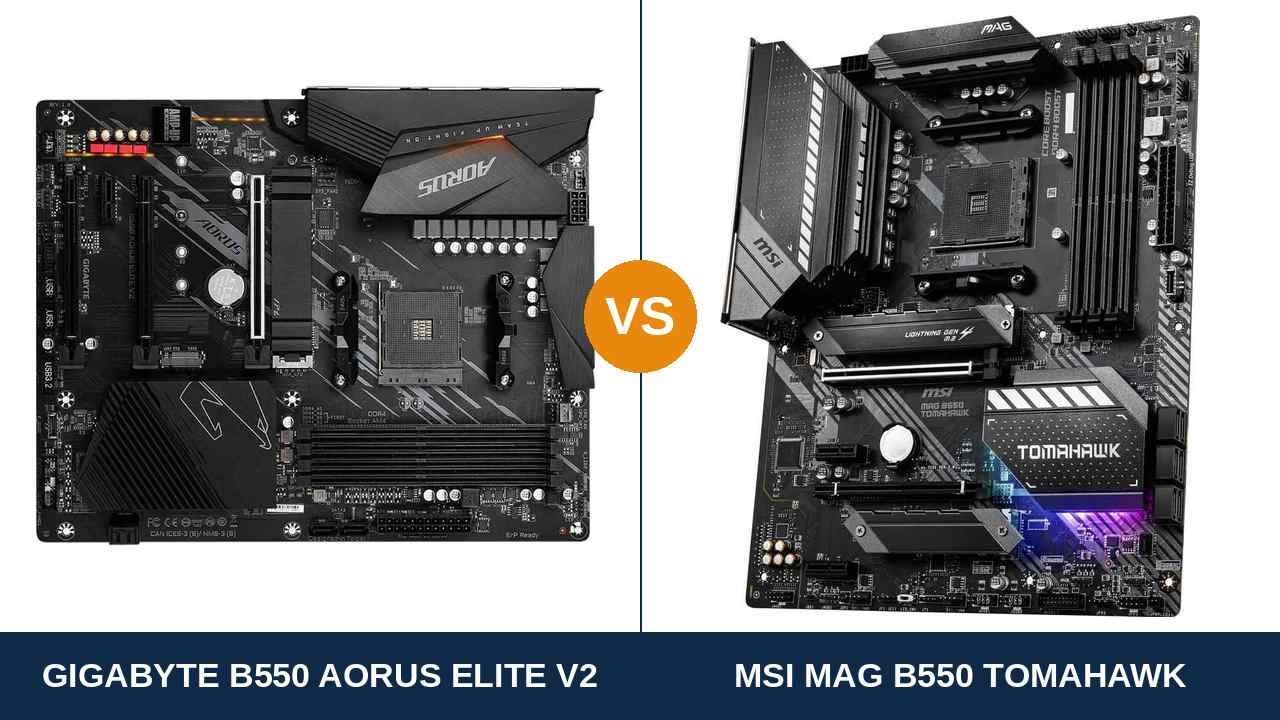
Twelve plus two is a bigger number than ten plus two plus one. Do that sum on a product page and the Gigabyte B550 Aorus Elite V2 appears to win this comparison before it starts.
Hold that thought. The Elite V2 really does field the stronger power design on paper — a 12+2 twin arrangement on 50A DrMOS stages. But a motherboard is not a VRM with accessories bolted on; it is also the ports, slots and connectors around the socket, and that is where this pairing is decided.
Read past the phase count and a pattern emerges. Gigabyte takes the headline rounds: more power stages, one extra rear USB port, display outputs specified to the standard. The Tomahawk takes the working rounds: a second network port, six SATA connectors, a properly wired second slot, heatsinks over both M.2 positions.
Everything below is drawn from the manufacturers’ own specification pages and manuals — including the conditions Gigabyte prints in its fine print, which turn out to matter. The verdict follows the spec sheet, not the poster.
Key Takeaways
- The Elite V2 wins the spec that sells boards. Its 12+2 DrMOS VRM out-counts the Tomahawk’s 10+2+1 on paper — though both run every AM4 processor at stock settings.
- The Tomahawk is the more complete board overall. Dual LAN, six SATA ports, an x4-wired second slot and heatsinks on both M.2 slots.
- NVMe speed and audio are dead ties: dual PCIe x4 M.2 storage on both, and the same ALC1200 codec with optical output.
- Read the Elite V2’s fine print. Its rear Gen 2 USB drops to Gen 1 speeds behind a G-series APU, and rev. 1.0/1.1 boards cool only one M.2 slot.
- One support gap settles some builds outright: the Tomahawk does not support the Ryzen 3 3200G or Ryzen 5 3400G. The Elite V2 does.
Quick Verdict
For most builds, the board to buy is the MSI MAG B550 Tomahawk. It wins this comparison on breadth rather than on any single headline.
It is the only board here with two wired network ports, it accepts six SATA drives against four, its second slot runs at x4, and it heatsinks both M.2 slots instead of just the first.
Buy the Gigabyte B550 Aorus Elite V2 if power delivery is the spec you shop by, or you are building around an APU. Its DrMOS design is the stronger published here, its seven rear USB ports lead on count, and DisplayPort 1.4 with HDMI 2.1 is the better documented output pair for integrated graphics.
Two conditions ride along — a CPU-dependent USB caveat and a revision-dependent cooling detail, both covered below. APU builders should read them before paying.
The Scorecard
Scores below are derived directly from the manufacturer specifications compared in this guide — phase counts, slot counts, port counts and supported standards. They are a reading aid, not benchmark results.
| Category | B550 Aorus Elite V2 | MAG B550 Tomahawk | ||
|---|---|---|---|---|
| Power delivery | 9 / 10 | 9 / 10 | ||
| Storage | 8 / 10 | 9 / 10 | ||
| Expansion | 7 / 10 | 8 / 10 | ||
| Memory | 8 / 10 | 9 / 10 | ||
| Networking & audio | 8 / 10 | 9 / 10 | ||
| USB & connectivity | 8 / 10 | 8 / 10 | ||
| Display outputs (APU builds) | 9 / 10 | 8 / 10 | ||
| Overall | 8.5 / 10 | 8.8 / 10 | ||
The scorecard is this review in miniature. On silicon — power stages, display standards — the Elite V2 pulls level or edges ahead. On infrastructure, the Tomahawk quietly collects one small, permanent win after another.
At a Glance: Who Each Board Fits
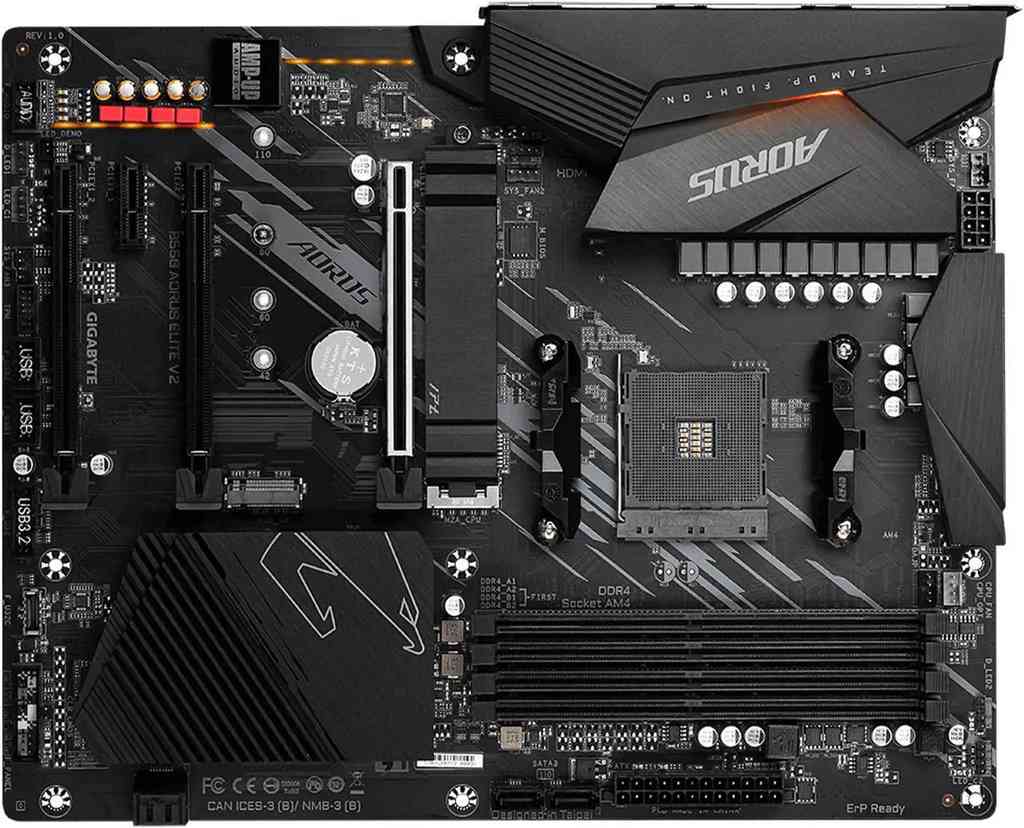
Gigabyte B550 Aorus Elite V2
- 12+2 phase twin VRM, 50A DrMOS, enlarged heatsinks
- Seven rear USB ports, two of them Gen 2
- DisplayPort 1.4 + HDMI 2.1 for APU builds
- Realtek 2.5GbE LAN, ALC1200 audio with optical out
- 256 Mbit BIOS with Q-Flash Plus button
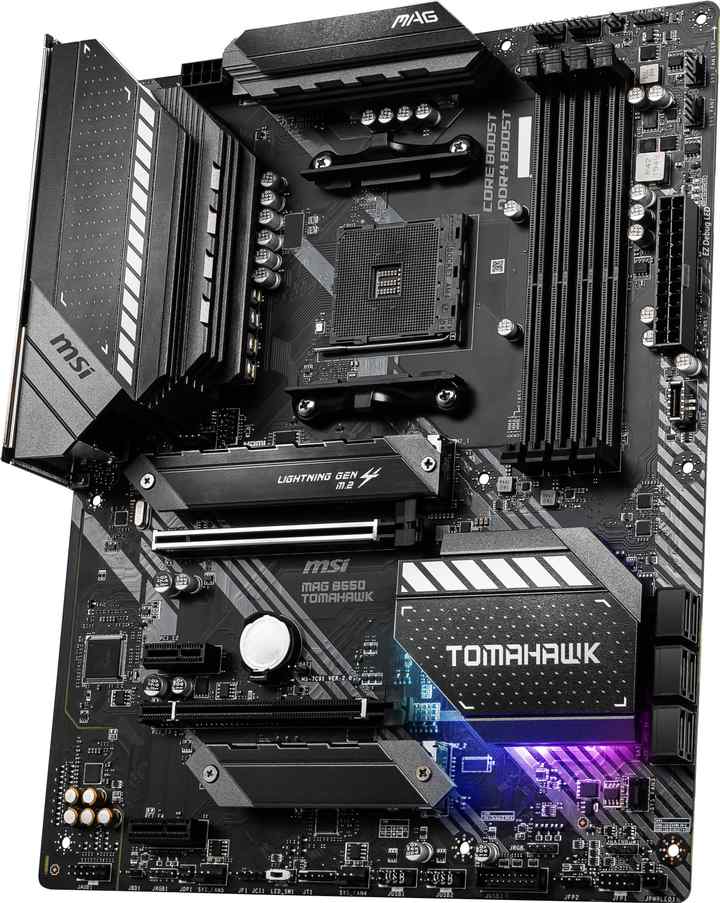
MSI MAG B550 Tomahawk
- 10+2+1 Duet Rail VRM with extended heatsinks
- Dual LAN: 2.5 Gb/s plus a second Gigabit port
- Six SATA ports; both M.2 slots heatsinked
- Second x16 slot runs at full x4 speed
- Rear USB-C at Gen 2 speed, Flash BIOS Button
Choose the B550 Aorus Elite V2 if…
Power delivery tops your priority list. Twelve plus two DrMOS stages is the stronger published design in this pairing.
You are driving a modern monitor from an APU. Gigabyte names its standards — DisplayPort 1.4 and HDMI 2.1 — where MSI leaves its versions unstated.
Your build recycles a Ryzen 3 3200G or 5 3400G — the only board here that supports them is the Elite V2.
Choose the MAG B550 Tomahawk if…
Your network is more than one cable. A NAS, a second machine or a home lab gives the second LAN port real work.
Your drive shelf runs deeper than four SATA devices. Six ports take the collection whole; four do not.
A serious add-in card is in the plan someday. The x4 slot feeds it properly rather than starving it at x2.
As an Amazon Associate I earn from qualifying purchases at no extra cost to you.
Specifications: The Specs That Actually Matter
Every figure below comes from Gigabyte’s and MSI’s published specifications and product data. Where a board exists in several revisions, the Gigabyte figures reflect revision 1.0/1.1 — the widely sold version, explained in the notes under the table.
| Specification | Gigabyte B550 Aorus Elite V2 | MSI MAG B550 Tomahawk |
|---|---|---|
| Form factor | ATX, 30.5 × 24.4 cm | ATX, 30.5 × 24.4 cm |
| Socket / chipset | AMD AM4 / B550 | AMD AM4 / B550 |
| CPU support | Ryzen 5000, 5000 G, 4000 G, 3000, 3000 G series | Ryzen 5000 & 3000, 4000 G-Series (not 3200G/3400G) |
| VRM design | 12+2 phase digital twin, 50A DrMOS, enlarged heatsinks | 10+2+1 Duet Rail, digital PWM, extended heatsinks |
| Memory | 4 × DDR4 DIMM, up to 128 GB, 4733 MT/s (O.C.), XMP | 4 × DDR4 DIMM, up to 128 GB, 5100 MT/s+ (O.C.) |
| Graphics outputs (APU) | DisplayPort 1.4, HDMI 2.1 | HDMI, DisplayPort |
| Expansion slots | PCIe 4.0 x16 + PCIe 3.0 x16 (x2) + PCIe 3.0 x16 (x1) + PCIe 3.0 x1 | PCIe 4.0 x16 Steel Armor + PCIe 3.0 x16 (x4) + 2 × PCIe 3.0 x1 |
| M.2 storage | 2 slots: PCIe 4.0 x4 (22110) + PCIe 3.0 x4 (22110); Thermal Guard on one slot | 2 slots: PCIe 4.0 x4 (22110) + PCIe 3.0 x4; heatsinks on both slots |
| SATA | 4 × SATA 6 Gb/s, RAID 0/1/10 | 6 × SATA 6 Gb/s, RAID 0/1/10 |
| LAN | Realtek 2.5GbE (2.5 Gb/s) | Realtek 2.5 Gb/s + Realtek Gigabit (dual LAN) |
| Audio | Realtek ALC1200, 7.1 HD, optical S/PDIF out | Realtek ALC1200, 7.1 HD, optical S/PDIF out |
| USB (rear panel) | 7 ports: 2 × USB 3.2 Gen 2, 3 × Gen 1, 2 × USB 2.0 | 6 ports: USB 3.2 Gen 2 Type-C + Type-A, 2 × Gen 1, 2 × USB 2.0 |
| Front-panel USB-C | USB 3.2 Gen 1 Type-C header | USB 3.2 Gen 1 Type-C header |
| BIOS flashing | Q-Flash Plus with rear-panel button, 256 Mbit flash | Flash BIOS Button (no CPU/RAM/GPU needed) |
| Wi-Fi | None (separate AX V2 Wi-Fi model exists) | None |
Two notes on the Gigabyte figures. First, the Elite V2’s M.2 cooling depends on revision. Boards from revisions 1.0/1.1 — the basis of this article — ship a single Thermal Guard, while Gigabyte’s rev. 1.5 page advertises guards on both slots. The M.2 cooling gap described below belongs to the earlier revisions.
Second, Gigabyte’s spec sheet ties the Elite V2’s rear Gen 2 USB speed to the processor: full Gen 2 with Ryzen 5000 and 3000 chips, Gen 1 with G-series APUs. MSI’s documentation attaches no processor condition to the Tomahawk’s rear Gen 2 ports.
One MSI support line also deserves daylight: the Tomahawk’s CPU list omits the 3200G and 3400G. If either APU is coming over from an older build, the Elite V2 is not the better choice — it is the only one that works.
The Differences That Actually Matter
1. Power delivery — the Elite V2’s headline, honestly sized
Begin with Gigabyte’s best argument: the Elite V2 spreads CPU power across a 12+2 phase twin digital design, each stage a 50A DrMOS part, under enlarged heatsinks.
MSI’s answer is a 10+2+1 Duet Rail arrangement driven by a digital PWM controller, under its own extended heatsinks — a different architecture with fewer counted phases. As a published specification, the Gigabyte design is the stronger one, and this guide scores it that way: more stages sharing the work means more headroom for a processor pushed beyond stock.
Then comes the part the posters leave out. At stock settings, both VRMs run the entire AM4 range — Ryzen 9 5950X included — without power delivery becoming a problem you would ever detect. The Elite V2’s margin is real, but for most builders it stays in reserve permanently.
Manual overclockers should weight this section heavily and buy the Gigabyte. Everyone else should treat it as level and move on — as the scorecard does.
2. Storage — identical NVMe layout, different supporting cast
On NVMe drives the two boards are interchangeable. Each provides a CPU-connected PCIe 4.0 x4 M.2 slot and a second, chipset-fed PCIe 3.0 x4 slot, both accepting the longer 22110 form factor. Boot times, game loads and file copies will not separate them.
Cooling is where they part. MSI installs a Shield Frozr heatsink over each slot. The Elite V2, in the rev. 1.0/1.1 form used here, fits its Thermal Guard to one slot and leaves the second drive to case airflow; only rev. 1.5 boards guard both positions.
A fast Gen 4 drive in the unguarded slot still works; it simply runs warmer under sustained writes — precisely what the heatsink exists for.
SATA draws the sharpest line here: six ports against four. One archive drive never shows the difference; a set of SATA drives transplanted from a previous machine can exhaust the Gigabyte’s four ports mid-job.
3. Networking — two ports against one, and no adapter fixes it
Headline networking is level: a Realtek 2.5-gigabit port apiece, and the same link speed into a modern switch. Then the Tomahawk plays its unique card — a second, gigabit Realtek port beside the first, where the Elite V2’s rear panel has empty space.
Who uses one? The NAS owner who wants storage traffic on its own segment, the builder with a second PC to feed, the home-lab experimenter, anyone who wants a backup route into a machine when the network is down.
If your networking begins and ends with one cable to one router, mark this section even. Otherwise, know the second port cannot be retrofitted as cleanly as one that was simply there. USB adapters exist; they are not the same thing.
4. USB — seven ports against six, with a condition attached
Count first: the Elite V2 leads the rear panel seven ports to six, two of them at USB 3.2 Gen 2 speed. On raw count, Gigabyte wins the section.
Look at shapes and the picture complicates. Both of the Elite V2’s Gen 2 ports are Type-A. The Tomahawk’s smaller set includes a rear Gen 2 Type-C — the connector phones, docks and fast external drives expect. Up front, honours are even: each board has a Gen 1 Type-C header for a case port.
Now attach the condition from Gigabyte’s own specification: those rear Gen 2 ports run at full speed only behind Ryzen 5000 and 3000 processors. Fit a G-series APU and they step down to Gen 1.
So the section splits by build. Behind a graphics card and a Ryzen 5000 chip, the Elite V2’s extra port and dual Gen 2 Type-A sockets make the better rear panel. In an APU build, the Tomahawk’s unconditional Gen 2 — Type-C included — beats a count with an asterisk.
5. Expansion — four slots that are not what they seem
The slot count flatters the Gigabyte: four physical slots against three on the MSI. Brochure arithmetic says the Elite V2 is the expansion board.
The wiring says otherwise: below the graphics slot, the Elite V2’s two additional full-length slots are fed at x2 and x1. A long card physically fits; its bandwidth does not follow.
MSI wires the Tomahawk’s second full-length slot at x4 — the wiring a capture card, a 10-gigabit network card or an NVMe carrier needs to perform as advertised rather than at a fraction of its rate.
For the majority build — one graphics card, nothing else, ever — this section is a formality, since both boards serve the GPU an identical full-speed PCIe 4.0 x16. For a PC expected to grow, the Tomahawk’s arrangement keeps its promises.
6. Display outputs — a section only APU builders need
Fitting a graphics card makes this section academic — both boards’ onboard outputs go dark. Discrete-GPU builders may skip ahead with a clear conscience.
Building on integrated graphics instead? Then the outputs are the display system, and Gigabyte documents its pair properly: DisplayPort 1.4 and HDMI 2.1, standards named in the specification. That pairing drives a 4K desktop or a high-refresh monitor as intended.
MSI also fits HDMI and DisplayPort outputs, so a two-monitor APU desk works on the Tomahawk too. What MSI does not publish is the versions of those standards — and an APU buyer should take named guarantees over unnamed ones.
One compatibility warning rides along: the APU must be one the Tomahawk supports. The 3200G and 3400G are absent from MSI’s list, while Gigabyte covers the 3000 G-series — for those two chips, this is not a preference but the whole decision.
7. Memory and audio — where the spec sheets shake hands
Memory, quickly: four DDR4 slots and a 128 GB ceiling on both boards. MSI publishes the bolder headline — 5100 MT/s and beyond, against Gigabyte’s 4733 MT/s.
File that headline under marketing. The speed a kit sustains is governed by the processor’s memory controller and the modules themselves, and the sensible AM4 buying zone — 3200 to 3600 MT/s — sits far beneath either ceiling. The Tomahawk takes the scorecard point for the printed number; in a running PC you will not measure it.
Audio requires even less deliberation, because there is nothing to deliberate: both manufacturers fit Realtek’s ALC1200 codec in a 7.1 HD implementation, and both include an optical S/PDIF output — still the cleanest way to feed an AV receiver or soundbar at this level.
One production note: MSI’s summaries list the Tomahawk’s codec as ALC1200 or ALC1220P by production run, while teardowns identify the fitted part as the ALC1200. This guide uses ALC1200 — audio is a genuine tie. Decide this comparison anywhere except here.
CPU Pairing Guide
Start from the processor and most of this comparison resolves itself. The table below is the short version of everything above.
| Your processor | B550 Aorus Elite V2 | MAG B550 Tomahawk | Our call |
|---|---|---|---|
| Ryzen 5 5600 / 5500 | Excellent | Excellent | Either — buy on price |
| Ryzen 5 5600G / 5700G (APU) | Excellent displays; rear Gen 2 drops to Gen 1 | Excellent — Gen 2 USB at full speed | Elite V2 for displays, Tomahawk for USB |
| Ryzen 3 3200G / 3400G (older APU) | Supported | Not supported | B550 Aorus Elite V2 |
| Ryzen 7 5700X / 5800X | Excellent | Excellent | Either — both VRMs are comfortably sufficient |
| Ryzen 9 5900X / 5950X | Excellent at stock, stronger VRM on paper | Excellent at stock | Elite V2 if you overclock; Tomahawk otherwise |
| Ryzen 3000 series | Excellent | Excellent | Either — buy on price |
The older-APU row is the only line that eliminates a board outright. Everything else here is emphasis; that row decides whether the machine boots with your processor at all.
Ready to check today’s price?
Both boards sell through Amazon. Prices move, so check the live figure on the board that fits your build.
View on Amazon — B550 Aorus Elite V2View on Amazon — MAG B550 TomahawkThe 30-Second Decision
| If this sounds like you… | Buy this |
|---|---|
| “I want the strongest VRM in this price band, full stop.” | B550 Aorus Elite V2 (12+2 DrMOS) |
| “Integrated graphics, and my monitor is 4K or high-refresh.” | B550 Aorus Elite V2 (DP 1.4 + HDMI 2.1) |
| “The build reuses a Ryzen 3 3200G or 5 3400G.” | B550 Aorus Elite V2 (only supported option) |
| “There is a NAS, or a second PC, that deserves its own network port.” | MAG B550 Tomahawk |
| “Half a dozen SATA drives are coming over from my old build.” | MAG B550 Tomahawk (six ports) |
| “A capture card or a 10-gigabit card is on the future shopping list.” | MAG B550 Tomahawk (x4 second slot) |
| “Whichever of the two is discounted when I check out.” | Fair call — for a simple gaming build the difference is small |
What You Gain. What You Give Up.
Gigabyte B550 Aorus Elite V2
You gain: the strongest power-delivery design published in this pairing — 50A DrMOS stages under enlarged heatsinks. Seven rear USB ports. Display outputs specified to the standard, and a 256 Mbit BIOS chip.
You give up: a second network port, two SATA connectors, and — on rev. 1.0/1.1 boards — a heatsink over the second M.2 slot. Full Gen 2 speed from the rear ports also disappears whenever an APU is installed.
MSI MAG B550 Tomahawk
You gain: a second wired network port nothing else in this pairing offers. Six SATA connectors, heatsinks over both M.2 slots, a second slot wired for real x4 work, and rear Gen 2 USB at rated speed behind every supported processor.
You give up: the phase-count argument — 10+2+1 against 12+2 DrMOS. One rear USB port. And any build based on the 3200G or 3400G, which this board does not support.
Pros and Cons
B550 Aorus Elite V2 — Pros
- 12+2 phase DrMOS VRM, 50A stages
- Seven rear USB ports, two at Gen 2
- DisplayPort 1.4 + HDMI 2.1, both specified
- ALC1200 audio with optical S/PDIF
- Supports the full AM4 APU range, incl. 3400G
- 256 Mbit BIOS with Q-Flash Plus
Cons
- Single LAN port
- Only four SATA ports
- One M.2 Thermal Guard on rev. 1.0/1.1
- Rear Gen 2 USB slows to Gen 1 behind APUs
- Extra x16-length slots run at only x2 and x1
- No Wi-Fi (that is the AX V2)
MAG B550 Tomahawk — Pros
- Dual LAN: 2.5 Gb/s plus Gigabit
- Six SATA ports for drive-heavy builds
- Both M.2 slots heatsinked
- Second x16 slot wired at x4
- Rear USB-C at Gen 2 speed
- Higher published memory ceiling (5100+ MT/s)
Cons
- No support for Ryzen 3 3200G / 5 3400G
- Six rear USB ports, one fewer than the Elite V2
- VRM is out-counted on paper by the Gigabyte
- No Wi-Fi
Check the Revision, the Variant and the Listing
Check the Elite V2 revision: one name, several boards, and revisions differ in ways that show up in this comparison.
Revisions 1.0/1.1, the basis used here, carry a single M.2 Thermal Guard; revision 1.5 advertises guards on both slots. The marking sits on the box label and the corner of the PCB — the board photographed for this guide is stamped REV: 1.0 — so confirm it before assuming the second drive gets a heatsink.
Do not let the AX V2 into the basket by accident. It is a separate, Wi-Fi-equipped model. Antennas in the photos, or wireless in the title, mean a different board from the one compared here.
The same caution covers the rest of the family: the original pre-V2 B550 Aorus Elite and the micro-ATX B550M Aorus Elite are distinct products with their own specifications. “V2” has to be in the name — the full name.
Apply the same discipline on the MSI side. The board in this guide is the wired MAG B550 Tomahawk. MSI also sells a MAG B550 Tomahawk MAX WiFi — a later model, not a bundle — and the Tomahawk name now sits on B650 and X870 boards for AM5, which take a different processor and different memory entirely.
Verify your APU appears on the Tomahawk’s CPU list. The 3200G and 3400G exclusions are the one hard compatibility trap in this pairing. Every other mainstream AM4 processor is covered by both boards, and both can update their BIOS with no processor installed — Q-Flash Plus on the Gigabyte, the Flash BIOS Button on the MSI.
Check the bundle. Expect workmanlike contents: the board, SATA cables and documentation, with the I/O shield pre-installed on the Aorus. No antennas in either box — neither board has wireless.
The Upgrade Path Test
Grade a mid-range board by what it permits in its second and third years, not by its first boot.
Processor headroom is shared. AM4 ends at the Ryzen 9 5950X and the 5800X3D, and both VRMs run those chips at stock. The Elite V2’s power-stage margin matters only to the minority who overclock manually.
Storage growth favours the Tomahawk: two additional SATA ports for the drives you accumulate, and a heatsink waiting over the second M.2 slot.
Expansion growth favours it as well: an x4 slot accepts tomorrow’s capture card or fast network adapter at full rate, where the Elite V2’s long slots feed the same hardware at x2 or x1.
Networking is a one-way door. The Tomahawk’s second port costs nothing until the day a NAS or second machine arrives — then it is priceless, and was free. The Elite V2 owner meets that day with an adapter purchase.
Gigabyte’s honest counter is about the present tense: the stronger VRM and the seventh USB port are there from the first power-on. Weigh which tense you are buying for.
When to Skip Both
Two good boards can both be wrong for a given build. These are the cases.
Skip both if wireless belongs on the board itself. The manufacturers anticipated you: MSI’s Tomahawk MAX WiFi and Gigabyte’s Elite AX V2 exist for exactly that.
Skip both if the build is compact. Each is full ATX at 30.5 × 24.4 cm, and micro-ATX expressions of the same formula are widely available.
Skip both if nothing is being reused. AM4 is a completed platform; with no AM4 processor and no DDR4 on the shelf, price the AM5 successors before committing to a finished socket.
And skip both if the plan calls for more than two M.2 drives, or PCIe 5.0 storage. Neither board offers either.
Outside those cases stands the large population of AM4 builders extending a platform they already own — and for them, the preceding sections identify the correct purchase.
BIOS and Long-Term Support
A finished platform is a support advantage in disguise. The surprises are known, the drivers settled, and the BIOS on both boards mature.
Each manufacturer maintains full support pages: CPU support lists by revision, BIOS downloads, chipset and LAN drivers. Future BIOS releases on a platform this stable concern security fixes and edge compatibility — the correct agenda.
Both boards also insure the update process itself: Q-Flash Plus and the Flash BIOS Button can each rewrite the firmware with no CPU, memory or graphics card fitted, so a failed update is recoverable at home. Gigabyte’s 256 Mbit flash chip gives that process generous room.
Keep one habit regardless of board: consult the support list for your revision, and update the BIOS before installing a newer processor. Ten minutes of prevention, on either board.
Final Verdict
Our money goes on the MSI MAG B550 Tomahawk.
It concedes the round printed in bold type: the Elite V2’s VRM is the stronger published design, and if that were the whole comparison, the Gigabyte would take it.
It is not the whole comparison. Around the socket, the Tomahawk assembles the more useful board: two network ports where the rival has one, six SATA connectors where it has four, cooling over both M.2 positions, a second slot wired for real work, and top-speed rear USB regardless of the processor installed.
Those are specifications with a long half-life: they decide whether a board still suits your setup years after the phase counts are forgotten.
Buy the Tomahawk for drive-heavy builds, for any desk with serious wired networking, and for a PC you expect to keep adding to.
View on Amazon — MAG B550 Tomahawk
Buy the B550 Aorus Elite V2 if power delivery is your stated priority, if an older APU the Tomahawk excludes is part of the build, or if its price undercuts the MSI’s by a margin that matters to you on the day.
It is a genuinely strong board that loses on breadth rather than quality. In a simple single-drive gaming build, its advantages are the ones you would feel, and its compromises may never surface.
View on Amazon — B550 Aorus Elite V2
Watch Out: Similar Names, Different Boards
B550 naming rewards sloppy reading, and both families are repeat offenders. Three distinctions are worth memorising.
First: within Gigabyte’s own range, the Elite V2 is one of four similar names. The original B550 Aorus Elite predates it, the B550M Aorus Elite shrinks it, and the AX V2 adds wireless to it. Only the plain V2 is the board specified here.
Second: the MAG B550 Tomahawk shares its badge with the Tomahawk MAX WiFi and with AM5 Tomahawks on B650 and X870 — shared branding over very different hardware. The AM5 versions accept neither an AM4 processor nor DDR4 memory.
Third: beware the abbreviated listing. A title that stops at “Aorus Elite” conceals the revision, the size and the wireless question at once.
Read the product page slowly. Full model name first, revision second, price last. In that order, every time.
Case, Power and Cabling Notes
Both boards measure 30.5 × 24.4 cm in full ATX. Either requires a case with ATX mounting; neither fits an enclosure built for micro-ATX.
The front-panel story is level: each board carries a Gen 1 Type-C header, so a modern case’s front USB-C port connects natively to both.
Drive cabling is where the layouts diverge in practice: six SATA ports let the Tomahawk serve a full drive cage, while the Elite V2’s four leave a simpler build with fewer cables to manage.
One note for APU builders running without a graphics card: leave breathing room above the VRM heatsinks — both boards cool substantial power stages passively, and airflow over them is cheap reliability.
Frequently Asked Questions
Which board is better, the B550 Aorus Elite V2 or the MAG B550 Tomahawk?
The Tomahawk, for most builders — narrowly. Gigabyte fields the stronger VRM on paper (12+2 DrMOS against 10+2+1), but MSI answers with dual LAN, six SATA ports, heatsinks on both M.2 slots and an x4 second slot. Which list matters more depends on your build.
Which of the two boards has the stronger VRM?
The B550 Aorus Elite V2, on specification: a 12+2 phase twin digital design with 50A DrMOS stages, against MSI’s 10+2+1 Duet Rail layout. In use, both boards run the full Ryzen 5000 range at stock settings without difficulty. The Gigabyte’s edge is headroom for manual overclocking.
Will both boards handle a Ryzen 9 5950X?
Yes. The 5950X appears on both support lists and both power designs are sized for it. Update the BIOS before installing a late-release chip. Note the Tomahawk’s one support gap at the other end of the range: the 3200G and 3400G are not supported on the MSI board.
Does either board have Wi-Fi?
Neither — both are wired designs built around 2.5-gigabit Ethernet. For wireless on the board, look at the MSI Tomahawk MAX WiFi or the Gigabyte Elite AX V2: separate models, separate listings.
Why does the Elite V2’s rear USB speed change with the processor?
Because Gigabyte’s specification routes those ports through the processor: they deliver Gen 2 speed behind Ryzen 5000 and 3000 chips, but fall back to Gen 1 behind G-series APUs. MSI publishes no equivalent restriction for the Tomahawk’s rear ports.
How many SATA drives does each board accept?
Four on the B550 Aorus Elite V2, six on the MAG B550 Tomahawk. Both also provide two M.2 slots for NVMe storage. Anyone migrating a shelf of SATA drives from an older PC will find the two-port difference among the most practical in this comparison.
What changes between the Elite V2 revisions?
The visible change is M.2 cooling: revisions 1.0/1.1 ship with one Thermal Guard, revision 1.5 with guards on both slots. The core specification used here — VRM, networking, USB, expansion — is consistent across the V2 revisions. The revision is printed on the box label and the board’s corner.
Is the B550 Aorus Elite V2 the same board as the AX V2?
No. The AX V2 is a distinct model that adds Wi-Fi and Bluetooth. The plain Elite V2 compared in this guide is wired-only. Antennas or wireless claims in a listing mean you are looking at the AX model.
Sources & Verification
GIGABYTE B550 AORUS ELITE V2 (rev. 1.0/1.1) official specifications, gigabyte.com • GIGABYTE B550 Aorus Elite V2 (rev. 1.5) product page for the Thermal Guard revision note • MSI MAG B550 TOMAHAWK official specifications and datasheet, msi.com • Manufacturer product data via Newegg listing N82E16813145249 (Elite V2) for revision and bundle details • Codec note: MSI’s summary lists the Tomahawk codec as ALC1200/ALC1220P by production run; reviews identify the fitted codec as ALC1200, used here. Specifications verified November 2026.

James Wilson
James has been building and benchmarking PCs for over a decade and writes Honestly Compared’s motherboard and component guides. His rule for every comparison: the verdict has to survive the spec sheet, not the marketing page.