
MSI B550-A Pro vs MSI MPG B550 Gaming Plus: Which Should You Buy?
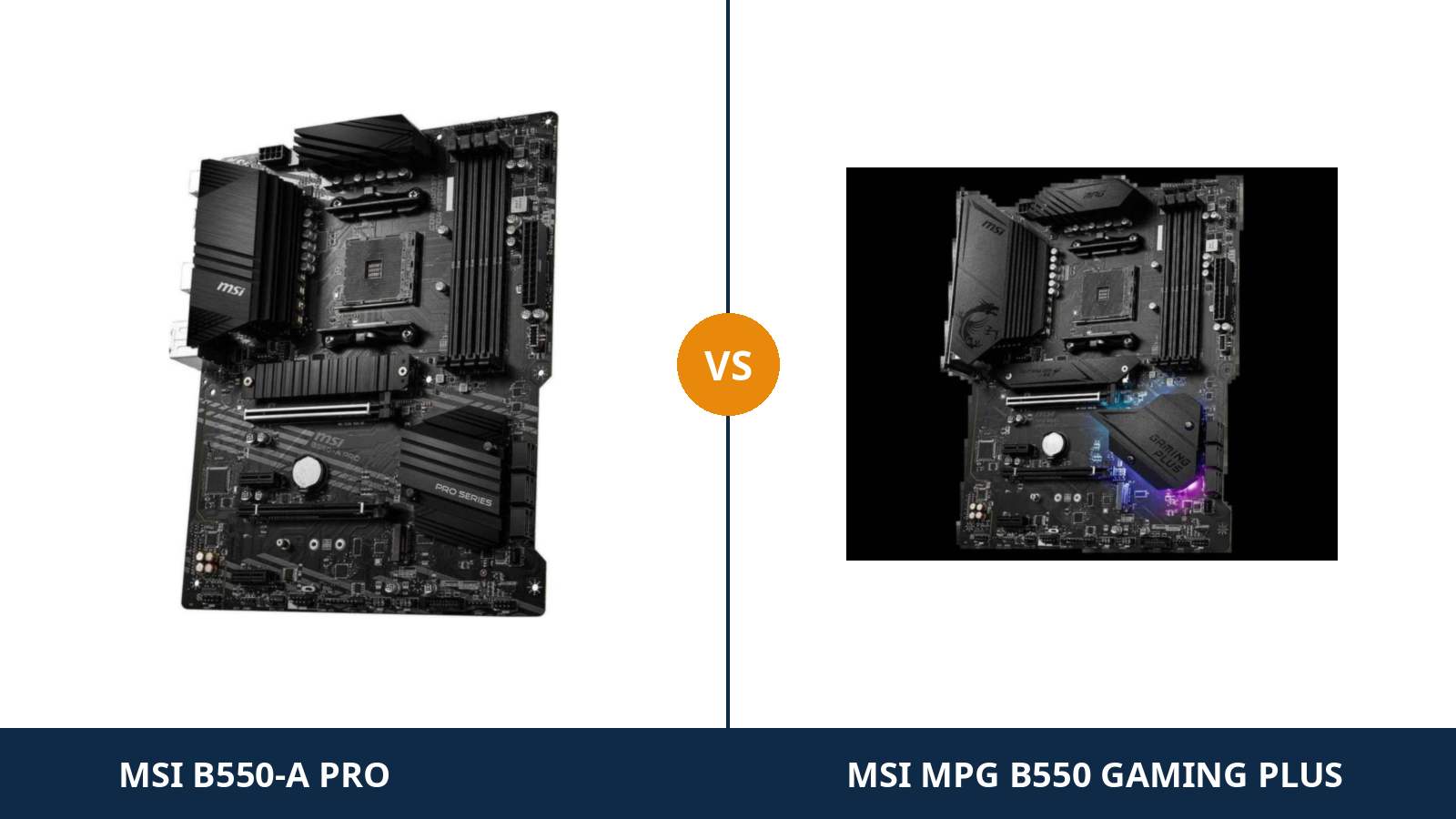
Most motherboard comparisons are settled on build day. This one is settled about a year later — on the afternoon you buy a second NVMe drive.
Up to that moment, these two MSI boards are functionally the same machine. Same power design. Same storage layout. Same USB map, same network chip, same audio codec.
MSI sells one as a workhorse and one as a gaming board. The gaming board usually costs more. What the extra money buys is presentation: an optical audio output, a shield already fitted at the factory, lighting controls.
What it quietly costs only shows up later. Populate the second M.2 slot on the Gaming Plus and its x4 expansion slot switches off. Do the same on the B550-A Pro and a humble x1 slot takes the sacrifice instead — the x4 slot keeps working.
That single rule, plus a handful of trim differences, is the whole comparison. This guide works through it from MSI's own data — and lands where we would land with a friend's money: the plainer board is the better buy, and not just because it is cheaper.
Key Takeaways
- The foundation is shared. Identical 10+2+1 Duet Rail VRM with extended heatsink and 8+4-pin power, dual M.2 storage, six SATA ports, the same gigabit LAN chip and the same audio codec.
- Lane sharing is the deciding difference. Fit a second NVMe drive and the B550-A Pro loses an x1 slot; the Gaming Plus loses its x4 slot outright.
- The Gaming Plus is the AV and showcase pick. Optical S/PDIF output, a pre-installed I/O shield, an LED control switch and Mystic Light headers.
- The B550-A Pro is the practical pick. EZ Debug LEDs for fault-finding, a serial port header, and a typically lower price for the same core hardware.
- Neither board has Wi-Fi or 2.5-gigabit Ethernet. If either is non-negotiable, you need a higher tier of MSI's B550 range.
Quick Verdict
Buy the MSI B550-A Pro for most builds. It is the same foundation without the garnish — and it keeps the more useful expansion slot when your storage grows.
Power delivery is identical. Storage is identical. USB is identical, right down to the front-panel Type-C header. When a second NVMe drive goes in, the A Pro gives up an x1 slot and keeps its x4 slot alive for a capture card, a faster network card or another SSD adapter.
Add EZ Debug LEDs for the day something refuses to boot, and a usually lower price, and the workhorse wins on points that outlast the unboxing.
Buy the MSI MPG B550 Gaming Plus if your audio runs over an optical cable, or the build is a glass-panel showcase. Its S/PDIF output feeds receivers, soundbars and DACs the A Pro cannot. Its shield arrives pre-installed. Its lighting controls are the real thing.
Those are genuine features. They are just narrow ones — worth the premium only if they describe your build.
The Scorecard
Scores below are derived directly from the manufacturer specifications compared in this guide — phase counts, slot counts, port counts and supported standards. They are a reading aid, not benchmark results.
| Category | B550-A Pro | MPG B550 Gaming Plus | ||
|---|---|---|---|---|
| Power delivery | 9 / 10 | 9 / 10 | ||
| Expansion & lane sharing | 8 / 10 | 7 / 10 | ||
| Storage | 9 / 10 | 9 / 10 | ||
| Memory | 9 / 10 | 9 / 10 | ||
| Networking & audio | 6 / 10 | 7 / 10 | ||
| USB & rear panel | 8 / 10 | 8 / 10 | ||
| Extras & trim | 7 / 10 | 8 / 10 | ||
| Overall | 8.0 / 10 | 7.8 / 10 | ||
Read the table the way the boards were designed. Everything that moves data or feeds the processor is level. The Gaming Plus scores its wins on the panel and the presentation; the A Pro scores its win in the one row that cannot be fixed later — what stays alive when the board fills up.
At a Glance: Who Each Board Fits
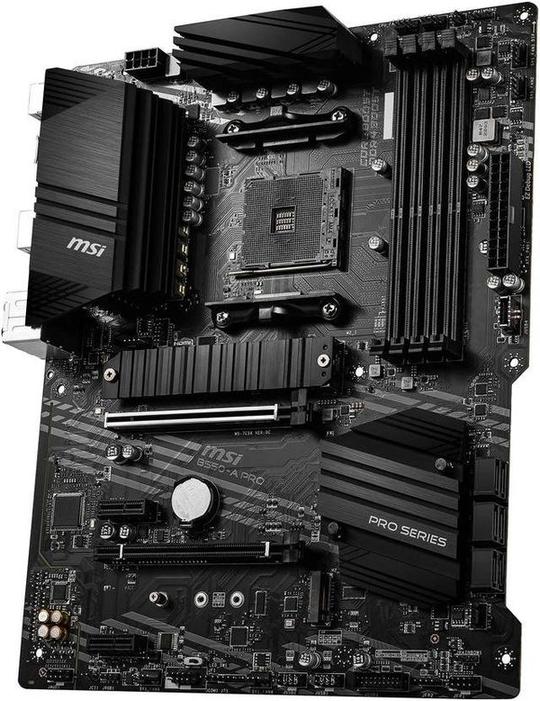
MSI B550-A Pro
- 10+2+1 Duet Rail VRM, extended heatsink, 8+4-pin CPU power
- Keeps its PCIe x4 slot live with two NVMe drives fitted
- EZ Debug LEDs for fast first-boot fault-finding
- Dual M.2 with Shield Frozr heatsink, 6 × SATA
- Serial port header for legacy and workshop gear
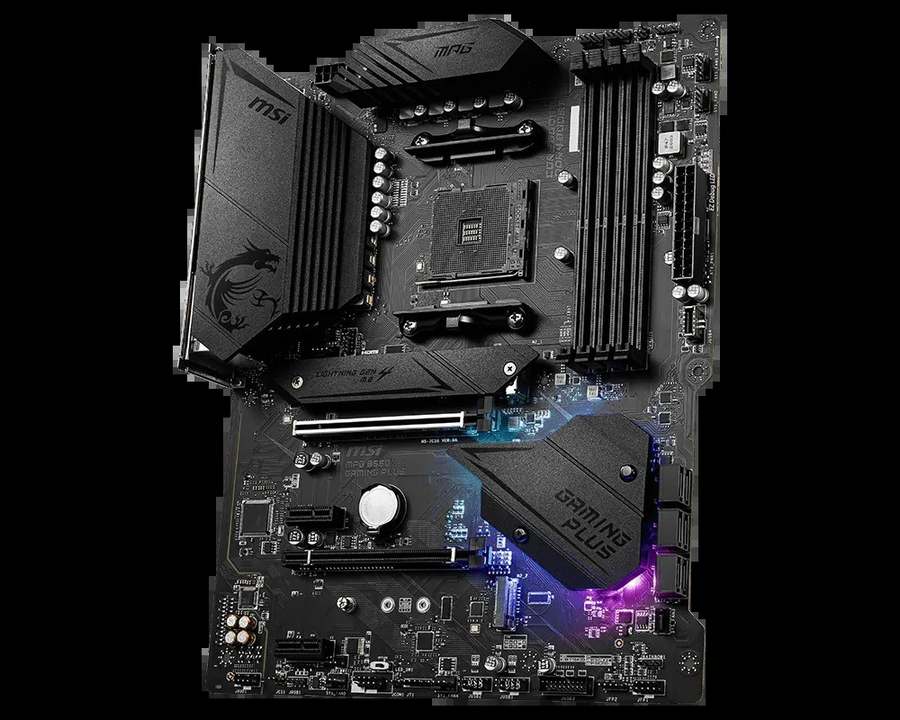
MSI MPG B550 Gaming Plus
- The same 10+2+1 Duet Rail VRM and extended heatsink
- Optical S/PDIF output for receivers and soundbars
- Pre-installed I/O shield — one less build-day fumble
- Mystic Light RGB headers plus an EZ LED Control switch
- Dual M.2 with Shield Frozr heatsink, 6 × SATA
Choose the B550-A Pro if…
A second NVMe drive is in the plan — now or in a year — and an add-in card might follow it. A capture card. A 10-gigabit network card. Another drive on an adapter.
You maintain your own PCs and want the board that tells you what failed. Four debug LEDs beat an hour of swapping parts.
Or your build is a workstation, an office machine or a home server, where a serial header is a feature and RGB is not.
Choose the MPG B550 Gaming Plus if…
Your sound comes from a receiver, a soundbar or a DAC with an optical input. On this pair, only the Gaming Plus can feed it digitally.
The build sits behind glass and lighting is part of the point. Mystic Light headers and a hardware LED switch are the tidier way to run it.
Or you will only ever fit one NVMe drive. In that build, the Gaming Plus's one real penalty never triggers — and its trim is free to enjoy.
As an Amazon Associate I earn from qualifying purchases at no extra cost to you.
Specifications: The Specs That Actually Matter
Every figure below is taken from MSI's published specifications, datasheets and manuals for these two models. The parity is real — this table is long because the boards share almost all of it.
| Specification | MSI B550-A Pro | MSI MPG B550 Gaming Plus |
|---|---|---|
| Form factor | ATX, 30.5 × 24.4 cm | ATX, 30.5 × 24.4 cm |
| Socket / chipset | AMD AM4 / B550 | AMD AM4 / B550 |
| CPU support | Ryzen 5000, 5000 G, 4000 G, 3000 series | Ryzen 5000, 5000 G, 4000 G, 3000 series |
| VRM design | 10+2+1 Duet Rail digital power, extended heatsink, 8+4-pin CPU power | 10+2+1 Duet Rail digital power, extended heatsink, 8+4-pin CPU power |
| Memory | 4 × DDR4 DIMM, up to 128 GB, 4400 MT/s (O.C.), A-XMP | 4 × DDR4 DIMM, up to 128 GB, 4400 MT/s (O.C.), A-XMP |
| Graphics outputs (APU) | HDMI, DisplayPort | HDMI, DisplayPort |
| Expansion slots | PCIe 4.0 x16 + PCIe 3.0 x16 (x4) + 2 × PCIe 3.0 x1 | PCIe 4.0 x16 + PCIe 3.0 x16 (x4) + 2 × PCIe 3.0 x1 |
| Lane sharing | Second M.2 populated → one PCIe x1 slot disabled; x4 slot stays live | Second M.2 populated → PCIe x4 slot disabled |
| M.2 storage | 2 slots: PCIe 4.0 x4 (CPU) + PCIe 3.0 x4 (chipset), M.2 Shield Frozr heatsink | 2 slots: PCIe 4.0 x4 (CPU) + PCIe 3.0 x4 (chipset), M.2 Shield Frozr heatsink |
| SATA | 6 × SATA 6 Gb/s, RAID 0/1/10 | 6 × SATA 6 Gb/s, RAID 0/1/10 |
| LAN | Realtek RTL8111H Gigabit Ethernet | Realtek RTL8111H Gigabit Ethernet |
| Audio | Realtek ALC892, 7.1 HD Audio Boost, analogue jacks only | Realtek ALC892, 7.1 HD Audio Boost, optical S/PDIF out |
| USB 3.2 (rear) | Gen 2 Type-A + Gen 2 Type-C (10 Gb/s), 2 × Gen 1 Type-A | Gen 2 Type-A + Gen 2 Type-C (10 Gb/s), 2 × Gen 1 Type-A |
| Front-panel USB-C | USB 3.2 Gen 1 Type-C header | USB 3.2 Gen 1 Type-C header |
| I/O shield | Separate shield in the box | Pre-installed |
| Lighting & extras | EZ Debug LEDs, serial port header | Mystic Light RGB headers, EZ LED Control switch |
| BIOS flashing | Flash BIOS Button (no CPU/RAM/GPU needed) | Flash BIOS Button (no CPU/RAM/GPU needed) |
One variance note, applying to both boards equally: MSI's specification summaries list the audio codec as “ALC892/ALC897” — a production-run variance between two near-identical chips. MSI's own datasheets name the ALC892, so that is the figure used here.
Either chip is a competent 7.1 HD implementation. The variance changes nothing in this comparison, because both boards carry it.
The VRM phase count, likewise, comes from MSI's datasheets rather than the compressed web summary. It is identical on the two boards by design — the Gaming Plus was built on the A Pro's power design, then dressed differently.
The Differences That Actually Matter
1. Lane sharing — the one difference with a fuse on it
Start with the mechanics. The second M.2 slot on a B550 board is fed by the chipset, and its bandwidth is shared with some of the expansion slots. Every B550 board makes a choice about which slot pays.
On the Gaming Plus, MSI's choice lands on the big slot. Populate the second M.2 and the PCIe 3.0 x16 slot — the one wired at x4, sitting below your graphics card — is disabled completely.
On the B550-A Pro, the same action disables one of the two PCIe x1 slots. The x4 slot keeps running. The drive and the card coexist.
Why does the x4 slot deserve defending? Because x4 is where useful hardware lives. Capture cards. 10-gigabit network adapters. NVMe expansion cards. Serious sound and storage controllers.
X1 slots host the small stuff: a basic Wi-Fi card, a serial bracket, extra USB ports. Losing one is an inconvenience. Losing the x4 slot is a closed door.
Now the honest limit of this argument. If your build will only ever hold one NVMe drive, the second M.2 slot stays empty, nothing gets disabled on either board, and this entire section never happens to you.
But storage is the upgrade people actually make. Games grow, libraries grow, and a second drive is the cheapest capacity fix there is. The A Pro is the board that does not bill you an expansion slot for it.
2. Power delivery — there is nothing extra to buy here
Sometimes the gaming version of a board carries a stronger VRM. This is not one of those times.
Both boards run MSI's 10+2+1 Duet Rail digital power design. Both wear the same extended heatsink over it. Both feed the processor through an 8+4-pin EPS arrangement.
That means identical behaviour with every AM4 processor: the same Ryzen 5 ease, the same Ryzen 7 comfort, the same Ryzen 9 stock-settings competence, the same memory and boost behaviour.
If a listing or a salesperson presents the Gaming Plus as the more powerful board, ask them to point at the component that makes it so. On the power design, there is not one.
The Gaming Plus's heatsinks are styled harder — angular, branded, lit by the board's lighting. Styling is a legitimate reason to buy things. It is not a performance figure, and it should not be priced as one.
3. Audio — one codec, one extra door
The audio story has two halves. The first half is a tie: both boards carry Realtek's ALC892 codec under MSI's Audio Boost treatment, with the same 7.1 HD output over analogue jacks.
Through a gaming headset or a pair of powered speakers, the two boards sound the same. There is no quality gap to buy your way across.
The second half is a genuine Gaming Plus win. It adds an optical S/PDIF output on the rear panel. The A Pro has none — analogue jacks only.
Optical is the connection a whole class of audio gear expects: AV receivers, most soundbars, many external DACs and headphone amplifiers. If your desk or your living room routes sound through one of those, the Gaming Plus is not the prettier option. It is the only option of the two.
If your audio is a USB headset, this section scores zero for your build. Know which listener you are before you pay for the port.
4. The rear panel and the shield — same ports, different first hour
Port for port, the rear panels match. A USB 3.2 Gen 2 Type-A and a Gen 2 Type-C at 10 Gb/s. Two more Gen 1 Type-A ports. HDMI and DisplayPort for APU graphics. The same RTL8111H gigabit Ethernet.
Round the front, the match continues: both boards carry a USB 3.2 Gen 1 Type-C header, so a case front-panel USB-C port works on either. No dead port surprises on these two.
The difference is a piece of stamped metal. The Gaming Plus ships with its I/O shield pre-installed on the board.
The A Pro ships with the shield loose in the box — the traditional design, with the traditional two failure modes: forgotten until the board is already screwed down, or seated with its grounding tabs bent into a port.
Neither failure is fatal. Both are annoying, and both happen in the first hour of the build. The Gaming Plus simply removes that hour's most classic mistake.
5. Debug LEDs versus the LED switch — fixing versus lighting
The extras each board chose say a lot about who it expects to own it.
The B550-A Pro carries MSI's EZ Debug LEDs: four small lights labelled CPU, DRAM, VGA and BOOT. When a build refuses to start, the lit LED names the stage that failed.
That turns a dead screen from an evening of reseating and swapping parts into a two-minute diagnosis. For a first build, a work machine or anything maintained by its owner, it is the most useful extra on either board.
The A Pro also keeps a serial port header — legacy, unglamorous, and exactly what certain printers, UPS units, industrial gear and workshop equipment still speak.
The Gaming Plus answers with the EZ LED Control switch, a hardware toggle for the board's lighting, and the fuller Mystic Light header set for strips and fans. If the PC lives behind glass and lighting is part of the build, these are the right extras.
Neither set is better in the abstract. One board helps you fix the computer. The other helps you light it. Buy according to which of those you actually do.
6. Storage, memory and networking — ties, called as ties
Everything else on the spec sheet matches, and an honest comparison gains nothing by dressing ties up as battles.
Storage: two M.2 slots apiece — a PCIe 4.0 x4 slot from the CPU and a PCIe 3.0 x4 slot from the chipset — with an M.2 Shield Frozr heatsink, plus six SATA ports with RAID 0, 1 and 10 on both.
Memory: four DDR4 slots, 128 GB ceiling, 4400 MT/s overclocked support and A-XMP profiles on both. A 3200–3600 MT/s kit remains the sensible gaming buy on either board, and it will run identically.
Networking: the same Realtek RTL8111H gigabit chip on both, and no wireless module on either. If your roadmap includes 2.5-gigabit Ethernet or Wi-Fi, neither of these boards is on it — that is a tier question, answered below.
CPU Pairing Guide
Because the power design is shared, no processor separates these boards. The pairing table is therefore really about which extras your build will use — the processor rows are the honest ties, and the call column points at the trim.
| Your processor | B550-A Pro | MPG B550 Gaming Plus | Our call |
|---|---|---|---|
| Ryzen 5 5600 / 5500 | Excellent | Excellent | Buy whichever is cheaper |
| Ryzen 7 5700X / 5800X | Excellent — full VRM headroom | Excellent — identical VRM | B550-A Pro, unless you need optical audio |
| Ryzen 9 5900X / 5950X | Workable — the shared VRM's sensible ceiling | Workable — same ceiling | Either at stock; a stronger tier for heavy overclocking |
| Ryzen 5 5600G / 5700G (APU) | Excellent — HDMI + DisplayPort | Excellent — HDMI + DisplayPort | Dead tie; choose on trim and price |
| Ryzen 3000 series | Excellent | Excellent | Buy whichever is cheaper |
Both boards run the big chips at stock settings without drama, because the VRM was never the cut-down part of either design. Sustained all-core overclocking is where a higher tier earns its money — over both of these, equally.
The 30-Second Decision
| If this sounds like you… | Buy this |
|---|---|
| “Two NVMe drives now — and maybe a capture card or a faster network card later.” | B550-A Pro (keeps the x4 slot) |
| “My receiver or soundbar connects with an optical cable.” | MPG B550 Gaming Plus |
| “Glass side panel, lighting everywhere, the build is part of the room.” | MPG B550 Gaming Plus |
| “An office or workshop PC that has to be easy to fix on a Monday morning.” | B550-A Pro (EZ Debug LEDs) |
| “One fast SSD, one graphics card, nothing else, ever.” | Either — buy the cheaper listing |
| “I need Wi-Fi or 2.5-gigabit Ethernet built in.” | Neither — see When to Skip Both |
Ready to check today’s price?
Both boards sell through Amazon. The price gap between them moves — check the live figure on the board that fits your build.
View on Amazon — B550-A ProView on Amazon — MPG B550 Gaming PlusWhat You Gain. What You Give Up.
MSI B550-A Pro
You gain: the same core hardware as the gaming board — VRM, storage, USB, LAN, codec — with the expansion layout that survives growth. An x4 slot that stays live with two NVMe drives fitted. EZ Debug LEDs for fault-finding, a serial header, and usually a lower price.
You give up: optical audio output entirely. The pre-installed shield and the lighting-control extras. And the gaming styling — this board looks like equipment, because it is.
MSI MPG B550 Gaming Plus
You gain: the optical S/PDIF output the A Pro lacks, a shield already fitted at the factory, an LED control switch and the fuller Mystic Light setup — wrapped around the same core hardware, with gaming heatsink styling to match.
You give up: the x4 expansion slot on the day a second NVMe drive goes in. The debug LEDs that make a dead build easy to diagnose. And typically some money, paid for presentation rather than capability.
Pros and Cons
B550-A Pro — Pros
- Identical 10+2+1 VRM to the gaming board
- Keeps its PCIe x4 slot live with two NVMe drives fitted
- EZ Debug LEDs for two-minute fault-finding
- Serial port header for legacy gear
- Typically the cheaper of the two
Cons
- No optical S/PDIF audio output
- Loose I/O shield — the classic forgotten part
- No lighting-control extras
- Gigabit LAN only, no Wi-Fi (true of both)
MPG B550 Gaming Plus — Pros
- Optical S/PDIF output for receivers and soundbars
- Pre-installed I/O shield
- EZ LED Control switch and Mystic Light headers
- The same core hardware as the A Pro
- Gaming heatsink styling for showcase builds
Cons
- Second NVMe drive disables the x4 slot
- No debug LEDs
- The premium buys presentation, not performance
- Gigabit LAN only, no Wi-Fi
Check the Name Carefully — One Letter Buys a Different Board
Mind the M. MSI also sells a B550M-A Pro. It is a micro-ATX board — smaller, differently laid out, with a different feature set — that shares nine-tenths of this board's name.
Listings abbreviate. Search results blur. Before ordering, confirm the full name reads “B550-A Pro” with no M, and that the board in the photo is a full ATX design with three PCIe x16-length slots below the socket.
Check what is actually in the box. On the A Pro, the I/O shield is a separate part in the packaging. If your box seems to lack a shield on the board, that is the design, not a defect — it is in the box, and it goes in the case before the board does.
On the Gaming Plus the shield arrives fitted. If a listing photo shows a bare rear panel on a Gaming Plus, you are looking at the wrong product photo.
Do not sweat the BIOS version. Both boards carry MSI's Flash BIOS Button. A board that ships with an older BIOS can be updated for a Ryzen 5000 processor with no CPU, memory or graphics card installed.
That removes the oldest AM4 buying anxiety entirely. Whichever of these you order, it can be made ready for your processor in minutes.
Buy for the second year, not the first day. The practical question in this comparison is not what your build looks like at assembly. It is whether a second drive and one more card are plausible later. Answer that honestly and the choice makes itself.
The Upgrade Path Test
AM4 is a finished platform, which makes the upgrade question refreshingly concrete: everything either of these boards will ever run already exists.
The processor path is shared. Start on a Ryzen 5, finish on a Ryzen 7 or a stock Ryzen 9 — the identical VRM covers the whole ladder on both boards, and four DIMM slots take memory to 128 GB either way.
The graphics path is shared too. A full PCIe 4.0 x16 slot on both, with room for any card the platform makes sense with.
Where the paths fork is storage and expansion together. On the A Pro, the natural endgame — two NVMe drives plus an x4 card for capture, networking or more storage — all fits at once.
On the Gaming Plus, that same endgame forces a choice: the second drive or the card. That is the upgrade this comparison keeps coming back to, because it is the one real-world builders actually reach.
If your endgame is a single fast drive and the best-looking board in the case, the Gaming Plus's path is uncompromised. If your endgame accumulates hardware, the A Pro is the one that keeps saying yes.
When to Skip Both
Neither board is the answer for every AM4 build. Four situations should send you elsewhere in the range.
Skip both if Wi-Fi has to live on the board. MSI sells wireless B550 models; do not spend an expansion slot solving a problem the range already solves.
Skip both if 2.5-gigabit Ethernet matters. Both boards stop at the RTL8111H gigabit chip. The MAG B550 Tomahawk class is where MSI's wired networking steps up.
Skip both if your case is micro-ATX. These are full ATX boards, and no amount of spec parity changes a physical fit.
And skip both if sustained all-core overclocking on a Ryzen 9 is the build's purpose. They run the big chips properly at stock; a heavier VRM tier exists for the other job.
Final Verdict
The MSI B550-A Pro is the board we would build on.
It takes this comparison on the only terms that survive contact with year two. The core hardware is identical to the gaming board's — the same VRM, the same storage, the same USB and networking — so nothing is surrendered by choosing it.
What it adds is staying power: an x4 slot that remains live when the second NVMe drive lands, and debug LEDs for the one bad morning every long-lived PC eventually has. That it usually costs less is a bonus, not the argument.
Buy the B550-A Pro for gaming builds that will grow, for workstations and home servers, and for anyone who maintains their own machine.
Buy the MPG B550 Gaming Plus if an optical cable runs from your PC to your sound system. If the build is a showcase and lighting is part of the specification. Or if one NVMe drive is the whole storage plan, forever.
It is the same foundation wearing its budget on the outside. For the right build, that is a fair trade — just make it knowingly.
View on Amazon — MPG B550 Gaming Plus
Watch Out: Similar Names, Different Boards
MSI's B550 naming is dense enough to catch careful buyers. Four traps surround this pair.
First: the B550M-A Pro is not this board. One letter smaller, one form factor smaller — a micro-ATX product with its own layout and feature set. Spot the M before you spot the bargain.
Second: the B450-A Pro and B450 Gaming Plus are the previous generation. B450 boards run PCIe 3.0 graphics and storage. A cheap listing with a 4 in it is not a bargain version of these boards; it is a different platform tier.
Third: the MAG B550 Tomahawk is a genuine step up, not a rename — faster wired networking, a higher audio tier, a stronger feature set. If its price ever meets the Gaming Plus's, the comparison in this guide no longer applies.
Fourth: the MPG B550 Gaming Edge WiFi is the wireless relative in the gaming line. The Gaming Plus here has no Wi-Fi module. Do not let a sibling's spec sheet sell you this board.
Case, Power and Cabling Notes
Both boards are full ATX, 30.5 × 24.4 cm. They need an ATX-capable case; mid-towers are the natural home for either.
Power is a 24-pin main connector plus the 8+4-pin EPS arrangement both boards share. A reputable modern supply with an 8-pin EPS lead covers stock processors comfortably; the additional 4-pin is headroom for high-draw overclocking, and both boards expose it identically.
Front-panel wiring is the same job on both: a USB 3.2 Gen 1 header, a USB-C Gen 1 header, USB 2.0 headers and the usual front-panel block. A case with front USB-C gets a working port from either board.
One layout note: the x4 slot sits below the graphics slot on both boards, so a card in it breathes the same way on either. The only difference is whether it stays electrically alive once your storage grows — Difference 1, and why the A Pro keeps winning it.
BIOS and Long-Term Support
Both boards sit on MSI's standard support pages, with BIOS updates, chipset and LAN drivers, and a full CPU support list per model. On a mature platform, that support is in its best phase: stable, complete, and free of launch-era surprises.
The Flash BIOS Button deserves a second mention in this section, because it is also the support story. Any BIOS a future processor needs can be applied with the board bare — no donor CPU, no shop visit.
Expect future updates for both boards to be about security fixes and edge-case compatibility rather than new features. That is exactly right for hardware at this point in its life.
One habit covers both boards equally: before a processor upgrade, check the CPU support list for your model, update the BIOS first, and only then swap the chip. Ten minutes of order saves the one troubleshooting session nobody enjoys.
Frequently Asked Questions
Are the MSI B550-A Pro and MPG B550 Gaming Plus the same motherboard?
Nearly. The core hardware is shared: the same 10+2+1 Duet Rail VRM, dual M.2 storage, six SATA ports, USB map, gigabit LAN chip and audio codec. They differ in lane sharing, the Gaming Plus's optical audio output and pre-installed shield, and the extras — debug LEDs and a serial header on the A Pro, lighting controls on the Gaming Plus.
Which board is better for two NVMe SSDs?
Both run two NVMe drives at full speed. The difference appears only if you also want an x4 expansion card: on the B550-A Pro, the second M.2 costs one x1 slot and the x4 slot stays live; on the Gaming Plus, the second M.2 disables the x4 slot itself.
Is the Gaming Plus's VRM better than the B550-A Pro's?
No. Both boards use MSI's 10+2+1 Duet Rail digital power design with the same extended heatsink and the same 8+4-pin CPU power arrangement. Processor support, boost behaviour and overclocking headroom are identical.
Does either board have Wi-Fi or 2.5-gigabit Ethernet?
No. Both boards use the Realtek RTL8111H gigabit Ethernet chip and carry no wireless module. If built-in Wi-Fi or 2.5G LAN is a requirement, look at MSI's higher B550 tiers rather than adding cards to these.
What is the optical output on the Gaming Plus for?
It is an S/PDIF Toslink connection for AV receivers, soundbars and external DACs or headphone amplifiers that take a digital optical feed. If your audio runs over USB or standard analogue jacks, the port changes nothing — the underlying ALC892 codec is the same on both boards.
Is the B550M-A Pro the same board as the B550-A Pro?
No. The B550M-A Pro is a separate micro-ATX model — smaller, with a different layout and feature set. The board in this comparison is the full ATX B550-A Pro. Check the full model name on the listing before buying.
Can I run a Ryzen 9 5900X or 5950X on these boards?
Yes, at stock settings. The shared 10+2+1 VRM with its extended heatsink handles the Ryzen 9 chips properly on both boards. For sustained heavy all-core overclocking, a higher board tier with a stronger power design is the safer buy.
Can I update the BIOS without a CPU installed?
Yes. Both boards have MSI's Flash BIOS Button, which updates the BIOS with no processor, memory or graphics card fitted. That also means a board shipped with an older BIOS can be prepared for a Ryzen 5000 processor in minutes.
Sources & Verification
MSI MPG B550 GAMING PLUS official specifications and datasheet, msi.com • MSI B550-A PRO official specifications and datasheet, msi.com • MSI B550-A PRO user manual (CPU power connectors; M.2/PCIe lane-sharing notes) • Codec figure per MSI datasheets (ALC892); the “ALC892/ALC897” production variance in MSI's spec summaries is noted in the article. Specifications verified November 2026.

James Wilson
James has been building and benchmarking PCs for over a decade and writes Honestly Compared's motherboard and component guides. His rule for every comparison: the verdict has to survive the spec sheet, not the marketing page.