
MSI MAG B550 Tomahawk vs MSI MPG B550 Gaming Plus: Which Should You Buy?
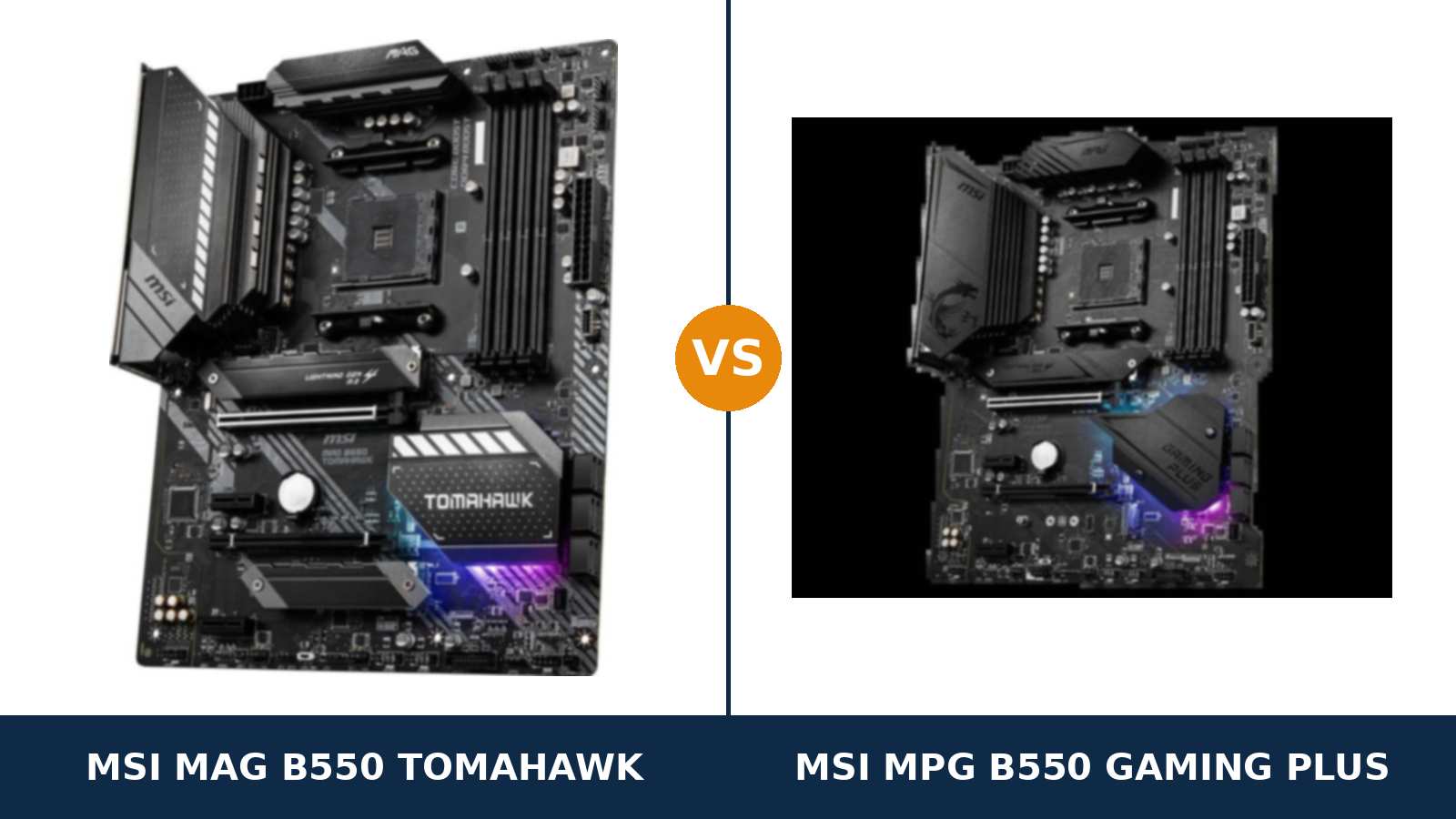
There is an accusation that follows the MAG B550 Tomahawk around every buying thread: that it is a Gaming Plus in a different jacket, sold at a markup for the MAG badge.
It is an easy claim to make: same chipset, same socket, same slot layout, same phase count on both boxes. On a retailer's comparison table, the pair look separated by styling and little else.
So let us audit the claim properly — not with impressions, but with MSI's own parts data: the power stages, the network chips, the audio codecs, the heatsinks, and one lane-sharing rule buried in the cheaper board's manual.
The verdict up front: the markup buys real hardware — but specific hardware, aimed at specific builds. If yours is not one of them, the Gaming Plus keeps your money where it belongs.
Key Takeaways
- The premium is hardware, not branding. The Tomahawk's extra money buys 60A power stages, a second LAN port at 2.5 Gb/s, a higher-tier audio codec and heatsinks over both SSDs.
- The shared 10+2+1 headline is misleading. Both boards print it; only the Tomahawk builds those phases from integrated Smart Power Stages.
- The Gaming Plus hides a real compromise. Install a second M.2 SSD and its x4 expansion slot is disabled — completely, by design.
- For a settled Ryzen 5 or 7 build, the Gaming Plus loses nothing you will feel. Same graphics slot, same storage layout, same front-panel headers.
- Neither board offers Wi-Fi, and neither supports the 3400G or 3200G. Two checkout traps worth knowing before either board reaches your basket.
Quick Verdict
Buy the MSI MAG B550 Tomahawk if the price gap is buying features you will actually use. It is the better-equipped board by any honest count.
Its VRM is built from 60-amp Smart Power Stages under a heatsink. Two Ethernet ports ride the rear panel, the faster at 2.5 Gb/s. The audio codec sits a tier higher, both M.2 slots are heatsinked, and memory ceiling and fan headers both lead the pair.
No single item justifies the premium alone. Together they describe a board specified for builds that grow — bigger processors, faster networks, more drives, more cards.
Buy the MSI MPG B550 Gaming Plus if your build is already decided. A mid-range Ryzen, one graphics card, wired gigabit networking, done.
For that PC, the Tomahawk's extras sit unused while its price difference could have bought memory or storage instead. The Gaming Plus is not the lesser board for simple builds; it is the correctly priced one.
The Scorecard
Scores below are derived directly from the manufacturer specifications compared in this guide — power-stage ratings, port counts, slot counts and supported standards. They are a reading aid, not benchmark results.
| Category | MAG B550 Tomahawk | MPG B550 Gaming Plus | ||
|---|---|---|---|---|
| Power delivery | 9.0 / 10 | 7.5 / 10 | ||
| Networking | 9.5 / 10 | 5.0 / 10 | ||
| Audio | 8.5 / 10 | 7.0 / 10 | ||
| Storage | 9.0 / 10 | 8.0 / 10 | ||
| Memory | 9.0 / 10 | 8.0 / 10 | ||
| Expansion | 8.5 / 10 | 7.5 / 10 | ||
| Overall | 8.8 / 10 | 7.8 / 10 | ||
Notice where the scores converge and where they split. Wherever a feature costs little to include — slots, SATA, headers — the boards tie. Wherever it costs real silicon, the Tomahawk pulls ahead. That is the audit in one table.
At a Glance: Who Each Board Fits
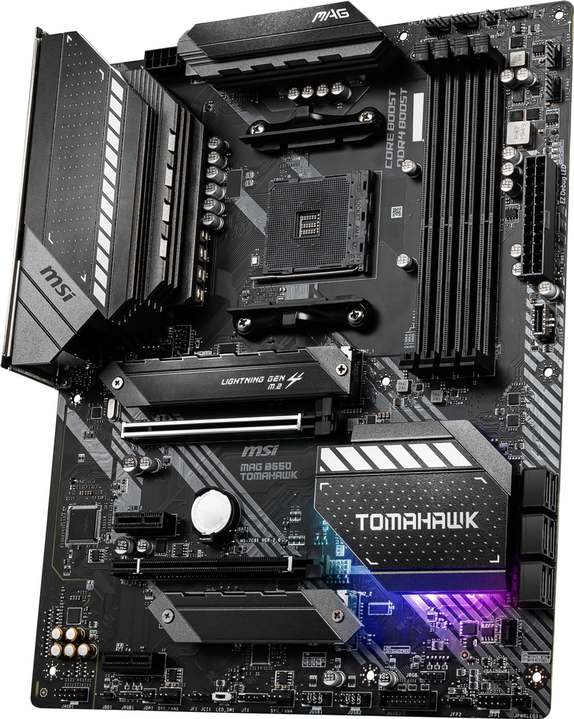
MSI MAG B550 Tomahawk
- 10+2+1 Duet Rail VRM built on 60A Smart Power Stages
- Two Ethernet ports: 2.5 Gb/s (RTL8125B) and gigabit (RTL8111H)
- Realtek ALC1200 audio, optical S/PDIF output included
- Heatsinks over both M.2 slots; memory rated to 5100+ MT/s (O.C.)
- Eight 4-pin fan headers for larger cooling setups
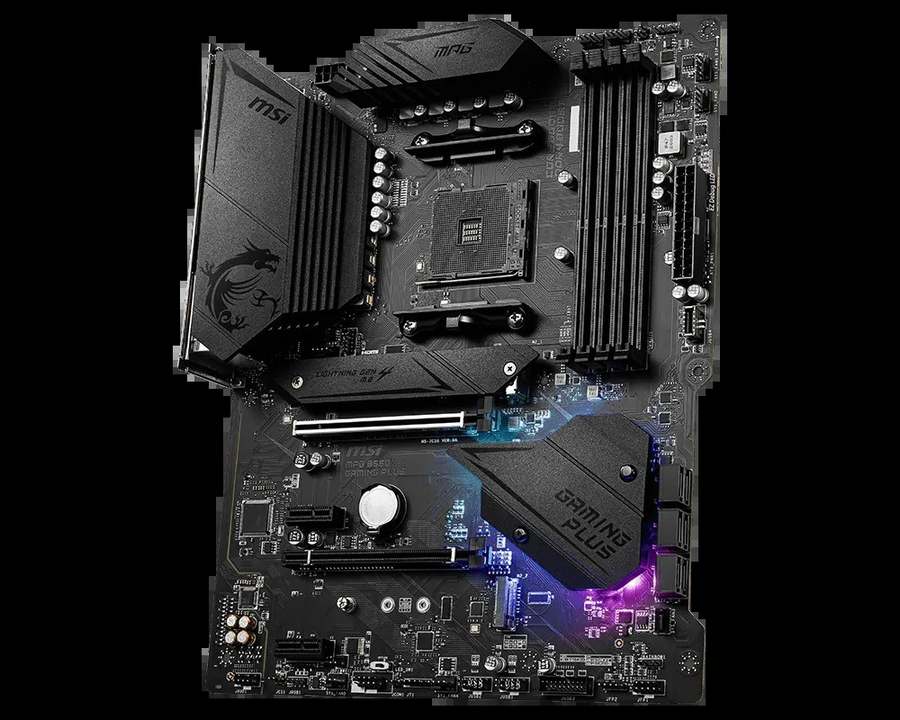
MSI MPG B550 Gaming Plus
- 10+2+1 Duet Rail VRM, discrete MOSFETs, 8+4-pin CPU power
- One gigabit Ethernet port (RTL8111H)
- Realtek ALC892 audio, optical S/PDIF output included
- Two M.2 slots; Shield Frozr heatsink on the primary only
- Typically the cheaper board of the pair
Choose the MAG B550 Tomahawk if…
Your network is faster than gigabit somewhere — a NAS, a home server, a 2.5-gigabit switch — or you want a second wired port in reserve.
A Ryzen 9 is in the build now, or is the upgrade you are quietly planning for when prices soften.
You expect a second SSD and an expansion card to coexist one day, and you listen through good headphones straight off the rear panel.
Choose the MPG B550 Gaming Plus if…
The build is finished on paper: mid-range Ryzen, one GPU, one or two drives, and an internet connection gigabit Ethernet already saturates.
You would rather spend the difference where it shows — a larger SSD, a better memory kit, a quieter cooler.
Or the MPG presentation genuinely appeals: dragon-etched heatsink, RGB underglow, a glass side panel to display both.
As an Amazon Associate I earn from qualifying purchases at no extra cost to you.
Specifications: The Specs That Actually Matter
Every figure below comes from MSI's published specifications, datasheets and user manuals, cross-checked against the manufacturer's product data.
Because the platform is shared, this table concentrates on the rows where the boards actually diverge. Two production-variant notes follow it, and both matter if you plan to quote a number from the table elsewhere.
| Specification | MSI MAG B550 Tomahawk | MSI MPG B550 Gaming Plus |
|---|---|---|
| Form factor | ATX, 30.5 × 24.4 cm | ATX, 30.5 × 24.4 cm |
| Socket / chipset | AMD AM4 / B550 | AMD AM4 / B550 |
| CPU support | Ryzen 5000, 5000 G, 4000 G, 3000 series — not 3400G / 3200G | Ryzen 5000, 5000 G, 4000 G, 3000 series — not 3400G / 3200G |
| VRM design | 10+2+1 Duet Rail, 60A Smart Power Stages, digital PWM, extended heatsink, 8-pin CPU power | 10+2+1 Duet Rail, discrete MOSFETs, extended heatsink, 8+4-pin CPU power |
| Memory | 4 × DDR4 DIMM, up to 128 GB, 5100+ MT/s (O.C.), A-XMP | 4 × DDR4 DIMM, up to 128 GB, 4400+ MT/s (O.C.), A-XMP |
| Graphics outputs (APU) | HDMI + DisplayPort | HDMI + DisplayPort |
| Expansion slots | PCIe 4.0 x16 + PCIe 3.0 x16 (x4) + 2 × PCIe 3.0 x1 | PCIe 4.0 x16 + PCIe 3.0 x16 (x4) + 2 × PCIe 3.0 x1 |
| M.2 storage | 2 slots: PCIe 4.0 x4 / SATA (up to 22110) + PCIe 3.0 x4; heatsinks on both slots | 2 slots: PCIe 4.0 x4 (CPU) + PCIe 3.0 x4 (chipset); Shield Frozr heatsink on slot 1 only |
| SATA | 6 × SATA 6 Gb/s, RAID 0/1/10 | 6 × SATA 6 Gb/s, RAID 0/1/10 |
| LAN | Realtek RTL8125B 2.5 Gb/s + RTL8111H 1 Gb/s (dual ports) | Realtek RTL8111H, 1 Gb/s (single port) |
| Audio | Realtek ALC1200, 7.1 HD, Audio Boost, optical S/PDIF out | Realtek ALC892, 7.1 HD, Audio Boost, optical S/PDIF out |
| USB (rear) | 2 × USB 3.2 Gen 2 (Type-A + Type-C), 2 × Gen 1, 2 × USB 2.0 | 2 × USB 3.2 Gen 2 (Type-A + Type-C), 2 × Gen 1, 4 × USB 2.0 |
| USB (front headers) | USB 3.2 Gen 1 Type-C header + Gen 1 header + 2 × USB 2.0 headers | USB 3.2 Gen 1 Type-C header + Gen 1 header + 2 × USB 2.0 headers |
| Fan headers | 8 × 4-pin (CPU, pump, 6 × system) | 6 × 4-pin (CPU, pump, 4 × system) |
| BIOS flashing | Flash BIOS Button (no CPU/RAM/GPU needed) | Flash BIOS Button (no CPU/RAM/GPU needed) |
Variant notes: MSI's current spec summary prints the Tomahawk's audio as “ALC1200/ALC1220P” and the Gaming Plus's as “ALC892/ALC897” — either chip may be fitted, depending on the production run. This guide uses the launch figures, ALC1200 and ALC892; teardowns of retail Tomahawks confirm the ALC1200 in the wild.
The Tomahawk's memory rating has moved during its production life, from 4866+ MT/s in the 2020 datasheet to 5100+ on MSI's current product page. We use the current figure. On either number, it clears the Gaming Plus's 4400+ rating comfortably.
The Differences That Actually Matter
1. Networking — the widest gap on the board
Start the audit where the difference is largest. The Tomahawk's rear panel carries two Ethernet ports: one driven by Realtek's RTL8125B at 2.5 Gb/s, one conventional gigabit port on the RTL8111H.
The Gaming Plus carries the gigabit port. Only the gigabit port. Its entire wired networking story fits in one sentence.
Now apply the honesty test: a PC wired to a gigabit router and nothing else gains nothing from the Tomahawk's networking — not one megabit. If that is your house, permanently, skip ahead with a clear conscience.
But networks grow peripherals the way cases grow fans. A NAS that transfers at hard-drive speed over a 2.5 Gb/s link. A second machine on a direct cable for backups. A home server. A spare port for the evening a cable drops packets mid-game.
Adding networking later means buying a PCIe card, which introduces the theme of section 3: on these boards, expansion slots are a currency, and the Gaming Plus spends them faster.
If anything you own already talks faster than gigabit, this section alone repays the Tomahawk's premium.
2. Power delivery — same count, different components
Both boxes print 10+2+1 Duet Rail. Read no further and you would call the VRMs identical. They are not, and this is precisely where the markup accusation falls apart.
A phase count counts stages; it does not grade them. The Tomahawk's stages are 60-amp Smart Power Stages — integrated devices combining switching and current sensing in one efficient package — driven by a digital PWM controller under the larger heatsink of the two boards.
The Gaming Plus hits the same count with discrete MOSFETs: proven, adequate, and cheaper silicon, stage for stage.
Under a Ryzen 5 or 7 at stock clocks, the distinction is academic. Both boards deliver clean, cool power indefinitely.
Under a Ryzen 9 sustaining all-core work — renders, compiles, transcodes measured in hours — the Tomahawk's stages run with more thermal margin. Margin is unglamorous. It is also exactly what long ownership consumes.
One apparent contradiction needs clearing up, because it misleads careful buyers. The Gaming Plus accepts an 8+4-pin CPU power feed. The Tomahawk accepts a lone 8-pin.
Connectors are not capability: a single 8-pin EPS feed carries several times the current any AM4 processor can draw at sensible settings, which is why the stronger VRM never asked for a second one. Rate a power design by its stages and heatsink — by that measure, the Tomahawk takes this section without argument.
3. Storage — identical layout, one buried rule
The storage specifications match line for line: a CPU-fed M.2 slot at PCIe 4.0 x4, a chipset M.2 at PCIe 3.0 x4, six SATA ports, RAID 0/1/10. Benchmarks will never separate these boards, and neither will your game library.
The fittings differ. The Tomahawk heatsinks both M.2 slots, so a second drive working hard gets cooling rather than bare PCB, and its primary slot accepts 22110-length drives as a bonus.
The Gaming Plus fits its M.2 Shield Frozr heatsink to the primary slot only. A second drive runs uncovered — acceptable for most SSDs, less kind to a fast one under sustained writes.
Then the rule. On the Gaming Plus, the second M.2 slot shares its lanes with the x4 expansion slot, and MSI's manual is blunt about the consequence: populate M.2_2 and PCI_E3 is disabled. Not slowed. Disabled.
The Tomahawk's manual carries a narrower version of the same arrangement — its x4 slot drops out only when the board is loaded to the maximum, both remaining slots occupied alongside the second M.2. Any ordinary two-drive build keeps the slot in service.
Translate that into ownership. One SSD and no add-in cards: a dead tie. Two SSDs plus a capture card, a sound card, or the network card from section 1: that configuration physically exists on only one of these boards.
4. Audio — a tier apart, with an honest ceiling
Realtek's ALC1200 in the Tomahawk sits a tier above the Gaming Plus's ALC892. Both wear MSI's Audio Boost treatment, both output 7.1 HD audio, and — a genuine tie — both provide an optical S/PDIF output for receivers and soundbars.
The ALC1200's advantage lives in the analogue outputs: cleaner signal, better behaviour with demanding headphones driven straight from the rear panel.
Your equipment decides whether that matters. Basic headsets and entry-level speakers will hide the difference entirely. Quality headphones, a headphone amplifier, or powered monitors will reveal it.
Already run a USB DAC? Then both codecs are bypassed and this section scores level. The audit does not oversell: a tier of codec is a real difference, and a conditional one.
5. Memory — a ceiling most owners will never touch
Four DIMM slots, 128 GB maximum, A-XMP profiles: shared, completely. The 3200–3600 MT/s kits that populate most AM4 builds behave identically on either board.
The divergence is the validated ceiling — 5100+ MT/s on the Tomahawk against 4400+ on the Gaming Plus, per MSI's current pages.
Read that gap as a signal rather than a target: a higher validated ceiling indicates a stronger memory layout beneath — cleaner routing, better training, more margin with four slots populated or a high-frequency kit fitted.
If memory tuning is your hobby, the Tomahawk is your board. If XMP gets switched on once and forgotten, file the difference under reassurance — headline speeds are overclocking figures on both boards, with your CPU's memory controller casting the deciding vote.
6. Cooling connections — two headers of headroom
Neither board disturbs the peace with a chipset fan; B550's passive heatsink remains one of the platform's quiet virtues, and both boards are built on 2 oz copper PCBs.
The difference is arithmetic. The Tomahawk provides eight 4-pin headers: CPU, pump, and six system fans. The Gaming Plus provides six: CPU, pump, and four system.
Four system headers run a typical mid-tower without splitters. Six absorb a large case, a radiator in push-pull and a spare or two, no hubs required.
Cooling arrangements rarely shrink over a motherboard's service life. The Tomahawk simply leaves more room for the arrangement you have not planned yet.
7. Rear panel and presentation — the Gaming Plus's home turf
Fairness demands a section the cheaper board wins, and here it is: four rear USB 2.0 ports against the Tomahawk's two, alongside an identical high-speed contingent — two USB 3.2 Gen 2 ports at 10 Gb/s (Type-A and Type-C) plus two Gen 1 ports on each board.
Legacy ports earn their keep quietly — keyboards, mice, dongles, drawing tablets. Two extra are a small, genuine convenience. Front-panel provision, including the USB-C header, is identical, as is the Mystic Light system with its 12V RGB and 5V addressable headers.
The Gaming Plus also leads on presentation: the etched dragon heatsink, RGB underglow, an EZ LED Control switch for killing the lights from the board itself, and a factory-fitted I/O shield.
The Tomahawk answers with gunmetal restraint. Behind glass, which of these looks better is a matter of taste, and taste is the one category this guide refuses to score.
Stand back and the audit's pattern is consistent: the Gaming Plus wins on price, legacy ports and looks; the Tomahawk wins on every component that cannot be swapped out later. Hold that sentence and you hold the whole comparison.
CPU Pairing Guide
Work backwards from the processor and the choice usually resolves itself. This table compresses the entire comparison into one screen.
| Your processor | MAG B550 Tomahawk | MPG B550 Gaming Plus | Our call |
|---|---|---|---|
| Ryzen 5 5600 / 5500 | Excellent | Excellent | Buy on price — usually the Gaming Plus |
| Ryzen 5 5600G / 5700G (APU) | Excellent — HDMI + DisplayPort | Excellent — HDMI + DisplayPort | Either board; Gaming Plus on price |
| Ryzen 7 5700X / 5800X | Excellent — 60A stages, larger heatsink | Very good | MAG B550 Tomahawk |
| Ryzen 9 5900X / 5950X | Very good — the sensible pick of the two | Workable at stock | Tomahawk; heavy all-core users should look higher |
| Ryzen 3000 series | Excellent | Excellent | Buy whichever is cheaper |
One exclusion applies to both boards with equal force: the Ryzen 5 3400G, Ryzen 3 3200G and every Ryzen 2000 processor are unsupported here. If one of those chips is your starting point, the “When to Skip Both” section below is written for you.
The 30-Second Decision
| If this sounds like you… | Buy this |
|---|---|
| “Skip the audit — which one is simply better?” | MAG B550 Tomahawk |
| “A NAS, a home server, or a 2.5-gigabit switch is on my network.” | MAG B550 Tomahawk (dual LAN) |
| “Ryzen 9 today, or pencilled in as the big upgrade.” | MAG B550 Tomahawk (60A stages) |
| “Two NVMe drives, and a capture card in the x4 slot as well.” | MAG B550 Tomahawk — the Gaming Plus disables that slot with a second M.2 fitted |
| “Ryzen 5, gigabit internet, and I would rather keep the change.” | MPG B550 Gaming Plus |
| “The Gaming Plus is heavily discounted this week.” | Legitimate — for settled builds, the gap stays invisible |
Ready to check today’s price?
Both boards sell through Amazon. Prices move, so check the live figure on the board that fits your build.
View on Amazon — MAG B550 TomahawkView on Amazon — MPG B550 Gaming PlusWhat You Gain. What You Give Up.
MSI MAG B550 Tomahawk
You gain: growing room in every direction — integrated 60A power stages fit for flagship Ryzens, a second network port at 2.5 times gigabit speed, the cleaner ALC1200 codec, cooling over both SSDs, the higher memory ceiling and two extra fan headers.
You give up: money, since it typically sells above its sibling. Two rear USB 2.0 ports. And a spare CPU power connector that its design never needed in the first place.
MSI MPG B550 Gaming Plus
You gain: the same platform for less — PCIe 4.0 graphics, twin M.2 slots, four memory slots and the front USB-C header all survive the price cut intact, joined by four rear USB 2.0 ports, an 8+4-pin power feed, a pre-fitted I/O shield and the full dragon-and-RGB show.
You give up: fast and dual networking. The integrated power stages. A tier of audio quality. Cooling on the second SSD — and the moment that second SSD is installed, the x4 slot goes with it.
Pros and Cons
MAG B550 Tomahawk — Pros
- 60A Smart Power Stages — genuine Ryzen 9 headroom
- Dual LAN: 2.5 Gb/s alongside gigabit
- ALC1200 audio with optical S/PDIF
- Heatsinks on both M.2 slots; 22110 support
- 5100+ MT/s memory ceiling; eight fan headers
Cons
- Usually the pricier of the two
- Single 8-pin CPU power (sufficient, but plain)
- Only two rear USB 2.0 ports
- No Wi-Fi — same as the Gaming Plus
- Overkill for a basic Ryzen 5 build
MPG B550 Gaming Plus — Pros
- Usually the cheaper route into the same platform
- Slot and storage layout identical to the Tomahawk
- Four rear USB 2.0 ports for peripherals
- 8+4-pin CPU power feed
- Pre-installed I/O shield; EZ LED Control switch
Cons
- Single gigabit LAN — no 2.5 Gb/s, no second port
- Discrete-MOSFET VRM behind the same 10+2+1 headline
- Second M.2 drive disables the x4 expansion slot
- ALC892 audio sits a tier below
- Memory support stops at 4400+ MT/s
- No Wi-Fi
Before You Order: Names, Codecs and Box Contents
Treat the listing title as a legal document. MSI's naming in this range is a genuine hazard, and three lookalikes matter for this comparison.
The B550 Tomahawk MAX WiFi is a newer, separate motherboard with Wi-Fi 6E on board and a price to match. This guide covers the original MAG B550 Tomahawk, which contains no wireless hardware whatsoever. Antenna stubs in a listing photo mean the photo shows another board.
The B450 Tomahawk Max is the previous generation wearing a near-identical name. One digit changes; PCIe 4.0 disappears entirely. A fine used buy on its own terms — just not the product on this page.
Within the MPG family, the Gaming Plus sits below the Gaming Edge WiFi and Gaming Carbon WiFi, both of which include wireless. A “Gaming” board advertised with Wi-Fi at a Gaming Plus price is either a listing error or a different model. Proceed accordingly.
Verify the codec if audio is your deciding section. The variant note under the spec table explains why: each board's production runs carry one of two possible chips. The ranking between the boards survives either draw, but the fitted codec is printed on the PCB, and a seller can confirm it.
Do not pay a premium for BIOS stickers. Both rear panels carry a Flash BIOS Button that updates firmware with no CPU, memory or graphics card installed. A board from early stock is no barrier to a Ryzen 5000 build, and a “5000 ready” sticker — present or absent — is worth exactly nothing.
Expect a spartan box. Board, SATA cables, M.2 screws, paperwork. The Gaming Plus saves you one small ritual by fitting its I/O shield at the factory. Neither box contains antennas, because neither board could connect one.
The Upgrade Path Test
Every other component in a PC can be swapped in an afternoon. The motherboard is the decision all future decisions must live with — so judge these two by their third year, not their first.
In year one, fitted with a Ryzen 5 and a mid-range graphics card, the boards are indistinguishable. Identical frame rates. Identical load times. Nothing a benchmark screenshot could separate.
Then ownership starts making requests. The Ryzen 9 falls in price. The game library outgrows the first SSD. The home network gains a faster switch. A capture card arrives for the streaming project that finally launches.
The Tomahawk fields every request without negotiation. Its stages were specified for the flagship chip. Its fast LAN port already exists. Its x4 slot survives the second SSD.
The Gaming Plus handles the processor request, within reason — then begins invoicing for the rest. The second SSD costs an expansion slot. Faster networking costs a card, possibly installed in the slot the SSD just took.
Neither board is a mistake. One was specified to be outgrown slowly; the other, to be enough. Buy according to the ownership you genuinely have planned, not the one that flatters the budget today.
When to Skip Both
An honest comparison also tells some readers to leave. Five profiles should do exactly that.
Wireless-first builders are the first: with no Wi-Fi module on either board, onboard wireless as a hard requirement points to MSI's B550 Tomahawk MAX WiFi or MPG B550 Gaming Edge WiFi instead.
Owners of excluded processors are the second. The Ryzen 5 3400G, Ryzen 3 3200G and the entire Ryzen 2000 series cannot run on B550 at all. Keeping one of those chips means shopping the B450 generation.
Small-case builders are the third. Both boards are full ATX; a micro-ATX case wants the MAG B550M Mortar class of product, not optimism and a hacksaw.
Platform movers are the fourth. Anyone committed to DDR5 memory and PCIe 5.0 belongs on AM5, and no B550 board — however well specified — alters that arithmetic.
The fifth is the hardcore overclocker. A Ryzen 9 destined for heavy daily manual overclocking deserves the power delivery of an X570 flagship, a class above everything discussed here.
Outside those five profiles sits the large majority of AM4 builders. For them, the answer is one of the two boards above — and the audit has already told you which.
BIOS and Long-Term Support
Maturity is an underrated specification, and both boards have it in full.
AM4's rough edges were discovered and filed down years ago. The firmware is settled, the drivers are settled, and the compatibility surprises have already happened — to other people, on older BIOS versions.
MSI maintains both products on its standard support pages: BIOS downloads, chipset, network and audio drivers, and CPU support lists that answer any processor question definitively. Expect future releases to concern security fixes and corner cases — the correct pace for a platform in its long, stable years.
The Flash BIOS Button earns a second mention here because it doubles as a support feature: a failed flash or a newly released CPU becomes a USB stick and ten minutes, not a returns process.
Keep one habit and either board serves quietly for years: before fitting a new processor, check the support list and update the BIOS first.
Final Verdict
The audit is closed, and it clears the Tomahawk: our money goes on the MSI MAG B550 Tomahawk.
The markup accusation does not survive contact with the parts list. Where the Gaming Plus matches a headline figure, the Tomahawk backs the same figure with better components — integrated 60A stages instead of discrete MOSFETs, a 2.5-gigabit port beside the ordinary one, a cleaner codec, heatsinks over both drives, and a memory ceiling in a different bracket.
Individually, each advantage is modest. Across five years of ownership they compound into the difference between a board you grow into and a board you negotiate with.
Order the Tomahawk for Ryzen 7 and 9 builds, for homes wired faster than gigabit, for serious headphones — and for any PC whose specification is still going to change.
View on Amazon — MAG B550 Tomahawk
Order the Gaming Plus when it undercuts the Tomahawk by a margin that matters and the build is finished on paper: mid-range Ryzen, one graphics card, gigabit networking, no expansion card anywhere in the roadmap.
Nothing about the Gaming Plus is a trick — it is a fair board sold at a fair price. Just understand the exchange before you accept it: the discount is paid out of tomorrow's flexibility, never out of today's performance.
View on Amazon — MPG B550 Gaming Plus
Frequently Asked Questions
What does the Tomahawk's higher price physically buy?
Components, not cosmetics. Integrated 60A Smart Power Stages instead of discrete MOSFETs, a second Ethernet port running at 2.5 Gb/s, the ALC1200 codec instead of the ALC892, a heatsink over the second M.2 slot, a higher validated memory ceiling and two extra fan headers. Whether that list earns the premium depends entirely on whether your build uses any of it.
My internet is gigabit. Is the Tomahawk's fast LAN port wasted on me?
For internet traffic alone, yes — a 2.5 Gb/s port cannot speed up a gigabit connection. It earns its place inside the home: moving files to a NAS, streaming between machines, linking two PCs directly. The Tomahawk's second gigabit port is separately useful as a spare.
Will a Ryzen 9 5950X overwhelm the Gaming Plus?
At stock settings, no — its 10+2+1 Duet Rail design feeds a 5950X correctly. What it lacks is the Tomahawk's margin: integrated 60A stages and a larger heatsink run cooler under hours of all-core load. For a 5950X bought for sustained productivity work, that margin is the sensible reason to step up.
What exactly happens when I add a second SSD to the Gaming Plus?
The drive works at full PCIe 3.0 x4 speed — but the board disables its PCI_E3 slot, the x16 slot wired at x4, to free the lanes. Any card living there stops working. The Tomahawk applies the same trade only when every remaining slot is also occupied, so a typical two-drive build keeps its x4 slot.
Does the Gaming Plus's 8+4-pin power feed make its VRM stronger?
No. It makes it differently fed. A single 8-pin EPS connector already carries far more current than any AM4 CPU can use, which is why the Tomahawk — with the stronger power stages of the two — ships with one connector. Compare the stages under the heatsinks, not the plugs beside them.
Can I add Wi-Fi to either board later?
Yes, with a PCIe wireless card — both boards have x1 slots suited to one. Plan the slot budget first on the Gaming Plus, whose x4 slot disappears if a second M.2 drive is fitted. If Wi-Fi is a day-one requirement rather than a maybe, the B550 Tomahawk MAX WiFi and MPG B550 Gaming Edge WiFi build it in.
Which board handles a four-stick memory kit better?
The Tomahawk, on paper and in practice. Its validated ceiling of 5100+ MT/s against the Gaming Plus's 4400+ reflects a stronger memory layout, which is what four populated slots stress. Most owners running 3200–3600 MT/s kits will never approach either ceiling — but if high-frequency or four-stick stability is the project, the Tomahawk is the safer foundation.
Is the B550 Tomahawk MAX WiFi the same board as the Tomahawk in this guide?
It is not. The MAX WiFi is a later, separate model with Wi-Fi 6E onboard and a different price. This comparison covers the original MAG B550 Tomahawk, which has no wireless hardware. The same caution applies to the B450 Tomahawk Max — a previous-generation board that shares most of the name and none of the PCIe 4.0 support.
Sources & Verification
MSI MAG B550 TOMAHAWK official specifications, datasheet and user manual • MSI MPG B550 GAMING PLUS official specifications and datasheet (storage-asset.msi.com) • MSI manufacturer product data via Scan UK (Gaming Plus power design) • Independent reviews of the MAG B550 Tomahawk (Tom's Hardware, KitGuru) for the fitted audio codec. Specifications verified November 2026.

James Wilson
James has been building and benchmarking PCs for over a decade and writes Honestly Compared's motherboard and component guides. His rule for every comparison: the verdict has to survive the spec sheet, not the marketing page.