
MSI MAG B550 Tomahawk vs ASUS ROG Strix B550-F Gaming: Which Should You Buy?
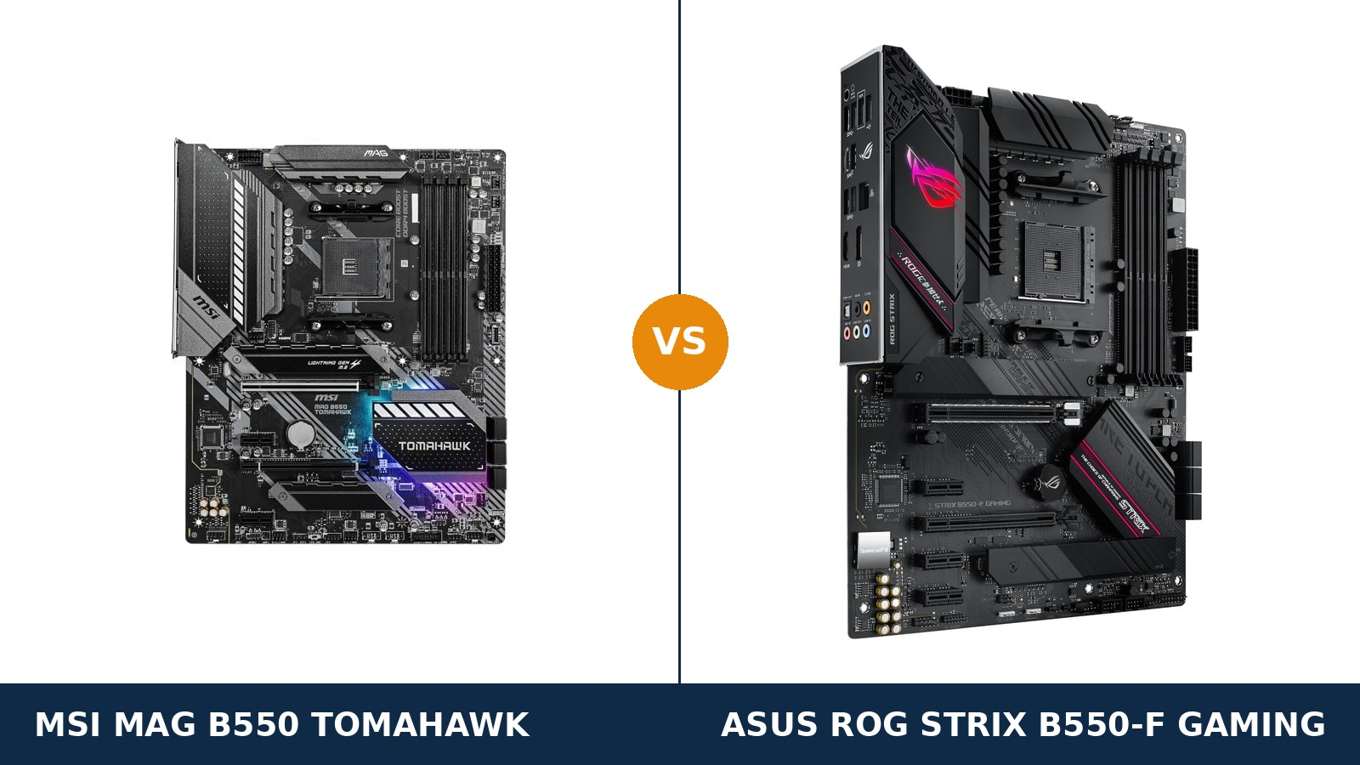
Read this matchup from the spec sheet up, not from the badge down, and it flips.
The famous name here belongs to ASUS. ROG Strix is the board most buyers reach for first, and the B550-F Gaming is a genuinely excellent board. But line the two specification pages up side by side and a pattern emerges: row after row — networking, front-panel connectivity, storage cooling — quietly belongs to the MSI MAG B550 Tomahawk.
That does not make this a walkover. ASUS wins two categories outright, and wins them big: onboard audio and the rear panel. If those are your priorities, the Strix is not the consolation prize. It is the correct answer.
Both boards are full-size ATX flagships for AMD's B550 chipset. Both promise X570-grade features without the X570 chipset fan. The gap between them, when we scored every category, came out at one tenth of a point.
So this guide does the only useful thing: it walks through where each board actually spends its money, using MSI's and ASUS's own published specifications, and tells you which spending pattern matches your build.
Key Takeaways
- The Tomahawk is the completeness champion. Dual LAN, a front USB-C header, heatsinks on both M.2 slots and all six SATA ports live in every configuration.
- The Strix owns sound and the rear panel. SupremeFX S1220A audio rated at 120 dB SNR, and eight rear USB ports against the Tomahawk's six.
- Power delivery is a dead heat. MSI's 10+2+1 Duet Rail and ASUS's 12+2 teamed stages both shrug off any AM4 processor ever made.
- Neither board in this comparison has Wi-Fi. The Strix B550-F name hides separate Wi-Fi variants — check the exact model before you pay.
- Your case, your network and your headphones decide this one. The chipset, the VRM and the memory support are effectively the same.
Quick Verdict
Buy the MSI MAG B550 Tomahawk for most builds. It is simply the more complete motherboard.
It is the only board here with two Ethernet ports. The only one whose front USB-C header makes your case's front port work. The only one that heatsinks both M.2 slots and never trades SATA ports away.
Nothing on its spec sheet is missing. That is rarer than it sounds, and it is why the Tomahawk takes this comparison.
Buy the ASUS ROG Strix B550-F Gaming if you hear and plug in more than you network. Its audio is a class above — a proper SupremeFX implementation, not a codec on a checklist.
Its rear panel carries eight USB ports to the Tomahawk's six. For a headphone-driven gaming rig with a desk full of peripherals, those two wins can outweigh everything MSI counters with.
The Scorecard
Scores below are derived directly from the manufacturer specifications compared in this guide — phase designs, slot counts, port counts and supported standards. They are a reading aid, not benchmark results.
| Category | B550 Tomahawk | Strix B550-F | ||
|---|---|---|---|---|
| Power delivery | 9 / 10 | 9 / 10 | ||
| Networking | 9 / 10 | 7 / 10 | ||
| Storage | 9 / 10 | 8 / 10 | ||
| Audio | 7 / 10 | 9 / 10 | ||
| Expansion | 7 / 10 | 8 / 10 | ||
| Memory | 9 / 10 | 9 / 10 | ||
| USB connectivity | 8 / 10 | 8 / 10 | ||
| Overall | 8.4 / 10 | 8.3 / 10 | ||
Read the table as a map, not a result. MSI's points come from breadth — more of everything. ASUS's come from depth — the best audio and the best rear panel in the B550 class.
At a Glance: Who Each Board Fits
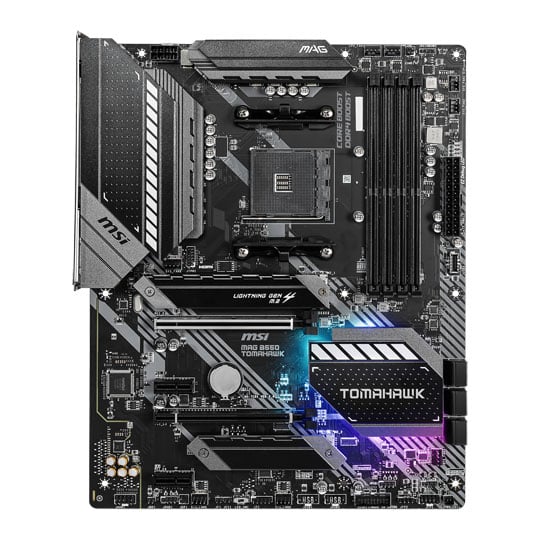
MSI MAG B550 Tomahawk
- 10+2+1 Duet Rail VRM with extended heatsinks
- Dual LAN: Realtek 2.5 Gb + Gigabit Ethernet
- Front-panel USB 3.2 Gen 1 Type-C header
- M.2 Shield Frozr heatsinks on both M.2 slots
- Flash BIOS Button, Steel Armor graphics slot
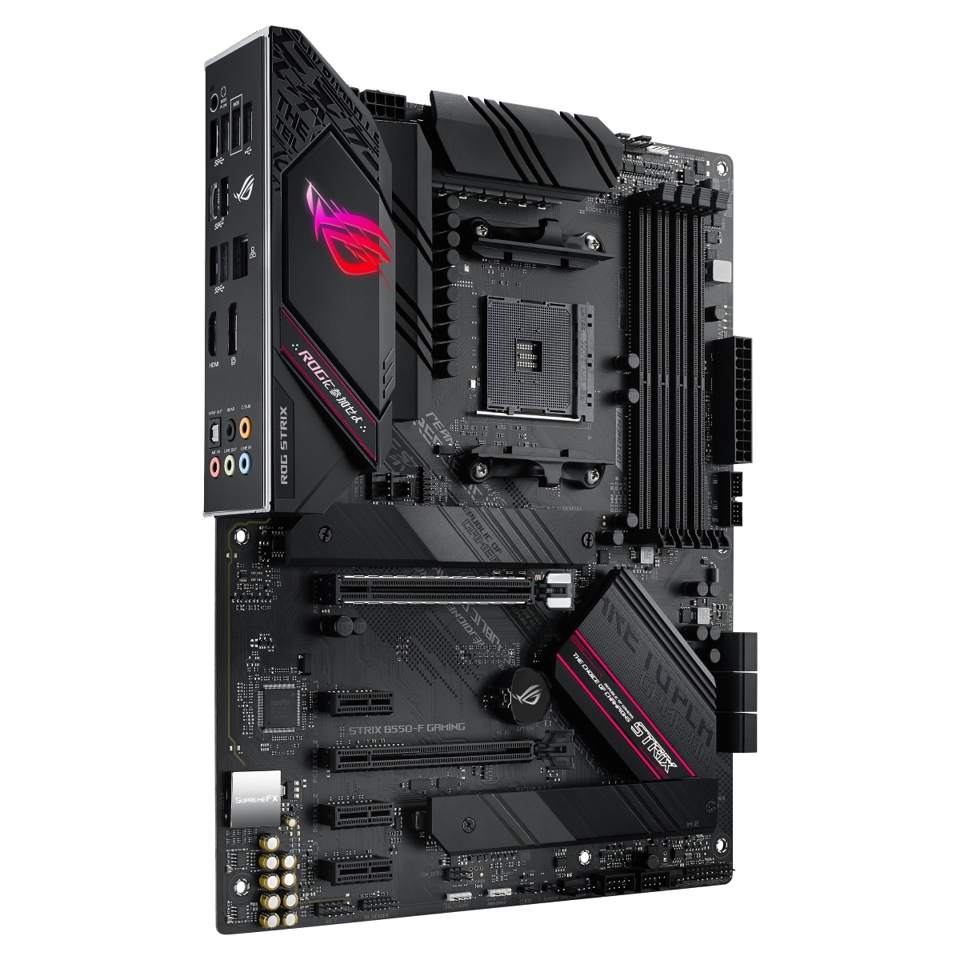
ASUS ROG Strix B550-F Gaming
- 12+2 teamed power stages, ProCool 8+4-pin power
- SupremeFX S1220A audio, 120 dB SNR playback, optical S/PDIF
- 8 rear USB ports, incl. USB 3.2 Gen 2 Type-A and Type-C
- Intel I225-V 2.5 Gb Ethernet with LANGuard protection
- BIOS FlashBack, Q-LED debug, pre-mounted I/O shield
Choose the MAG B550 Tomahawk if…
Your case has a front USB-C port and you intend to use it. The Tomahawk is the only board here with the header to make it work.
You have any use — now or later — for a second Ethernet connection. Home labs, stream PCs that split their traffic, small servers: dual LAN is either essential to you or invisible, and only MSI offers it.
You plan a storage-heavy build that grows over time. Two heatsinked NVMe slots plus all six SATA ports, in every combination, with no small print.
Choose the Strix B550-F Gaming if…
Sound matters to you and your headphones plug straight into the PC. The SupremeFX S1220A is the one component in this comparison with no MSI equivalent.
Your desk runs on rear-panel USB. Eight ports, two of them 10 Gbps, is simply more room for drives, dongles, capture gear and controllers.
You already live in the ROG world — Armoury Crate, Aura Sync, a BIOS layout you know by heart. Familiarity is a real feature when a build misbehaves at midnight.
As an Amazon Associate I earn from qualifying purchases at no extra cost to you.
Specifications: The Specs That Actually Matter
Every figure below comes from MSI's and ASUS's published specifications for these exact models, cross-checked against the manufacturers' product data.
One warning before the table, because it catches real buyers: the Strix in this comparison is the base B550-F Gaming — wired only, no antenna posts on the rear panel. ASUS sells Wi-Fi versions under nearly identical names, and they are different products with different listings.
| Specification | MSI MAG B550 Tomahawk | ASUS ROG Strix B550-F Gaming |
|---|---|---|
| Form factor | ATX, 30.5 × 24.4 cm | ATX, 30.5 × 24.4 cm |
| Socket / chipset | AMD AM4 / B550 | AMD AM4 / B550 |
| CPU support | Ryzen 5000 & 3000, 4000 G-Series (not 3200G/3400G) | Ryzen 5000, 5000 G, 4000 G, 3000 series |
| VRM design | 10+2+1 Duet Rail, digital PWM, extended heatsinks | 12+2 teamed power stages, ProCool 8+4 pin |
| Memory | 4 × DDR4 DIMM, up to 128 GB, 5100 MT/s+ (O.C.) | 4 × DDR4 DIMM, up to 128 GB, OptiMem II |
| Graphics outputs (APU) | HDMI, DisplayPort | HDMI 2.1 (4K@60), DisplayPort 1.2 |
| Expansion slots | PCIe 4.0 x16 Steel Armor + PCIe 3.0 x16 (x4) + 2 × PCIe 3.0 x1 | PCIe 4.0 x16 SafeSlot + PCIe 3.0 x16 (x4) + 3 × PCIe 3.0 x1 |
| M.2 storage | 2 slots: PCIe 4.0 x4 (22110) + PCIe 3.0 x4; heatsinks on both slots | 2 slots: PCIe 4.0 x4 (22110) + PCIe 3.0 x4 (22110); heatsink on primary slot |
| SATA | 6 × SATA 6 Gb/s, RAID 0/1/10 | 6 × SATA 6 Gb/s, RAID 0/1/10 (ports 5/6 disabled if M.2_2 populated) |
| LAN | Realtek 2.5 Gb + Realtek Gigabit (dual LAN) | Intel I225-V 2.5 Gb Ethernet |
| Audio | Realtek ALC1200, 7.1 HD, optical S/PDIF | ROG SupremeFX S1220A, 7.1 HD, 120 dB SNR playback, optical S/PDIF |
| USB (rear) | 6 ports: USB 3.2 Gen 2 Type-C + Type-A, 2 × Gen 1, 2 × USB 2.0 | 8 ports: 2 × USB 3.2 Gen 2 (Type-A + Type-C), 4 × Gen 1, 2 × USB 2.0 |
| Front USB-C header | Yes — USB 3.2 Gen 1 Type-C | None |
| BIOS flashing | Flash BIOS Button (no CPU/RAM/GPU needed) | BIOS FlashBack button (no CPU/RAM/GPU needed) |
| Wi-Fi | None | None (separate Wi-Fi variants exist) |
Memory note: MSI prints one headline ceiling for the Tomahawk — 5100 MT/s+ with overclocking. ASUS publishes the Strix's speeds per processor generation instead: 4400 MT/s (O.C.) in the 3rd Gen Ryzen table, with higher tables for later G-series chips. Treat both as marketing ceilings. The 3200–3600 MT/s kits sensible builders buy run identically on either board.
Variant note: the Strix B550-F Gaming (Wi-Fi) adds an Intel Wi-Fi 6 AX200 module to this same design, and the later WiFi II refresh moves to Wi-Fi 6E. Same family, different boards, different prices. If a listing photo shows antenna connectors on the rear panel, it is not the board in this comparison.
The Differences That Actually Matter
1. Networking — the Tomahawk's signature win
Start where the spec sheets diverge hardest. Both boards carry 2.5-gigabit Ethernet: Realtek's RTL8125B on the MSI, Intel's I225-V on the ASUS.
Then MSI fits a second, independent gigabit port beside it. Two Ethernet connections on one B550 board is a feature you normally shop a workstation range for.
Who actually uses it? More people than you'd think. The home-lab builder running virtual machines. The streamer who keeps game traffic and stream traffic on separate networks. Anyone whose PC doubles as a media server, a backup target or a soft router.
If that list sounds like your future, this section ends the comparison — the Strix has no answer to hardware it does not carry. One port is one port.
If it does not, call the fast ports equal and move on. ASUS's LANGuard surge protection is a thoughtful extra on its single port. But the round, and the hardware, belong to MSI.
2. Audio — the Strix's signature win
Now the mirror image. ASUS fits its SupremeFX S1220A codec with dual OP amplifiers, quality capacitors and proper shielding, and rates playback at 120 dB signal-to-noise.
MSI fits Realtek's ALC1200. It is a good mainstream codec — the same one plenty of boards advertise as a feature. Here it is simply outgunned by a published specification, not by opinion.
Plug decent headphones or powered speakers straight into the rear panel and the Strix is the cleaner source. For gaming headsets and competitive play, where you live in your audio, that is a daily difference, not a spec-sheet one.
The honest boundary: run a USB DAC, an external amp or a dedicated sound card and the onboard codec never touches your signal. For those builders this section scores nil-nil, and the decision moves elsewhere.
3. Power delivery — different maths, same answer
MSI's 10+2+1 Duet Rail design runs from a digital controller and hides under extended heatsinks — the Tomahawk's VRM cooling is visibly substantial. ASUS counters with 12+2 teamed stages fed through ProCool solid-pin connectors, an 8-pin plus a 4-pin.
Two engineering dialects, one conclusion: both VRMs were sized for a Ryzen 9 5950X at full song, and both treat the Ryzen 5 and 7 chips most builds use as a light workout.
Arguing a winner here means arguing about bragging rights. ASUS can claim the stage count; MSI can claim the heatsink mass for long all-core sessions in warm cases. We decline to split them.
However you plan to use an AM4 processor — stock, tuned, or dropped in years from now as a bargain upgrade — neither board's power delivery will be your limiting factor. Spend your decision-making on the sections above and below.
4. USB — ASUS owns the back, MSI owns the front
Count ports at the rear and the Strix wins clearly: eight against six. Both boards put USB 3.2 Gen 2 in Type-A and Type-C at the back, but ASUS adds four Gen 1 ports where MSI fits two.
For a desk that permanently hosts drives, dongles, a capture device and a wheel or stick setup, those two extra ports get used every single week.
Now check the front of the case. MSI provides a USB 3.2 Gen 1 Type-C front-panel header. ASUS provides none at all.
Most modern cases ship with a front USB-C socket. On the Tomahawk it works at full speed. On the Strix it is a hole in your front panel that will never do anything — no adapter fixes a missing header.
USB is therefore a split decision, and the split is about furniture: your desk argues for ASUS, your case argues for MSI. Know which one you live with more.
5. Storage — same speeds, different fine print
The headline is a tie. Each board offers a PCIe 4.0 x4 M.2 slot from the processor, a PCIe 3.0 x4 M.2 slot from the chipset, and six SATA ports with RAID 0, 1 and 10. Both primary slots take longer 22110 drives, and the Strix's second slot does too.
The differences live below the headline. MSI bolts its M.2 Shield Frozr heatsinks to both slots. ASUS heatsinks the primary slot and leaves the second drive bare.
A chipset-fed Gen 3 drive runs cool regardless, so the bare slot is a venial sin. But a fast second drive under sustained writes — game installs, video scratch disks — will quietly thank MSI for the metal.
The weightier difference is a trade ASUS prints in its own specification: populate the Strix's M.2_2 slot and SATA ports 5 and 6 switch off. Your six-SATA board becomes a four-SATA board.
Two NVMe drives plus six SATA drives is a niche build. If it is your build, the niche decides everything, and the Tomahawk — which makes no such trade — wins storage running away.
6. Expansion — one extra slot for ASUS
The graphics slots are equals: both armoured, both PCIe 4.0 x16 with a Ryzen 3000 or 5000 processor. Steel Armor versus SafeSlot is a naming contest, not an engineering one.
Both boards also carry a physical x16 slot wired at x4 — home to capture cards, NVMe adapters and fast network cards on either.
The separation is in the small slots: three PCIe 3.0 x1 on the Strix, two on the Tomahawk. One extra slot of future flexibility goes to ASUS.
With one caveat, printed in ASUS's own documentation: on the Strix, that x4 slot shares its bandwidth with the three x1 slots. Fill everything and things divide. It rarely matters in practice, but it keeps this round close rather than clear.
Most builders will never populate the difference. Score it a narrow ASUS win and do not let it outweigh networking or audio on its own.
7. The small stuff — debug lights, shields and software
ASUS fits Q-LED, a four-light diagnostic that names the guilty component — CPU, memory, graphics, boot device — when a build refuses to start. MSI's EZ Debug LEDs do the same job in plainer form. Either beats swapping parts blind.
The Strix's I/O shield arrives pre-mounted. It saves ninety seconds and one forgotten-shield rebuild. Every experienced builder has done that rebuild once, and remembers it.
BIOS recovery is level: both boards flash new firmware from a rear button with no processor, memory or graphics card installed. Different trademark, identical mercy.
Software is the softest difference of all. Armoury Crate and Aura Sync on one side; MSI Center and Mystic Light on the other. Neither suite wins awards. Both work.
If you already own peripherals in one ecosystem, let that familiarity break the tie. It is a more honest reason than half the spec rows in this guide.
CPU Pairing Guide
Neither board will bottleneck any processor AMD released for this socket. The table's job is the opposite: showing where the choice stops mattering, so you can decide on features with a clear conscience.
| Your processor | B550 Tomahawk | Strix B550-F | Our call |
|---|---|---|---|
| Ryzen 5 5600 / 5600X | Excellent | Excellent | Either — features decide, not the CPU |
| Ryzen 7 5700X / 5800X | Excellent | Excellent | Either — both VRMs are oversized here |
| Ryzen 7 5800X3D | Excellent (update BIOS first) | Excellent (update BIOS first) | Either — the flagship AM4 gaming pairing |
| Ryzen 9 5900X / 5950X | Excellent — heatsink mass | Excellent — 12+2 stages | Dead tie; decide on LAN, audio or USB |
| Ryzen 5 5600G / 5700G (APU) | Excellent — HDMI + DP out | Excellent — HDMI 2.1 + DP 1.2 out | Either; the Strix's outputs are better documented |
| Ryzen 3000 (3600, 3700X) | Excellent, PCIe 4.0 unlocked | Excellent, PCIe 4.0 unlocked | Either |
| Ryzen 3200G / 3400G | Not supported (MSI states this explicitly) | Not the intended pairing — check ASUS's CPU list | Neither — use a B450 board instead |
That last row catches real people out. These are flagship B550 boards aimed at Ryzen 3000 and 5000; if you are recycling one of the oldest G-series APUs, check the support list before money moves, not after.
Ready to check today’s price?
Both boards sell through Amazon. Prices move, so check the live figure on the board that fits your build.
View on Amazon — B550 TomahawkView on Amazon — Strix B550-FThe 30-Second Decision
| If this sounds like you… | Buy this |
|---|---|
| “I want the most complete B550 board, full stop.” | MSI MAG B550 Tomahawk |
| “My case has a front USB-C port and I refuse to leave it dead.” | MSI MAG B550 Tomahawk |
| “Home lab, streaming rig, part-time server — I can use two network ports.” | MSI MAG B550 Tomahawk |
| “Two NVMe drives now, and my SATA drives are not going anywhere.” | MSI MAG B550 Tomahawk |
| “I game on good headphones plugged straight into the PC.” | ASUS ROG Strix B550-F Gaming |
| “Everything I own plugs into the back of the PC.” | ASUS ROG Strix B550-F Gaming |
| “Whichever is cheaper this week.” | Legitimate — this matchup is that close |
What You Gain. What You Give Up.
MSI MAG B550 Tomahawk
You gain: a second Ethernet port nobody else in the class offers, a front USB-C header that works, heatsinks on both M.2 slots, all six SATA ports in every storage configuration, and extended VRM heatsinks over an already-strong power design.
You give up: the best onboard audio in the class — the ALC1200 is solid, not special. Two rear USB ports and one x1 expansion slot against the Strix. Completeness was bought with the polish budget.
ASUS ROG Strix B550-F Gaming
You gain: SupremeFX S1220A audio with a 120 dB playback rating, an eight-port rear panel with two 10 Gbps connections, a third x1 slot, Q-LED diagnostics and a pre-mounted I/O shield.
You give up: the second Ethernet port and the front USB-C header entirely. A heatsink on the second M.2 slot. And two SATA ports whenever that second slot holds a drive.
Pros and Cons
MAG B550 Tomahawk — Pros
- Dual LAN: 2.5 Gb + Gigabit Ethernet
- Front USB 3.2 Gen 1 Type-C header
- Heatsinks on both M.2 slots
- 10+2+1 VRM with extended heatsinks
- All six SATA ports always available
Cons
- ALC1200 audio trails the Strix
- Six rear USB ports, not eight
- Two PCIe x1 slots, not three
- No Wi-Fi
- Ryzen 3200G / 3400G explicitly unsupported
Strix B550-F Gaming — Pros
- SupremeFX S1220A audio, 120 dB SNR playback
- 8 rear USB ports incl. Gen 2 Type-C
- 12+2 teamed power stages, ProCool connectors
- Q-LED debug display and pre-mounted I/O shield
- Three PCIe x1 slots
Cons
- No front-panel USB-C header
- Single Ethernet port
- M.2_2 use disables SATA ports 5/6
- Second M.2 slot has no heatsink
- No Wi-Fi on this variant
Check the Variant and the Bundle, Not Just the Board
Check the Strix variant. This is the single most expensive mistake in this comparison, and listings invite it.
Three boards share the B550-F name family. The base Gaming model in this guide: no Wi-Fi, no antenna posts. The Gaming (Wi-Fi): adds an Intel Wi-Fi 6 AX200 module. The WiFi II: a later refresh with Wi-Fi 6E.
They look near-identical in thumbnail photos. The rear panel tells the truth — antenna connectors mean a different board, a different listing and usually a different price. Match the full model name before the price talks you into anything.
Check the CPU pairing. Both boards flash their BIOS from a button with nothing installed. A board that shipped with early firmware can be brought up to date for a Ryzen 5000 or a 5800X3D in about ten minutes.
Do that update first, with the new processor still in its box. Both manufacturers keep per-model CPU support lists; your chip, your board, your revision — that is the check that counts.
Check the bundle. ASUS packs four SATA cables with the Strix, generous for the class. MSI packs two, plus the M.2 hardware both boards include.
Neither box contains Wi-Fi antennas — neither board has Wi-Fi. A listing that promises antennas is showing you a different variant's box, which loops back to the first warning in this section.
The Upgrade Path Test
Flagship boards are bought for year three. Judge both of these there.
The second NVMe drive is usually the first upgrade. On the Tomahawk it lands under a heatsink and changes nothing else. On the Strix it lands bare — fine — and quietly retires two of your SATA ports, which may not be fine.
The case swap is the second upgrade nobody plans. New case, front USB-C port, same story as day one: the Tomahawk lights it up, the Strix cannot.
The processor upgrade is where they finally tie again. A discounted Ryzen 9 or a 5800X3D drops into either socket, and both VRMs treat it as the job they were built for.
Notice the pattern: MSI's wins compound with time and hardware changes. ASUS's wins — sound, rear ports — are at full strength on day one. Neither pattern is wrong. They are different ownership experiences, and you know which one is yours.
When to Skip Both
Some builders should walk past this matchup entirely, and honesty requires naming them.
Skip both if you need Wi-Fi out of the box. ASUS sells this exact Strix with wireless fitted; MSI's B550 range has its own wireless models. Buy the feature on the board, not as an afterthought dongle.
Skip both if the budget is genuinely tight. A board a class down runs a Ryzen 5 5600 and a mid-range graphics card at identical frame rates, and the saving buys memory or storage you will actually feel.
Skip both if your case is micro-ATX. These are full-size ATX boards; no optimism amends a spec sheet.
And skip both if you are starting fresh at the high end with no AM4 parts on the shelf. These are the kings of a finished platform. A brand-new flagship budget belongs on the current one — AM5 — while these two serve the enormous AM4 installed base superbly.
BIOS and Long-Term Support
AM4 is a completed platform, and for boards of this class that is good news.
Both ASUS and MSI maintain full support pages for these models: BIOS updates, drivers, and CPU support lists that still get revised when a security patch or an edge case demands it.
Expect future firmware to be about AGESA updates, security and compatibility polish. Neither board needs new features; both already support every processor they were ever meant to run.
The platform's quirks are equally settled. Early memory-training oddities and USB edge cases were found, documented and fixed years ago — by other people, at no cost to you.
One habit protects all of it: update the BIOS before a processor swap, not after a failed boot. With a flash button on both boards, the precaution costs ten minutes and no spare hardware.
Final Verdict
The MSI MAG B550 Tomahawk is the B550 board we would buy.
The margin is the smallest in the class, and we will not pretend otherwise. But when two boards tie on power, memory and speed, the one with nothing missing wins — and the Tomahawk is the one with nothing missing.
Two network ports. A front USB-C header that works. Heatsinks on both M.2 slots. Six SATA ports that stay six, whatever you install. That is not a spec-sheet trick; it is a board that keeps saying yes for the whole life of the build.
Buy the Tomahawk for gaming builds, home-lab and streaming duties, storage plans that will grow, and any machine you intend to keep upgrading until AM4 itself is a memory.
View on Amazon — B550 Tomahawk
Buy the Strix B550-F Gaming if your ears outrank your network. Its SupremeFX audio is a genuine class above, its rear panel is the strongest in the class, and the ROG BIOS and lighting ecosystem is a real, daily quality-of-life edge.
It does not lose this comparison on quality. It loses it on completeness — and for an audio-first gaming build, completeness was never the point.
Frequently Asked Questions
Which board should most people buy?
The MSI MAG B550 Tomahawk, narrowly. It matches the Strix on power delivery, memory and core speed, then adds dual LAN, a front USB-C header and heatsinks on both M.2 slots. The Strix is the better buy only when its two strengths — audio and rear-panel USB — are the things you will actually use daily.
Is the Tomahawk's audio good enough?
For most builders, yes. The Realtek ALC1200 is a respectable 7.1 codec with optical output, and through typical gaming headsets it performs well. The Strix's SupremeFX S1220A is measurably cleaner — 120 dB SNR on playback — and better headphones will reveal that gap. A USB DAC bypasses both codecs entirely.
Why does the Tomahawk have two Ethernet ports?
For builds that talk to two networks, or two jobs, at once: home labs and virtualisation, streamers separating game and stream traffic, and PCs doubling as servers or backup targets. Each port is independent — a 2.5-gigabit Realtek and a gigabit Realtek. If none of that applies to you, the second port simply sits spare; the main ports on both boards run at the same 2.5 Gb speed.
Does the ASUS ROG Strix B550-F Gaming have Wi-Fi?
No — not the board in this comparison. The base B550-F Gaming is wired-only. ASUS sells a B550-F Gaming (Wi-Fi) with Wi-Fi 6 and a later WiFi II with Wi-Fi 6E as separate models. Check the rear panel in the listing: antenna connectors mean you are looking at a different board.
Will the front USB-C port on my case work?
On the Tomahawk, yes — it has a USB 3.2 Gen 1 Type-C front-panel header. On the Strix, no — ASUS fits no front Type-C header, so a case's front USB-C socket cannot be connected. It is one of the most common disappointments in this class, and it is decided entirely by this one header.
What happens to my SATA ports when I add a second M.2 drive?
On the Tomahawk, nothing — both M.2 slots are heatsinked and all six SATA ports stay live. On the Strix, populating the M.2_2 slot disables SATA ports 5 and 6, per ASUS's own specification, and that slot has no heatsink. Two NVMe drives plus a full set of SATA drives is a Tomahawk build.
Can both boards run a Ryzen 7 5800X3D or a Ryzen 9 5950X?
Yes. Both VRMs — MSI's 10+2+1 Duet Rail and ASUS's 12+2 teamed stages — were designed for the top of the AM4 stack. If your board shipped with early firmware, update the BIOS first; both boards can be flashed from a button with no processor installed, so it is a short, safe job.
Is either board a worthwhile upgrade from B450?
Yes, if you want PCIe 4.0 for a current graphics card and NVMe drive, plus a VRM with headroom for a Ryzen 5000 upgrade — both boards deliver all three. If your B450 board already runs your processor well and PCIe 4.0 is not on your shopping list, the honest advice is to keep it and spend the money where it shows.
Sources & Verification
MSI MAG B550 Tomahawk official specifications and datasheet, msi.com • ASUS ROG Strix B550-F Gaming official specifications, rog.asus.com • MSI and ASUS retail product data for MAG B550 Tomahawk (10+2+1 Duet Rail, ASIN-verified listing) and ROG Strix B550-F Gaming (12+2 power stages, ASIN-verified listing). Audio codec note: MSI's spec summary lists ALC1200 / ALC1220P; independent reviews identify the fitted Tomahawk codec as the Realtek ALC1200, which this guide uses. Specifications verified November 2026.

James Wilson
James has been building and benchmarking PCs for over a decade and writes Honestly Compared's motherboard and component guides. His rule for every comparison: the verdict has to survive the spec sheet, not the marketing page.