
MSI MAG B550 Tomahawk vs MSI MPG B550 Gaming Plus: Which Should You Buy?
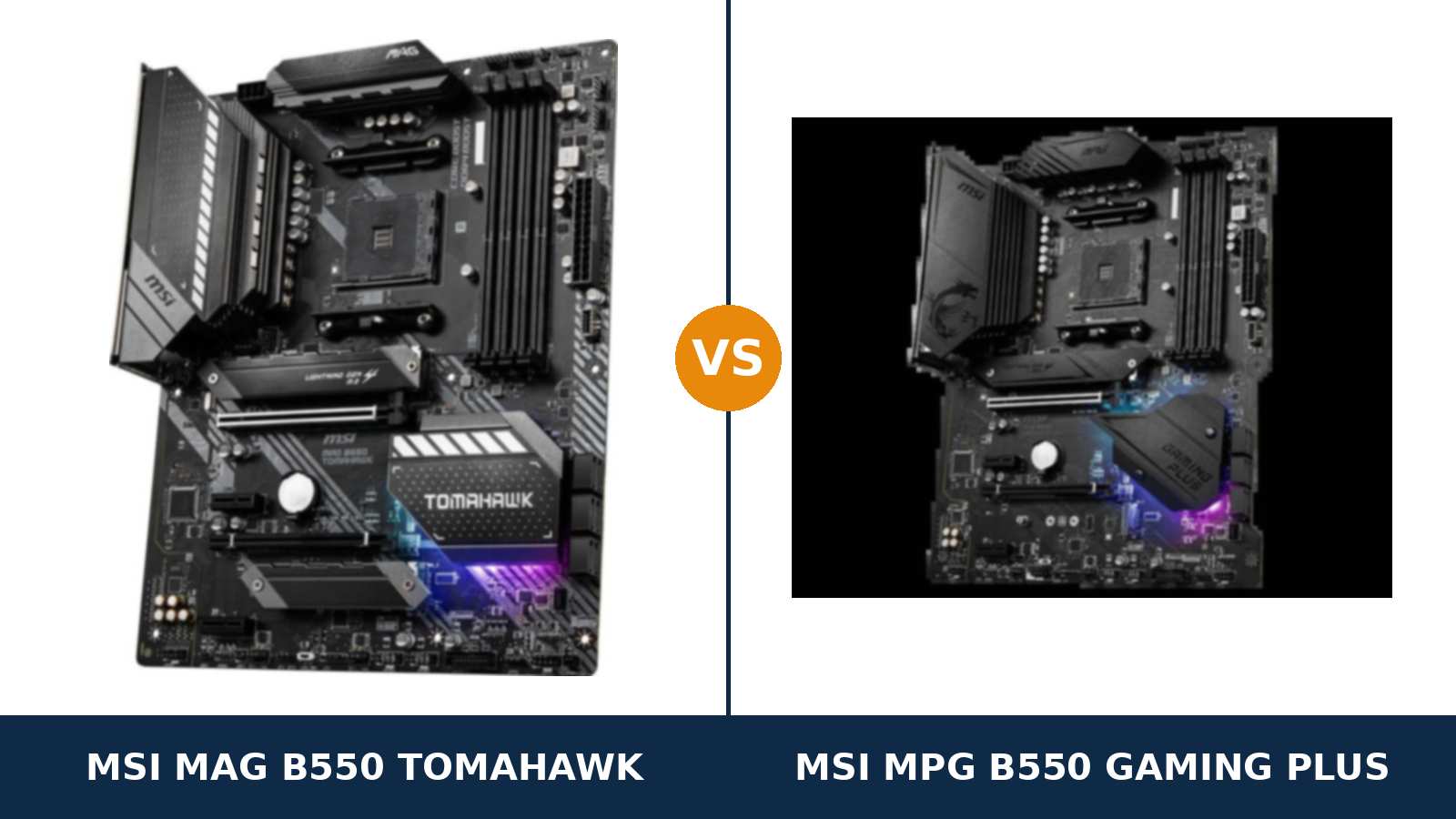
Ask a forum for the best B550 motherboard and two MSI boards answer back: the MAG B550 Tomahawk, and the MPG B550 Gaming Plus.
Then the confusion starts. The boxes promise the same phase count. The slot layouts match. A buyer could be forgiven for concluding that the Tomahawk is a Gaming Plus wearing a higher price tag.
It is not. The two boards share a platform, not a parts list. Underneath the matching headlines, MSI fitted different power stages, different networking and a different audio chip — and hid one genuinely nasty surprise inside the cheaper board's second M.2 slot.
This guide pulls the pair apart using MSI's own specifications, datasheets and manuals — no marketing claims, no invented benchmarks. Just the hardware differences, and which board your money should buy.
Key Takeaways
- The Tomahawk is the stronger board. 60A power stages, dual LAN with 2.5 Gb/s, the better audio codec and the higher memory ceiling.
- The Gaming Plus is the value play. Same slots, same storage layout, same platform — usually for less money.
- Do not trust the shared VRM headline. Both say 10+2+1 Duet Rail. Only the Tomahawk builds it from 60A Smart Power Stages.
- The Gaming Plus has a lane-sharing trap. Fit a second M.2 SSD and its x4 expansion slot switches off completely.
- Neither board has Wi-Fi, and neither runs a 3400G or 3200G. Two easy mistakes to make at checkout — check before you buy.
Quick Verdict
Buy the MSI MAG B550 Tomahawk if you want the best board of the two. It is the more complete package.
Its power delivery is built from 60-amp Smart Power Stages that shrug at a Ryzen 9. It carries two wired network ports, one at 2.5 Gb/s. Its audio codec sits a tier higher, both M.2 slots wear heatsinks, and it tops the pair on memory support and fan headers.
Nothing here is a landslide on its own. But every hardware gap points the same direction, and they compound over the life of a build.
Buy the MSI MPG B550 Gaming Plus if your build is straightforward and the saving is real. A Ryzen 5 or Ryzen 7, one graphics card, gigabit internet.
On that build, the Gaming Plus surrenders nothing you will feel in daily use. Spend the difference on memory or a bigger SSD and the cheaper board becomes the smarter purchase.
The Scorecard
Scores below are derived directly from the manufacturer specifications compared in this guide — power-stage ratings, port counts, slot counts and supported standards. They are a reading aid, not benchmark results.
| Category | MAG B550 Tomahawk | MPG B550 Gaming Plus | ||
|---|---|---|---|---|
| Power delivery | 9.0 / 10 | 7.5 / 10 | ||
| Networking | 9.5 / 10 | 5.0 / 10 | ||
| Audio | 8.5 / 10 | 7.0 / 10 | ||
| Storage | 9.0 / 10 | 8.0 / 10 | ||
| Memory | 9.0 / 10 | 8.0 / 10 | ||
| Expansion | 8.5 / 10 | 7.5 / 10 | ||
| Overall | 8.8 / 10 | 7.8 / 10 | ||
Read the table as a map of where MSI spent money: the Gaming Plus matches the Tomahawk wherever a feature is cheap to include, and falls behind wherever one costs real components.
At a Glance: Who Each Board Fits
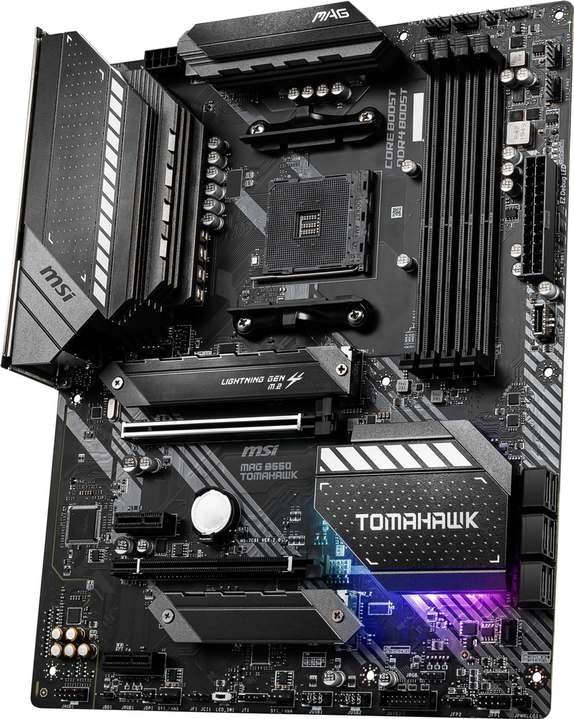
MSI MAG B550 Tomahawk
- 10+2+1 Duet Rail VRM with 60A Smart Power Stages
- Dual LAN: 2.5 GbE (RTL8125B) plus gigabit (RTL8111H)
- Realtek ALC1200 audio with optical S/PDIF output
- Heatsinks on both M.2 slots; memory support to 5100+ MT/s (O.C.)
- Eight 4-pin fan headers — the fuller cooling setup
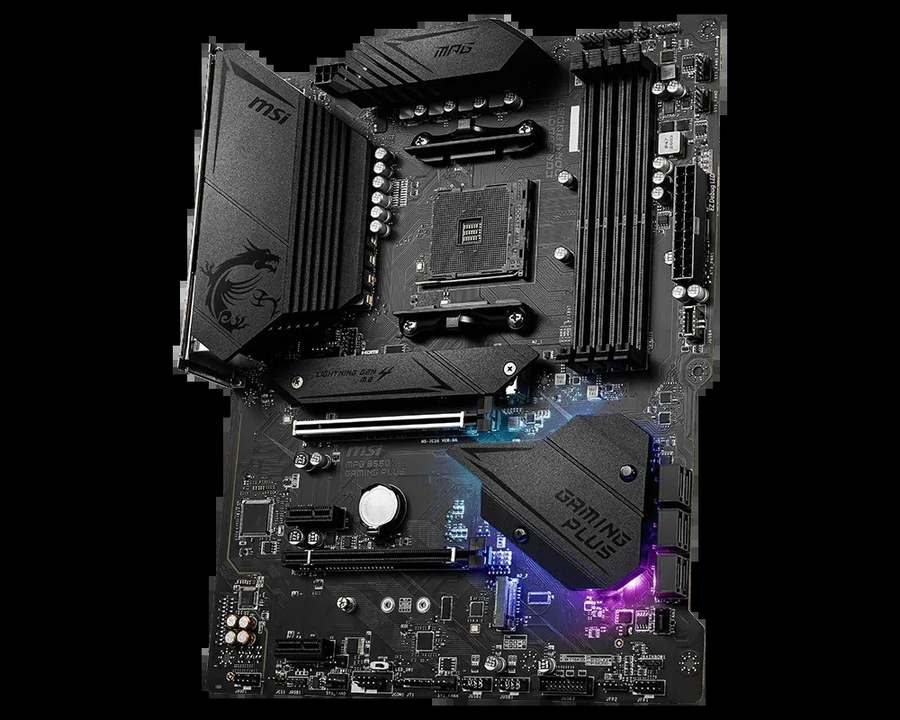
MSI MPG B550 Gaming Plus
- 10+2+1 Duet Rail VRM, extended heatsink, 8+4-pin CPU power
- Single Realtek gigabit LAN (RTL8111H)
- Realtek ALC892 audio with optical S/PDIF output
- Dual M.2 (Gen4 x4 + Gen3 x4), Shield Frozr on the primary slot
- Usually the cheaper of the two boards
Choose the MAG B550 Tomahawk if…
You keep a motherboard for years and grow the PC around it. A Ryzen 9 is fitted now, or pencilled in for later.
Your home has a NAS, a server, or a 2.5-gigabit switch waiting for a port that can use it — or you simply want a second LAN port in reserve.
You run good headphones from the rear panel and will hear what a better codec buys.
Choose the MPG B550 Gaming Plus if…
Your build is settled: a mid-range Ryzen, one graphics card, one or two SSDs, and an internet connection that gigabit Ethernet already fills.
You would rather point the saving at parts with a visible payoff — more RAM, a faster SSD, a better cooler.
Or the MPG look is the point — dragon heatsink, RGB underglow, a glass case to show them off.
As an Amazon Associate I earn from qualifying purchases at no extra cost to you.
Specifications: The Specs That Actually Matter
Every figure below is taken from MSI's published specifications, datasheets and manuals, cross-checked against the manufacturer's product data.
Shared platform, shared dimensions — so the table skips the ceremony and concentrates on the rows where the boards genuinely part company. Two notes on production variants follow the table, and both are worth reading before you quote a figure from it.
| Specification | MSI MAG B550 Tomahawk | MSI MPG B550 Gaming Plus |
|---|---|---|
| Form factor | ATX, 30.5 × 24.4 cm | ATX, 30.5 × 24.4 cm |
| Socket / chipset | AMD AM4 / B550 | AMD AM4 / B550 |
| CPU support | Ryzen 5000, 5000 G, 4000 G, 3000 series — not 3400G / 3200G | Ryzen 5000, 5000 G, 4000 G, 3000 series — not 3400G / 3200G |
| VRM design | 10+2+1 Duet Rail, 60A Smart Power Stages, digital PWM, extended heatsink, 8-pin CPU power | 10+2+1 Duet Rail, discrete MOSFETs, extended heatsink, 8+4-pin CPU power |
| Memory | 4 × DDR4 DIMM, up to 128 GB, 5100+ MT/s (O.C.), A-XMP | 4 × DDR4 DIMM, up to 128 GB, 4400+ MT/s (O.C.), A-XMP |
| Graphics outputs (APU) | HDMI + DisplayPort | HDMI + DisplayPort |
| Expansion slots | PCIe 4.0 x16 + PCIe 3.0 x16 (x4) + 2 × PCIe 3.0 x1 | PCIe 4.0 x16 + PCIe 3.0 x16 (x4) + 2 × PCIe 3.0 x1 |
| M.2 storage | 2 slots: PCIe 4.0 x4 / SATA (up to 22110) + PCIe 3.0 x4; heatsinks on both slots | 2 slots: PCIe 4.0 x4 (CPU) + PCIe 3.0 x4 (chipset); Shield Frozr heatsink on slot 1 only |
| SATA | 6 × SATA 6 Gb/s, RAID 0/1/10 | 6 × SATA 6 Gb/s, RAID 0/1/10 |
| LAN | Realtek RTL8125B 2.5 Gb/s + RTL8111H 1 Gb/s (dual ports) | Realtek RTL8111H, 1 Gb/s (single port) |
| Audio | Realtek ALC1200, 7.1 HD, Audio Boost, optical S/PDIF out | Realtek ALC892, 7.1 HD, Audio Boost, optical S/PDIF out |
| USB (rear) | 2 × USB 3.2 Gen 2 (Type-A + Type-C), 2 × Gen 1, 2 × USB 2.0 | 2 × USB 3.2 Gen 2 (Type-A + Type-C), 2 × Gen 1, 4 × USB 2.0 |
| USB (front headers) | USB 3.2 Gen 1 Type-C header + Gen 1 header + 2 × USB 2.0 headers | USB 3.2 Gen 1 Type-C header + Gen 1 header + 2 × USB 2.0 headers |
| Fan headers | 8 × 4-pin (CPU, pump, 6 × system) | 6 × 4-pin (CPU, pump, 4 × system) |
| BIOS flashing | Flash BIOS Button (no CPU/RAM/GPU needed) | Flash BIOS Button (no CPU/RAM/GPU needed) |
Variant notes: MSI's current specification summary lists the Tomahawk's audio as “ALC1200/ALC1220P” and the Gaming Plus's as “ALC892/ALC897” — MSI fits either codec depending on production run. This guide uses the launch figures (ALC1200, ALC892); independent teardowns of the Tomahawk confirm the ALC1200 on retail boards.
The Tomahawk's memory rating has also drifted over its production life: 4866+ MT/s in the launch datasheet, 5100+ on MSI's current product page. We have used the current figure — and on either figure, it stands well clear of the Gaming Plus's 4400+ ceiling.
The Differences That Actually Matter
1. Power delivery — identical headline, different components
Start with the number both boxes shout about: 10+2+1. Identical. Case closed, apparently.
It is not. A phase count tells you how many power stages a board has. It says nothing about what those stages are.
The Tomahawk's stages are 60-amp Smart Power Stages — integrated parts that combine the switching and sensing in one efficient package, run by a digital PWM controller and cooled by the larger of the two heatsinks in this comparison.
The Gaming Plus reaches the same count with discrete MOSFETs. Perfectly serviceable, cheaper to build, and less efficient stage for stage.
With a Ryzen 5 or Ryzen 7 at stock settings, you cannot feel the difference. Both boards deliver clean power all day.
With a Ryzen 9 pulling sustained all-core loads — rendering, compiling, transcoding — the Tomahawk's stages run cooler with more margin in hand. That margin is what you are paying for.
One detail trips up careful readers, so let us deal with it head-on. The Gaming Plus takes an 8+4-pin CPU power feed. The Tomahawk takes a single 8-pin.
More connectors does not mean more capability. A single 8-pin EPS feed supplies far more current than any AM4 processor can use at sane settings. The Tomahawk omits the second connector because its power stages never asked for it.
Judge a VRM by its stages and its heatsink, never by its connector count. On stages and heatsink, the Tomahawk wins this section outright.
2. Networking — two ports against one, and it is not close
Here is the widest functional gap in the comparison. The Tomahawk carries two Ethernet ports: a Realtek RTL8125B running at 2.5 Gb/s, and a conventional gigabit port beside it.
The Gaming Plus carries a single gigabit port on the older RTL8111H chip. That is the beginning and the end of its wired networking.
Now the honest caveat. If this board will spend its life plugged into a gigabit-or-slower internet connection and nothing else, the second port and the extra speed are worth precisely nothing.
But homes accumulate networked hardware. A NAS that a 2.5 Gb/s port can finally feed at full speed. A backup PC or streaming rig on a direct cable link. A home server. Even a humble spare port earns its keep the day a cable, a switch port or a driver starts misbehaving.
Retrofitting networking later means a PCIe card — which costs money and consumes a slot this comparison is about to show is precious.
If anything on your network runs faster than gigabit, this section settles the comparison on its own.
3. Storage — equal on paper, separated by one trap
The storage layouts read identically. Each board: one CPU-connected M.2 slot at PCIe 4.0 x4, one chipset M.2 at PCIe 3.0 x4, six SATA ports with RAID 0/1/10.
Boot times, game loading, file copies — indistinguishable. No storage benchmark will ever separate these two boards.
The separation is in the fittings. The Tomahawk puts a heatsink over both M.2 slots, so a hard-working second drive gets cooling instead of a bare PCB. Its primary slot also accepts 22110-length drives — a niche format, but the flexibility costs you nothing.
The Gaming Plus fits its M.2 Shield Frozr heatsink to the primary slot only, leaving a second drive uncovered — tolerable for most drives, less welcome for fast ones under sustained writes.
Then comes the trap, and it is the single most important paragraph in this guide for expansion-minded builders. On the Gaming Plus, the second M.2 slot shares its lanes with the x4 expansion slot.
Populate M.2_2, and PCI_E3 — the x4 slot — is disabled. Entirely. The second SSD and the slot cannot coexist.
The Tomahawk's manual contains a far narrower version of the rule. Its x4 slot only drops out when the board is fully loaded — second M.2 fitted and both remaining slots populated at once. A normal two-drive build keeps the slot alive.
So the practical verdict: one SSD and no add-in cards, the boards tie. Two SSDs plus a capture card, a sound card or a network card — that build only exists on the Tomahawk.
4. Audio — one tier apart, honestly assessed
The Tomahawk's ALC1200 and the Gaming Plus's ALC892 are both Realtek 7.1 HD codecs wrapped in MSI's Audio Boost treatment, and both boards include an optical S/PDIF output — a genuine tie. The ALC1200 is the cleaner chip: a tier up in Realtek's range, with better signal quality on the analogue outputs.
Whether you hear it depends entirely on what hangs off the back panel. A budget headset or basic desktop speakers will mask the difference completely.
Good headphones, a headphone amp or powered studio monitors will not. Feed quality equipment from the board and the Tomahawk's output is the one to build the chain on.
And if you already own a USB DAC, both codecs are bypassed and this section is a draw. Your money question returns to the other sections.
5. Memory — headroom you may never use, pointing the same way
Four DIMM slots and 128 GB maximum on both boards. A-XMP profiles on both. For the 3200–3600 MT/s kits in the overwhelming majority of AM4 builds, there is nothing between them.
The difference is the validated ceiling. MSI rates the Tomahawk to 5100+ MT/s with overclocked memory. The Gaming Plus stops at 4400+.
That gap speaks to one buyer: the memory enthusiast coaxing high-frequency kits or four densely populated slots into stability on a Ryzen 7 or 9. A higher validated ceiling signals a stronger memory layout underneath — better traces, better training, more margin.
Everyone else should file this under “nice to have” — and remember that headline speeds are overclocking figures on both boards, with your processor's memory controller holding the final word.
6. Fan headers and cooling — the quiet gap
Neither board spins a chipset fan; B550's passive heatsink is one of the platform's enduring pleasures. Both boards use 2 oz copper PCBs.
The count is where they part. The Tomahawk provides eight 4-pin headers — CPU, pump and six system fans. The Gaming Plus provides six — CPU, pump and four system.
Six headers cover a typical mid-tower build without complaint. Eight cover a large case, a radiator in push-pull, and a couple of spares, with no splitters and no hubs. Cooling setups tend to grow over a board's life, not shrink — and the Tomahawk leaves more room for that growth.
7. The small stuff — ports, lighting and taste
One category in this comparison belongs to the Gaming Plus, and it deserves its moment. Its rear panel carries four USB 2.0 ports against the Tomahawk's two, alongside the same pair of 10 Gb/s USB 3.2 Gen 2 ports — one Type-A, one Type-C — and two Gen 1 ports on each board.
Keyboards, mice, headset dongles: legacy ports get used more than spec sheets admit, and two extra are genuinely handy. Front-panel headers, including the USB-C header, are identical on both.
Lighting is shared territory — MSI Mystic Light, 12V RGB and 5V addressable headers on both. The Gaming Plus adds its own flourishes: an EZ LED Control switch for extinguishing the lights from the board itself, plus the dragon-etched MPG styling.
The Tomahawk counters with restraint: gunmetal MAG armour and angles. Which board looks right behind glass is a taste call, and we decline to score taste.
Step back and the pattern is plain. The Gaming Plus wins on price, legacy ports and looks. The Tomahawk wins on the hardware that cannot be upgraded later. That sentence is the whole comparison.
CPU Pairing Guide
Start from the processor and the choice usually makes itself. This table is the whole comparison compressed into one view.
| Your processor | MAG B550 Tomahawk | MPG B550 Gaming Plus | Our call |
|---|---|---|---|
| Ryzen 5 5600 / 5500 | Excellent | Excellent | Buy on price — usually the Gaming Plus |
| Ryzen 5 5600G / 5700G (APU) | Excellent — HDMI + DisplayPort | Excellent — HDMI + DisplayPort | Either board; Gaming Plus on price |
| Ryzen 7 5700X / 5800X | Excellent — 60A stages, bigger heatsink | Very good | MAG B550 Tomahawk |
| Ryzen 9 5900X / 5950X | Very good — the sensible pick of the two | Workable at stock | Tomahawk; heavy all-core users should look higher |
| Ryzen 3000 series | Excellent | Excellent | Buy whichever is cheaper |
One warning covers both boards equally. The Ryzen 5 3400G and Ryzen 3 3200G are not supported here, and neither is any Ryzen 2000 chip. Owners of those processors should jump straight to “When to Skip Both” — their answer is an older chipset generation, not either board on this page.
The 30-Second Decision
| If this sounds like you… | Buy this |
|---|---|
| “Just tell me which board is better.” | MAG B550 Tomahawk |
| “Ryzen 9 now, or a Ryzen 9 upgrade later.” | MAG B550 Tomahawk (60A stages) |
| “I have a NAS, a home server, or a 2.5-gigabit switch.” | MAG B550 Tomahawk (dual LAN) |
| “Two NVMe drives and a capture card in the x4 slot.” | MAG B550 Tomahawk — the Gaming Plus disables that slot with a second M.2 fitted |
| “Ryzen 5 build, gigabit internet is fine, save me the money.” | MPG B550 Gaming Plus |
| “The Gaming Plus is on a serious sale this week.” | Legitimate — for simple builds, the gap will not show |
Ready to check today’s price?
Both boards sell through Amazon. Prices move, so check the live figure on the board that fits your build.
View on Amazon — MAG B550 TomahawkView on Amazon — MPG B550 Gaming PlusWhat You Gain. What You Give Up.
MSI MAG B550 Tomahawk
You gain: headroom in every direction a build can grow — 60A power stages for flagship Ryzens, a second LAN port running at 2.5 Gb/s, the ALC1200 codec, heatsinks over both SSDs, the higher memory ceiling and two extra fan headers.
You give up: a slice of budget, since it normally sells above its sibling. Two rear USB 2.0 ports. And a second CPU power connector you were never going to need.
MSI MPG B550 Gaming Plus
You gain: the same platform for less money — PCIe 4.0 graphics, two M.2 slots, four DIMM slots and the front USB-C header all survive the price cut. So do four rear USB 2.0 ports, an 8+4-pin power feed, a pre-fitted I/O shield and the full MPG dragon-and-RGB presentation.
You give up: fast or dual networking. The 60-amp stages. A tier of audio quality. Cooling for a second SSD — and, the moment that second SSD goes in, the x4 expansion slot with it.
Pros and Cons
MAG B550 Tomahawk — Pros
- 60A Smart Power Stages — real Ryzen 9 headroom
- Dual LAN: 2.5 Gb/s plus gigabit
- ALC1200 audio with optical S/PDIF
- Heatsinks on both M.2 slots; 22110 support
- 5100+ MT/s memory ceiling; eight fan headers
Cons
- Usually the pricier of the two
- Single 8-pin CPU power (sufficient, but plain)
- Only two rear USB 2.0 ports
- No Wi-Fi — same as the Gaming Plus
- Overkill for a basic Ryzen 5 build
MPG B550 Gaming Plus — Pros
- Usually the cheaper way into the same platform
- Identical slot and storage layout to the Tomahawk
- Four rear USB 2.0 ports — handy for peripherals
- 8+4-pin CPU power feed
- Pre-installed I/O shield; EZ LED Control switch
Cons
- Single gigabit LAN — no 2.5 Gb/s, no second port
- Discrete-MOSFET VRM behind the same 10+2+1 headline
- Second M.2 drive disables the x4 expansion slot
- ALC892 audio is a tier below
- Memory support stops at 4400+ MT/s
- No Wi-Fi
Before You Order: Names, Codecs and Box Contents
Read the listing title like a contract. MSI's naming department has made this range genuinely hazardous, and three near-misses matter here.
The B550 Tomahawk MAX WiFi is a newer, different motherboard — Wi-Fi 6E on board, higher price. This comparison covers the original MAG B550 Tomahawk, which has no wireless hardware at all. Photographs showing antenna stubs are photographs of another product.
The B450 Tomahawk Max belongs to the previous chipset generation. The name differs by one digit; the board lacks PCIe 4.0 entirely. A respectable used purchase — just not this one.
And within the MPG line, the Gaming Plus sits a rung below the Gaming Edge WiFi and Gaming Carbon WiFi, both of which include wireless. A “Gaming” board advertised with Wi-Fi at a Gaming Plus price is a listing error or a different model. Either way, walk carefully.
Confirm the audio codec if audio decides it. The variant note under the spec table explains the situation: production runs of each board carry one of two codecs. The gap between the boards holds whichever pair you draw — but the chip is silkscreened on the PCB, and a seller can confirm it if this is the section that swings your order.
Ignore BIOS-version anxiety. The Flash BIOS Button on both rear panels updates the firmware with no processor, memory or graphics card installed. An older boxed board is therefore no obstacle to a Ryzen 5000 build, and “5000 ready” box stickers — present or missing — should not move what you pay by a penny.
Know what the box holds. Board, SATA cables, M.2 screws and paperwork is the standard of both. The Gaming Plus fits its I/O shield at the factory, sparing you the classic mid-build discovery that the shield is still in the box. Neither package contains antennas — neither board could use them.
The Upgrade Path Test
A motherboard is the one component every other upgrade has to live with. Judge both boards by year three, not day one.
On day one, with a Ryzen 5 and a mid-range graphics card installed, they are indistinguishable. Same frame rates, same boot times, same everything that shows up in a screenshot.
Then ownership starts asking questions. The Ryzen 9 drops in price. The game library outgrows one SSD. The home network gets a faster switch. A capture card joins the build for the streaming project that finally starts.
The Tomahawk answers every one of those without negotiation. Its stages were built for the Ryzen 9. Its fast LAN port is already on the back panel. Its x4 slot survives a second SSD.
The Gaming Plus answers the processor question, within reason — and then starts charging for the rest. The second SSD costs the x4 slot. Faster networking costs a card, in a slot that may no longer exist.
One board was specified to be outgrown slowly; the other, to be enough. Buy the one matching the ownership you actually have planned.
When to Skip Both
A fair comparison also names the buyers it cannot help. Several profiles should close this page and look elsewhere.
Wireless is the first. Neither board carries a Wi-Fi module, so if onboard wireless is a requirement rather than a preference, MSI's own B550 Tomahawk MAX WiFi and MPG B550 Gaming Edge WiFi are the intended products.
Processor support is the second. The Ryzen 5 3400G, Ryzen 3 3200G and the whole Ryzen 2000 series are locked out of B550. Keeping one of those chips means shopping the older B450 generation instead.
Form factor is the third. Both boards are full ATX; a micro-ATX case wants the MAG B550M Mortar class of board, not a saw.
Platform timing is the fourth. Anyone already committed to DDR5 and PCIe 5.0 belongs on AM5. No B550 board, however good, changes that arithmetic.
And the fifth is ambition. A Ryzen 9 destined for heavy daily overclocking deserves X570 flagship power delivery, a step above everything discussed here.
Outside those five profiles sits the great majority of AM4 builders — and for them, the answer is one of the two boards above.
BIOS and Long-Term Support
Buying into a mature platform is an underrated virtue, and both boards collect it.
AM4's rough edges were found and filed down years ago. The BIOS code is settled, the driver stack is settled, and the compatibility surprises have already happened to other people.
MSI maintains both boards on its standard support pages — BIOS downloads, chipset, LAN and audio drivers, and a per-board CPU support list that settles any processor question definitively. From here, new BIOS releases will concern security fixes and corner cases, which is precisely the pace a settled platform should keep.
The Flash BIOS Button deserves a second mention in this section, because it is as much a support feature as a convenience. A corrupted flash or an unsupported new CPU becomes a USB stick and ten minutes, not a support ticket.
Keep one habit and either board will serve quietly for years: before fitting a new processor, consult the support list and update the BIOS first.
Final Verdict
Our money goes on the MSI MAG B550 Tomahawk.
The scoreboard at the top of this page tells the story in numbers; the differences section tells it in hardware. Where the Gaming Plus matches a headline, the Tomahawk backs it with better components — integrated 60A stages rather than discrete MOSFETs, a 2.5-gigabit port beside the standard one, the cleaner codec, heatsinks over both SSDs, and a memory ceiling in a different league.
Each advantage is modest in isolation. Stacked together across a five-year ownership, they are the difference between a board you grow into and a board you grow out of.
Order the Tomahawk for Ryzen 7 and 9 builds, for wired homes with faster-than-gigabit hardware, for serious headphones — and for any PC whose spec is still going to change.
View on Amazon — MAG B550 Tomahawk
Order the Gaming Plus when its price undercuts the Tomahawk by a margin that matters, and when the build is finished on paper: mid-range Ryzen, one graphics card, gigabit networking, no expansion card in the roadmap.
It is an honest board at an honest price. Buy it with eyes open: the discount is paid out of tomorrow's options, never out of today's performance.
View on Amazon — MPG B550 Gaming Plus
Frequently Asked Questions
Both boards claim a 10+2+1 VRM. Are they really the same?
No. They share the phase-count layout, not the components. The Tomahawk builds its phases from 60A Smart Power Stages run by a digital PWM controller; the Gaming Plus uses discrete MOSFETs. Equal counts, unequal capability — the difference shows up under sustained Ryzen 9 loads, not in everyday gaming.
Is the Tomahawk worth the extra money over the Gaming Plus?
If you will use any of its advantages — a Ryzen 9, a NAS or 2.5-gigabit network, good headphones, two SSDs plus an expansion card — yes, comfortably. If your build is a Ryzen 5 with one graphics card and gigabit internet, the extra buys headroom you will likely never touch, and the Gaming Plus is the rational purchase.
Does the Gaming Plus really lose its x4 slot with a second SSD?
Yes. MSI's manual is explicit: the Gaming Plus's second M.2 slot shares lanes with the PCI_E3 (x4) slot, and populating M.2_2 disables the slot. The Tomahawk's equivalent rule only bites when the board is fully loaded, so a normal two-drive build keeps its x4 slot available.
Why does the cheaper board have an extra CPU power connector?
Because connector count is not the limiting factor. The Gaming Plus takes an 8+4-pin feed; the Tomahawk a single 8-pin. One 8-pin EPS connector supplies far more power than any AM4 CPU draws at sane settings, so the Tomahawk's stronger power stages never needed the second feed. Judge the VRM by its stages, not its sockets.
Which board should I buy for a Ryzen 7 5800X3D gaming build?
Either — the 5800X3D is a gaming chip, not a power-delivery stress test, and both boards feed it identically; frame rates will match. Choose the Tomahawk if its LAN, audio or expansion headroom matters to the rest of the build, and put any saving from the Gaming Plus toward the graphics card, where gaming performance actually lives.
Can both boards run two NVMe SSDs at full speed?
Yes — both pair a PCIe 4.0 x4 M.2 slot with a PCIe 3.0 x4 slot, so two NVMe drives run at their slots' rated speeds on either board. The caveats: the Gaming Plus disables its x4 expansion slot with the second drive fitted, and only its first M.2 slot gets a heatsink, where the Tomahawk heatsinks both.
Does either board have Wi-Fi?
No — wireless is absent from both, full stop. Each board is Ethernet-only. Built-in Wi-Fi means stepping to other models entirely: the B550 Tomahawk MAX WiFi on the MAG side, or the MPG B550 Gaming Edge WiFi on the other. Alternatively, add a PCIe Wi-Fi card — remembering that on the Gaming Plus, a second M.2 drive takes the x4 slot out of play.
Will these boards work with a Ryzen 5 3400G?
They will not. The 3400G and its 3200G sibling are excluded from B550 support, as is the entire Ryzen 2000 series. Supported families are Ryzen 3000 apart from those two APUs, the 4000 G-Series, and the Ryzen 5000 and 5000 G-Series ranges. MSI's CPU support list for each board gives the definitive per-chip answer.
Sources & Verification
MSI MAG B550 TOMAHAWK official specifications, datasheet and user manual • MSI MPG B550 GAMING PLUS official specifications and datasheet (storage-asset.msi.com) • MSI manufacturer product data via Scan UK (Gaming Plus power design) • Independent reviews of the MAG B550 Tomahawk (Tom's Hardware, KitGuru) for the fitted audio codec. Specifications verified November 2026.

James Wilson
James has been building and benchmarking PCs for over a decade and writes Honestly Compared's motherboard and component guides. His rule for every comparison: the verdict has to survive the spec sheet, not the marketing page.