
MSI MAG B650 Tomahawk WiFi vs ASUS ROG Strix B650E-F Gaming WiFi: Which Should You Buy?
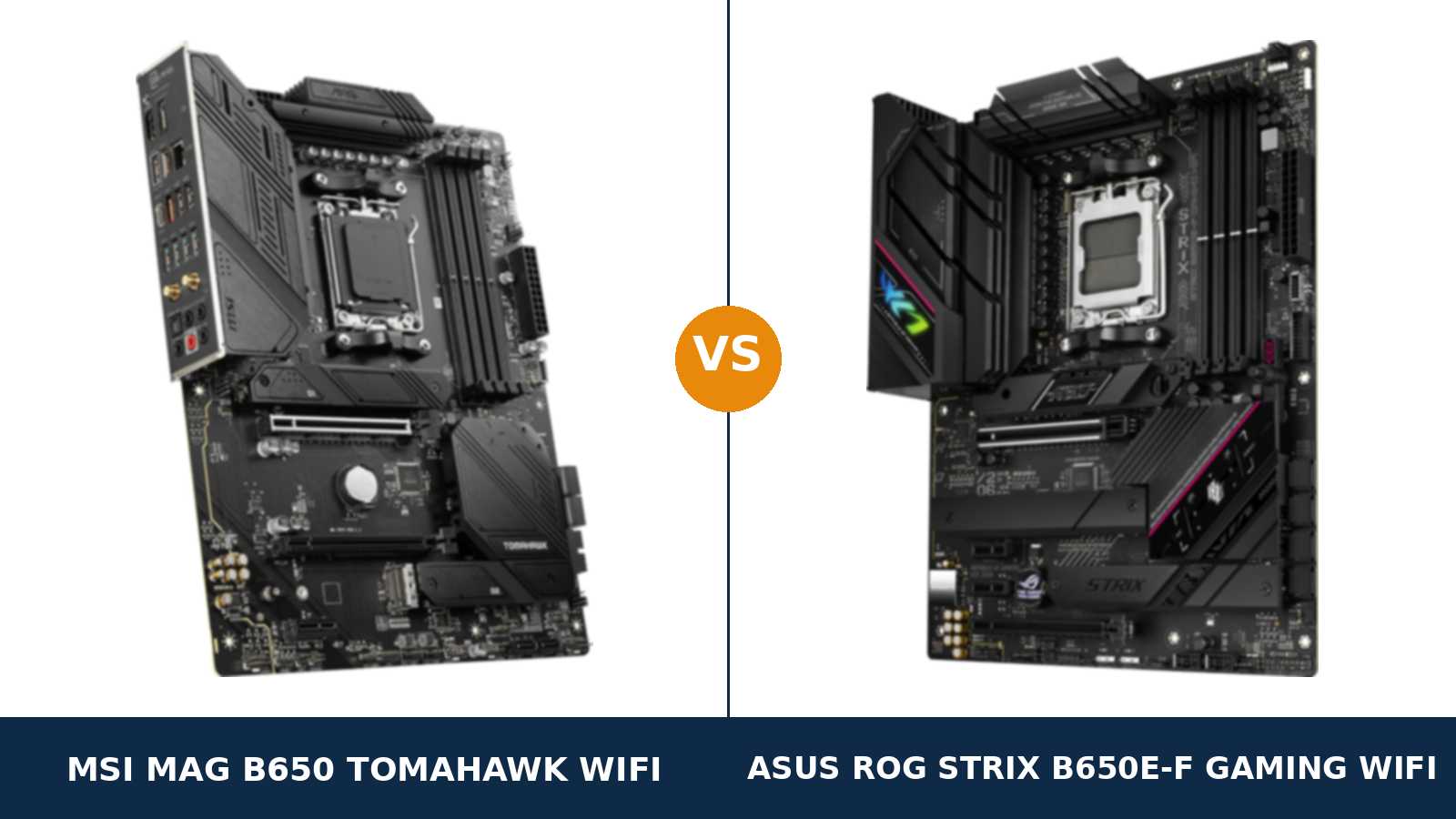
Two AM5 boards. Same price class. Same Wi-Fi 6E, same 2.5-gigabit LAN, same ALC4080 audio codec.
On the shelf, the MSI MAG B650 Tomahawk WiFi and the ASUS ROG Strix B650E-F Gaming WiFi look like the same motherboard in different liveries. They are not.
One letter does most of the damage. The ASUS is a B650E board, and that E buys PCIe 5.0 for both the graphics slot and the first SSD. The MSI is a plain B650 board — and spends its budget on power delivery, storage count and the rear panel instead.
So the real question is not which board is “better.” It is whether you would rather have tomorrow's bandwidth or today's headroom.
This guide settles it properly. Every specification below comes from MSI's and ASUS's own published data. And the verdict at the end is the same one we would give a friend spending their own money.
Key Takeaways
- The Strix B650E-F owns the future. A PCIe 5.0 x16 slot and a PCIe 5.0 M.2 slot — the Tomahawk has neither.
- The Tomahawk owns the present. A stronger 14+2+1 VRM, six SATA ports, rear optical audio and Bluetooth 5.3.
- Networking and audio silicon are near-identical. Both run 2.5G Ethernet, Wi-Fi 6E and the ALC4080 codec.
- Memory is not a reason to pick either. ASUS rates a higher DDR5 ceiling; real-world kits run the same on both.
- Buy for the upgrade you will actually make: a future GPU and Gen 5 SSD, or a Ryzen 9 and a stack of SATA drives today.
Quick Verdict
Buy the ASUS ROG Strix B650E-F Gaming WiFi for a gaming build you plan to keep through its next graphics card. It is the only one of the two with a PCIe 5.0 x16 slot and a PCIe 5.0 M.2 slot.
AM5 is a long-lived socket. The board you buy now may host two or three GPUs. The Strix is the one that will not ask you to replace it when Gen 5 hardware becomes the norm.
It also carries the fuller rear panel — twelve USB ports — and ASUS's Q-Release slot and Q-Latch drive mounts, which make builds and upgrades genuinely easier.
Buy the MSI MAG B650 Tomahawk WiFi if your build is heavy today. A Ryzen 9 under sustained load, a shelf of SATA drives carried over from an old PC, or a receiver that connects by optical cable.
Its power delivery is a class above, and it gives up nothing in day-to-day features. It simply bets on the present instead of the future.
The Scorecard
Scores below are derived directly from the manufacturer specifications compared in this guide — phase counts, slot counts, port counts and supported standards. They are a reading aid, not benchmark results.
| Category | MAG B650 Tomahawk WiFi | ROG Strix B650E-F | ||
|---|---|---|---|---|
| Power delivery | 9 / 10 | 8 / 10 | ||
| Future-proofing (PCIe 5.0) | 5 / 10 | 10 / 10 | ||
| Storage | 8 / 10 | 8 / 10 | ||
| Memory | 8 / 10 | 9 / 10 | ||
| USB & rear panel | 8 / 10 | 9 / 10 | ||
| Networking & audio | 9 / 10 | 8 / 10 | ||
| Overall | 8.3 / 10 | 8.7 / 10 | ||
The pattern is a clean split. The Tomahawk wins the categories about the build you assemble today. The Strix wins the categories about the build this becomes in three years — and on a socket built to last, that weighs more.
At a Glance: Who Each Board Fits
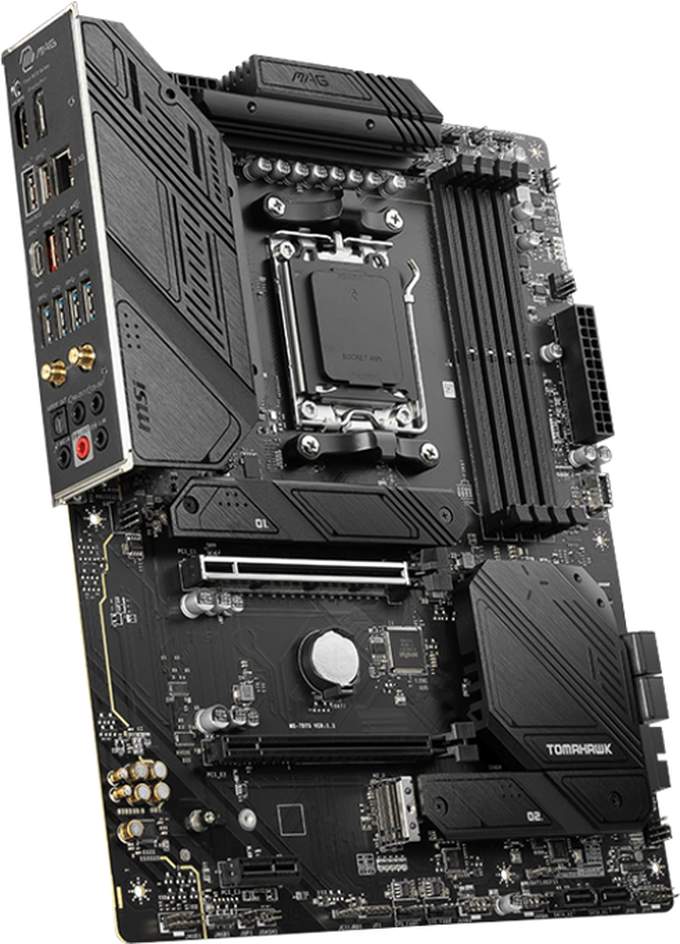
MSI MAG B650 Tomahawk WiFi
- 14+2+1 Duet Rail VRM, 80A stages, dual 8-pin EPS
- Three PCIe 4.0 M.2 slots plus six SATA ports
- ALC4080 audio with rear optical S/PDIF output
- Wi-Fi 6E with Bluetooth 5.3, Realtek 2.5G LAN
- No PCIe 5.0 anywhere — GPU and storage are Gen 4
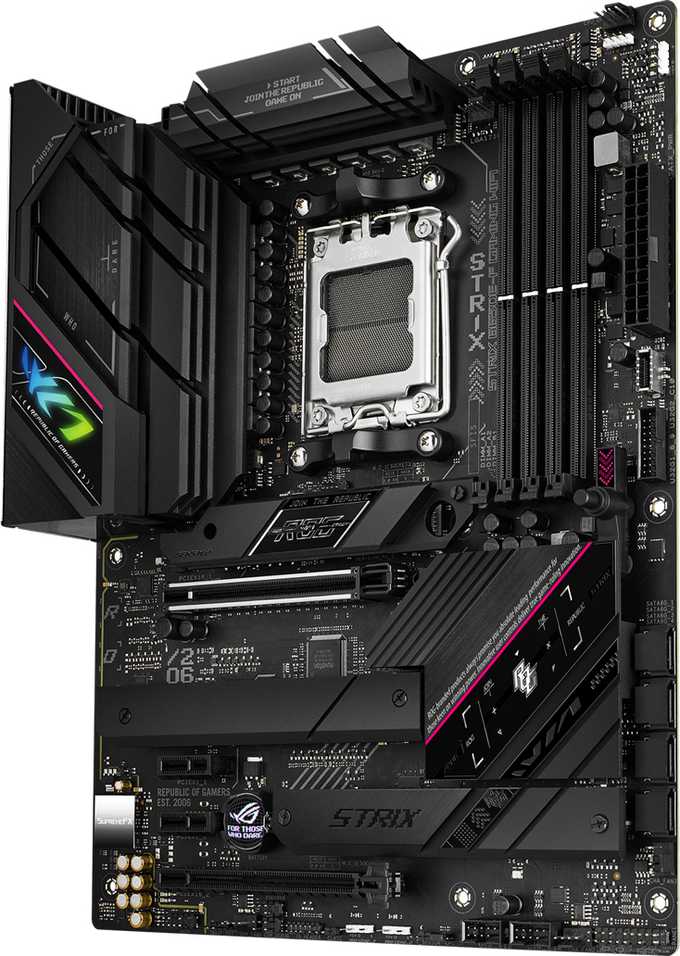
ASUS ROG Strix B650E-F Gaming WiFi
- PCIe 5.0 x16 SafeSlot for the next GPU generation
- PCIe 5.0 M.2 slot plus two PCIe 4.0 M.2 slots
- 12+2 power stages, 80A each, ProCool 8+4 pin
- Twelve rear USB ports, Q-Release and Q-Latch fittings
- Intel 2.5G LAN, Wi-Fi 6E, Bluetooth 5.2
Choose the MAG B650 Tomahawk WiFi if…
You are building around a Ryzen 9, or a Ryzen 7 you intend to push hard for years. The VRM headroom is real.
You are bringing SATA drives over from an older machine. Six ports against four is a difference you feel on build day.
Your amplifier or soundbar connects by optical cable. The Tomahawk has the rear optical output; the Strix does not.
Choose the ROG Strix B650E-F Gaming WiFi if…
You keep a motherboard for five years or more. Gen 5 graphics and storage support is the insurance policy.
You swap graphics cards often. The Q-Release slot latch and tool-less M.2 latches remove the two fiddliest jobs in a build.
You plug a lot into the rear panel. Twelve USB ports, including two Type-C, is the fuller hub.
As an Amazon Associate I earn from qualifying purchases at no extra cost to you.
Specifications: The Specs That Actually Matter
Every figure below is taken from MSI's and ASUS's published specifications, cross-checked against the manufacturers' product data.
| Specification | MSI MAG B650 Tomahawk WiFi | ASUS ROG Strix B650E-F Gaming WiFi |
|---|---|---|
| Form factor | ATX, 30.5 × 24.4 cm | ATX, 30.5 × 24.4 cm |
| Socket / chipset | AMD AM5 / B650 | AMD AM5 / B650E |
| CPU support | Ryzen 9000, 8000, 7000 series | Ryzen 9000, 8000, 7000 series |
| VRM design | 14+2+1 Duet Rail, 80A Smart Power Stages, dual 8-pin EPS | 12+2 power stages, 80A each, ProCool 8+4 pin |
| PCB | 6-layer, 2 oz thickened copper | 8-layer (per ASUS product material) |
| Memory | 4 × DDR5 DIMM, up to 256 GB, 7600+ MT/s (O.C.), EXPO | 4 × DDR5 DIMM, up to 192 GB, 8000+ MT/s (O.C.), EXPO |
| Graphics outputs (iGPU) | HDMI 2.1 (4K@60), DisplayPort 1.4 (8K@60) | HDMI 2.1, DisplayPort 1.4 |
| Expansion slots | PCIe 4.0 x16 + PCIe 4.0 x16-length (x2) + PCIe 3.0 x1 | PCIe 5.0 x16 SafeSlot + PCIe 4.0 x16-length (x4) + 2× PCIe 4.0 x1 |
| M.2 storage | 3 slots, all PCIe 4.0 x4, Shield Frozr heatsinks | 3 slots: PCIe 5.0 x4 + 2× PCIe 4.0 x4, all heatsinked |
| SATA | 6 × SATA 6 Gb/s | 4 × SATA 6 Gb/s |
| USB (rear) | 10 ports: 20 Gb/s Type-C, 3× 10 Gb/s A, 4× 5 Gb/s A, 2× USB 2.0 | 12 ports: 20 Gb/s Type-C, 2× 10 Gb/s A + 10 Gb/s C, 4× 5 Gb/s A, 4× USB 2.0 |
| USB (front headers) | Type-C 10 Gb/s, 2× 5 Gb/s A, 4× USB 2.0 | Type-C 10 Gb/s (Gen 2), USB 3.2 Gen 1, 2× USB 2.0 |
| LAN | Realtek RTL8125BG 2.5 GbE | Intel I225-V 2.5 GbE |
| Wireless | Wi-Fi 6E + Bluetooth 5.3 | Wi-Fi 6E + Bluetooth 5.2 |
| Audio | Realtek ALC4080, 7.1, optical S/PDIF out on rear panel | Realtek ALC4080 SupremeFX, 7.1, Savitech amplifier, S/PDIF header only |
| BIOS flashing | Flash BIOS Button on rear panel | BIOS FlashBack button on rear panel |
Chipset note: the difference between B650 and B650E is exactly one thing — the E chipset guarantees PCIe 5.0 wiring for the primary graphics slot and an M.2 slot. Everything else about the two platforms is shared, which is why so much of this table reads as a tie.
APU note: with a Ryzen 8000-series APU installed, both boards trim their expansion. On the ASUS, the first M.2 slot falls back to PCIe 4.0. On the MSI, the second M.2 slot disappears entirely with an 8500G or 8300G, and the graphics slot drops to x8 or x4 depending on the chip.
The Differences That Actually Matter
1. PCIe 5.0 — the difference you cannot retrofit
This is the comparison in one section. The Strix wires its primary x16 slot at PCIe 5.0 and gives its first M.2 slot PCIe 5.0 x4.
The Tomahawk tops out at PCIe 4.0 everywhere. Its graphics slot is Gen 4. All three of its M.2 slots are Gen 4.
Does that matter today? Barely. Current graphics cards do not saturate a PCIe 4.0 x16 connection, and Gen 5 SSDs only show their advantage in sustained sequential transfers.
Does it matter over the life of an AM5 build? Much more. AMD has committed to this socket for years, and the whole point of buying in is keeping the board while CPUs and GPUs rotate around it.
A Gen 5 slot costs nothing in performance now and removes a ceiling later. A missing Gen 5 slot can never be added. That asymmetry is why this section outweighs several others combined.
2. Power delivery — the Tomahawk's home turf
Read the VRM rows in the spec table again. MSI fits a 14+2+1 Duet Rail design with 80A Smart Power Stages and feeds it with two full 8-pin EPS connectors.
ASUS fits 12+2 stages, also rated at 80A each, behind an 8+4 pin ProCool connector. It is a strong design. It is simply the smaller of the two.
For a Ryzen 5 or Ryzen 7, either board is comfortably over-specified. You will never feel the difference in a game or a render.
For a Ryzen 9 7950X or 9950X under sustained all-core load — rendering, compiling, simulation — the Tomahawk's extra stages and dual 8-pin feed spread current and heat further. That is the workload where VRM design stops being marketing.
Principle worth remembering: you can replace every part around a motherboard except its power delivery. Buy it for the biggest CPU the board will ever host, not the one in the first build.
3. Storage — a dead tie, split two ways
Both boards carry three M.2 slots, every one of them covered by a heatsink. Both support RAID from the platform. On raw slot count, this is a draw.
The split is in what surrounds the slots. The Strix's first slot runs at PCIe 5.0 speed — the Tomahawk cannot match that, full stop.
The Tomahawk answers with six SATA ports against four. If your old PC donates two hard drives and an SSD or two, the ASUS runs out of ports first.
One caution on the ASUS: its third M.2 slot shares bandwidth with the second x16-length slot. Populate the M.2 slot in PCIe mode and that expansion slot is disabled. Most builders will never use both — but know the trade exists before you plan around it.
And one on the MSI: its M.2 heatsinks and layout are clean, but every slot is Gen 4. Your Gen 5 SSD will work — at Gen 4 speeds.
4. Memory — headline numbers, real-world tie
ASUS rates the Strix to DDR5-8000 and beyond, with a 192 GB ceiling. MSI rates the Tomahawk to 7600+, with a 256 GB ceiling.
Neither figure should drive your decision. AM5's sweet spot for gaming remains a 6000 MT/s EXPO kit at tight timings, and both boards run exactly that, identically.
Push far past 6000 with four sticks and you are negotiating with your CPU's memory controller, not the motherboard. Both boards even share the same practical behaviour there.
The only builders who should care: workstation users who genuinely need more than 192 GB — the Tomahawk's ceiling wins — and memory overclockers chasing records, who already know which board they want.
For everyone else: memory is a tie. Do not let either board be sold to you on it.
5. The rear panel — twelve ports against ten
Count the USB rows. The Strix puts twelve ports on the rear panel, including a 20 Gb/s Type-C and a second 10 Gb/s Type-C.
The Tomahawk puts ten, with the same 20 Gb/s Type-C at the top. Both give your case a 10 Gb/s front Type-C header.
In practice the ASUS is the better hub for a desk full of peripherals — drives, interfaces, dongles, capture gear. The MSI is entirely adequate for a normal gaming desk.
Display outputs are level: HDMI 2.1 and DisplayPort 1.4 on both, driven by the processor's integrated graphics when one is present.
Both boards also carry a BIOS flash button on the rear panel. Either can be updated for a new CPU generation with no processor installed at all.
6. Networking and audio — same silicon, different details
The spec sheets converge here. Both boards run 2.5-gigabit Ethernet and Wi-Fi 6E. Both run the same Realtek ALC4080 audio codec.
The differences are in the supporting cast. The wired controller differs — Realtek on the MSI, Intel's I225-V on the ASUS — with no practical performance gap between them.
Bluetooth goes to MSI: 5.3 against 5.2, fixed in the specification rather than varying by production batch.
Audio splits the other way on amplification and MSI's way on outputs. ASUS pairs its ALC4080 with a Savitech headphone amplifier — the better front-panel headphone drive.
But the MSI puts an optical S/PDIF output on the rear panel, and the ASUS leaves optical on an internal header. If your receiver or soundbar takes optical, that single port can settle the whole comparison.
7. Living with the board — latches, shields and LEDs
Small quality-of-life features never headline a spec sheet. They are, however, what you remember at the third rebuild.
ASUS's Q-Release lets you remove a heavy graphics card with a button instead of a fingertip fight against the slot latch. Its M.2 Q-Latch mounts drives without a screwdriver or a dropped screw.
The Strix also pre-mounts its I/O shield and carries Q-LED diagnostic lights. The Tomahawk answers with its own EZ Debug LEDs and tool-less Shield Frozr M.2 heatsinks.
Cooling headers are close: both boards cover a CPU fan, an AIO pump and a full set of case fans, with MSI listing six system fan headers.
Call this section a narrow ASUS win on fittings, with MSI level on diagnostics. Neither board is a chore to build in — one is just slightly kinder.
CPU Pairing Guide
The fastest way to choose between these boards is to start from your processor. This table is the whole comparison in one view.
| Your processor | MAG B650 Tomahawk WiFi | ROG Strix B650E-F | Our call |
|---|---|---|---|
| Ryzen 5 7600 / 9600X | Excellent | Excellent | Buy whichever is cheaper |
| Ryzen 7 7700X / 9700X | Excellent | Excellent | Strix, for the GPU you buy next |
| Ryzen 7 7800X3D / 9800X3D | Excellent | Excellent | Strix — gaming builds live longest |
| Ryzen 9 7900X / 7950X / 9950X | Excellent — 80A stages, dual 8-pin | Very good | Tomahawk, for sustained all-core work |
| Ryzen 7 8700G (APU) | Very good — x16 slot at x8 | Very good — M.2_1 falls to Gen 4 | Dead tie; pick on price |
| Ryzen 5 8500G / 8300G (APU) | Workable — second M.2 slot unavailable, x16 at x4 | Good — slots trimmed less severely | Strix, slightly |
Read the Ryzen 9 and APU rows together. They are the two honest exceptions to the headline verdict: heavy CPUs favour the MSI's power delivery, and small APUs trim the MSI's slots harder than the ASUS's.
Ready to check today’s price?
Both boards sell through Amazon. Prices move, so check the live figure on the board that fits your build.
View on Amazon — MAG B650 Tomahawk WiFiView on Amazon — ROG Strix B650E-FThe 30-Second Decision
| If this sounds like you… | Buy this |
|---|---|
| “This board has to survive my next two graphics cards.” | ROG Strix B650E-F (PCIe 5.0 x16) |
| “I want a Gen 5 SSD running at full speed.” | ROG Strix B650E-F (PCIe 5.0 M.2) |
| “Ryzen 9, long renders, no throttling excuses.” | MAG B650 Tomahawk WiFi (14+2+1 VRM) |
| “I am bringing a stack of SATA drives from my old PC.” | MAG B650 Tomahawk WiFi (6 ports) |
| “My receiver connects by optical cable.” | MAG B650 Tomahawk WiFi (rear S/PDIF) |
| “Gaming build, Ryzen 5 or 7, one fast SSD.” | Whichever is cheaper — honestly |
What You Gain. What You Give Up.
MSI MAG B650 Tomahawk WiFi
You gain: the stronger power delivery — 14+2+1 phases of 80A stages on dual 8-pin feeds. Six SATA ports. Rear optical audio. Bluetooth 5.3. A board specified for today's heaviest AM5 builds.
You give up: PCIe 5.0, entirely. Your next graphics card runs at Gen 4, your fastest SSD runs at Gen 4, and no BIOS update will ever change that. You also give up two rear USB ports and the ASUS's tool-less fittings.
ASUS ROG Strix B650E-F Gaming WiFi
You gain: the only future-proof expansion in this comparison — a Gen 5 graphics slot and a Gen 5 M.2 slot. Twelve rear USB ports. Q-Release and Q-Latch fittings, a pre-mounted I/O shield, and a headphone amplifier on the audio path.
You give up: two SATA ports, rear optical audio, and a measure of VRM headroom against the MSI. Its third M.2 slot also shares bandwidth with its second full-length slot, so one expansion plan quietly cancels the other.
Pros and Cons
MAG B650 Tomahawk WiFi — Pros
- 14+2+1 VRM with 80A stages and dual 8-pin EPS
- Six SATA ports — best in this comparison
- Rear optical S/PDIF output
- Bluetooth 5.3, fixed specification
- Three heatsinked M.2 slots, Flash BIOS Button
Cons
- No PCIe 5.0 for GPU or storage
- Ten rear USB ports, not twelve
- Second M.2 slot lost with small APUs fitted
- No tool-less PCIe slot release
ROG Strix B650E-F — Pros
- PCIe 5.0 x16 slot and PCIe 5.0 M.2 slot
- Twelve rear USB ports, two of them Type-C
- Q-Release slot and Q-Latch drive mounts
- Higher rated DDR5 ceiling (8000+)
- Pre-mounted I/O shield, Q-LED diagnostics
Cons
- Smaller VRM than the Tomahawk (12+2)
- Only four SATA ports
- No rear optical output — header only
- M.2_3 shares bandwidth with the second x16 slot
- Bluetooth 5.2, not 5.3
Check the Name, the Bundle and the BIOS, Not Just the Board
Check the name. ASUS sells a ROG Strix B650-A Gaming WiFi that looks near-identical and costs less — but its graphics slot is PCIe 4.0, which deletes this board's main reason to exist.
There is also a Strix B650E-E above this board, with a larger VRM and more M.2. The one in this comparison is the B650E-F. Match the full name, letter for letter.
On the MSI side, the trap is generational: the MAG B550 Tomahawk is an AM4 board that shares the name and nothing else. You want the B650, for socket AM5.
Check the bundle. Both boxes are complete but not generous: board, Wi-Fi antenna, SATA cables, M.2 hardware and documentation. The ASUS adds its Q-Latch fittings in the box.
The Wi-Fi antenna matters more than it looks. Both boards' wireless performance assumes the bundled external antenna is actually connected — budget the desk space for it.
Check the BIOS. Either board may need an update before it recognises the newest Ryzen generation. Both flash from USB with no CPU installed, via the rear-panel button.
Do that update first, before the build goes together. It is a ten-minute job on an empty board and an irritating one in a finished case.
The Upgrade Path Test
Judge an AM5 board by its third year, not its first day. The socket's entire selling point is that the board stays while everything else changes.
Year one, these boards are indistinguishable in a gaming PC. Same CPU, same memory speed, same frame rates. Nobody could tell them apart in a blind test.
Year two or three, the paths split. A new graphics card generation arrives built for PCIe 5.0. A Gen 5 SSD drops to mainstream money.
The Strix takes both at full speed. The Tomahawk takes both at Gen 4 speed — perfectly usable, quietly capped.
The Tomahawk's counter-argument is a CPU upgrade instead: drop a Ryzen 9 into the same build, and its power delivery handles sustained loads with more margin than the ASUS's.
So the upgrade test reduces to one question. Which will you actually upgrade — the parts that plug into the slots, or the processor in the socket? Most gamers upgrade graphics cards. That is why the Strix wins this comparison.
When to Skip Both
Honesty cuts both ways. There are builders neither of these boards serves best.
Skip both if you need more than three M.2 slots or a second full-speed x16 slot for a workstation card — that is X670E territory, at X670E prices.
Skip both if your case is compact. These are full ATX boards; both brands sell micro-ATX and mini-ITX AM5 models that fit small cases properly.
Skip the Tomahawk if a Gen 5 SSD is the point of the build, and skip the Strix if you are carrying more than four SATA drives or driving a Ryzen 9 at full load all day.
And skip both if Wi-Fi 7 is a hard requirement. Both boards top out at Wi-Fi 6E; newer revisions and rival models cover the newer standard.
For everyone else — which is most AM5 builders — one of these two is the right answer. The only question is which future you are buying for.
BIOS and Long-Term Support
AM5 is a young but fast-maturing platform. Both manufacturers publish regular BIOS releases with AGESA updates that add processor support and memory compatibility.
Expect the pattern of the last AM4 decade: early BIOS versions chase memory kits and new CPU launches; later ones settle into security and stability work.
Both boards sit on their makers' standard support pages — BIOS files, chipset and LAN drivers, and a per-model CPU support list. Check that list before any processor upgrade, and update first.
ASUS lists a three-year manufacturer warranty for this board through its own store. MSI's warranty terms vary by region, so check the figure for your market before you buy rather than assuming parity.
One habit worth keeping on either board: keep the BIOS reasonably current while the platform is young. AM5 updates still deliver real compatibility gains, not just housekeeping.
Final Verdict
The ASUS ROG Strix B650E-F Gaming WiFi is the board we would build on.
It wins this comparison on the one specification that cannot be added later. Its PCIe 5.0 graphics slot and PCIe 5.0 M.2 slot mean the board never becomes the bottleneck in an AM5 system built to evolve.
Everything else about it is at least competitive: a strong 12+2 stage VRM, the fuller rear panel, the kinder fittings, the higher memory ceiling. It gives up remarkably little for its future-proofing.
Buy the Strix B650E-F for gaming builds, long ownership, and any PC whose graphics card will be replaced before its motherboard is.
View on Amazon — ROG Strix B650E-F
Buy the MAG B650 Tomahawk WiFi if your build is heavy right now: a Ryzen 9 under real load, a stack of SATA drives moving house, or an optical-fed audio system.
It is the stronger board for the PC you assemble this weekend. Just buy it knowing its ceiling is fixed at PCIe 4.0, permanently.
View on Amazon — MAG B650 Tomahawk WiFi
Watch Out: Similar Names, Different Boards
AM5 board names are a trap for the hurried buyer. Three warnings belong in every version of this guide.
First: the ROG Strix B650-A Gaming WiFi is not this board. It drops the graphics slot to PCIe 4.0 and costs less for a reason. The E in B650E-F is the whole point.
Second: the ROG Strix B650E-E Gaming WiFi sits above the F — more power stages, more storage. Listings abbreviate names; verify the final letter before you pay.
Third: “Tomahawk” spans two sockets. The MAG B550 Tomahawk fits AM4 processors; the MAG B650 Tomahawk WiFi fits AM5. They share branding, heatsink design and absolutely no compatibility.
Slow down on the product page. Match the full model name, then the chipset, then the price — in that order.
Case, Power and Cabling Notes
Both boards are full ATX, 30.5 × 24.4 cm. They need an ATX case, and they fill one properly.
Power connectors differ slightly. The MSI wants two 8-pin EPS CPU cables; the ASUS wants one 8-pin plus one 4-pin. Any reputable modern power supply above entry level covers both without adapters.
Front-panel connections are painless on both: a 10 Gb/s USB Type-C header, USB 3.x headers for Type-A ports, and USB 2.0 headers for the rest.
One ASUS convenience reappears here. Its Q-Release latch matters most in exactly the tight, finished builds where a conventional slot latch is hardest to reach past a large graphics card.
And one shared strength: both boards route their M.2 slots clear of the graphics card's backplate zone, with heatsinks that come off without disturbing the GPU. Storage upgrades stay a five-minute job on either.
Frequently Asked Questions
Is the ROG Strix B650E-F better than the MAG B650 Tomahawk WiFi?
For most gaming builds, yes — because of one feature. It offers a PCIe 5.0 x16 graphics slot and a PCIe 5.0 M.2 slot; the Tomahawk is PCIe 4.0 throughout. The Tomahawk counters with a stronger VRM, six SATA ports and rear optical audio.
What does the E in B650E actually mean?
It guarantees PCIe 5.0 wiring for the primary graphics slot and at least one M.2 slot. Plain B650 boards may offer Gen 5 on one, both or neither — the Tomahawk offers it on neither. Everything else about the platform is shared.
Do both boards support Ryzen 9000 processors?
Yes. Both are AM5 boards supporting Ryzen 9000, 8000 and 7000 series processors, and both can be BIOS-flashed from USB with no CPU installed if the board ships with an older BIOS. Always confirm your exact CPU on the manufacturer's support list.
Which board is better for a Ryzen 9 9950X?
The MAG B650 Tomahawk WiFi. Its 14+2+1 VRM with 80A stages and dual 8-pin EPS feed is built for sustained all-core loads. The Strix's 12+2 design runs a Ryzen 9 perfectly well, but with less power-delivery margin.
Can I run three M.2 SSDs on either board?
Yes. Both have three heatsinked M.2 slots. On the ASUS, the third slot shares bandwidth with the second x16-length slot, which is disabled when the M.2 slot runs in PCIe mode. On the MSI, all three run at PCIe 4.0 x4, though the second slot is unavailable with an 8500G or 8300G fitted.
Does either board have optical audio output?
The MSI does — a rear-panel optical S/PDIF port. The ASUS provides S/PDIF on an internal header only, so connecting a receiver means a bracket or a different connection. Both boards use the same ALC4080 codec; the ASUS adds a Savitech headphone amplifier.
How much memory can each board take?
Both have four DDR5 slots. ASUS rates the Strix to 192 GB and DDR5-8000+ (O.C.); MSI rates the Tomahawk to 256 GB and 7600+ (O.C.). For gaming, a 32 GB or 64 GB EXPO kit at 6000 MT/s is the sensible buy on either board.
What is the difference between the B650E-F and the B650-A?
The graphics slot. The ROG Strix B650-A Gaming WiFi runs its x16 slot at PCIe 4.0; the B650E-F runs it at PCIe 5.0, and adds a Gen 5 M.2 slot. The boards look alike and share most features, so check the exact model name when ordering.
Sources & Verification
MSI MAG B650 TOMAHAWK WIFI official specifications and datasheet, us.msi.com • ASUS ROG STRIX B650E-F GAMING WIFI official tech specs and product pages, rog.asus.com / asus.com • Manufacturer product data for both boards via ASUS Store and Newegg listings (part number 90MB1BQ0-M0AAY0; MSI UPC 824142301036). Specifications verified November 2026.

James Wilson
James has been building and benchmarking PCs for over a decade and writes Honestly Compared's motherboard and component guides. His rule for every comparison: the verdict has to survive the spec sheet, not the marketing page.